How to Choose a Seated Exercise Bike for a Professional Facility
The seated exercise bike is one of the least glamorous machines on a gym floor and one of the most consistently used. In a commercial club it absorbs the deconditioned member, the returning injury and the cool-down; in a hotel it is the machine guests actually get on; in a care home or a physiotherapy room it is often the only cardio station that suits the whole population. Specifying one for professional use is a different exercise from buying one for a spare bedroom, and the criteria below are the ones that decide whether the machine is still working in year five.
Start with the format, not the brand
Seated cycling covers two distinct machine formats, and they are not interchangeable in a professional room.
The upright exercise bike puts the user above the crank with a conventional riding posture. It has a small footprint, suits general fitness and interval work, and is the default choice where floor space is tight.
The recumbent or semi-recumbent bike seats the user in a supported position with a backrest and the pedals in front of the body. It removes load from the lower back and wrists, makes mounting and dismounting far easier, and is the format of choice for older users, for cardiac and orthopaedic rehabilitation and for anyone whose balance is a concern. If your user base includes seniors, medical supervision or a return-to-activity programme, the recumbent format is not an optional extra.
Formats built around portability – folding frames and compact under-desk pedal units – belong to a different market. They are not designed for the duty cycle of a supervised commercial floor and should not be specified for one.
Resistance system and flywheel
For professional use, specify magnetic resistance. Eddy-current and electromagnetic braking systems give a smooth, silent and repeatable load, adjust in defined increments and have no friction surface to wear out or to replace. That last point matters more in a commercial setting than anywhere else: a resistance system with consumable parts becomes a maintenance line item the moment the machine is used for eight hours a day.
Flywheel mass governs how the pedal stroke feels. A heavier flywheel carries the crank through the dead spots and produces a fluid, road-like stroke instead of a pulsing one; a light flywheel feels jerky as soon as the load rises. It also affects perceived quality, which is what a member notices in the first thirty seconds. Ask for the actual flywheel mass rather than a marketing description of it.
Alongside the resistance system, check the frame class. Indoor professional equipment should be declared to EN ISO 20957-1 class S, the class intended for commercial and supervised use, and the maximum user weight and the warranty terms should be stated for that class of service.
Adjustment: the criterion that decides shared use
A machine in a private home is adjusted once. A machine on a commercial floor is adjusted twenty times a day by users between 1.50 m and 2.00 m tall. Adjustment range and adjustment speed are therefore a throughput issue, not a comfort detail.
Look for a seat that adjusts fore and aft on a graduated rail with a single lever a seated user can reach, an ergonomic seat and backrest on a recumbent model, and handlebars and pedal straps that can be set without tools. Graduated markings let a member return to their own position in seconds, and let a physiotherapist record and reproduce a setting between sessions. Our recumbent bikes and upright exercise bikes ranges are built around exactly that requirement.
Console, data and connectivity
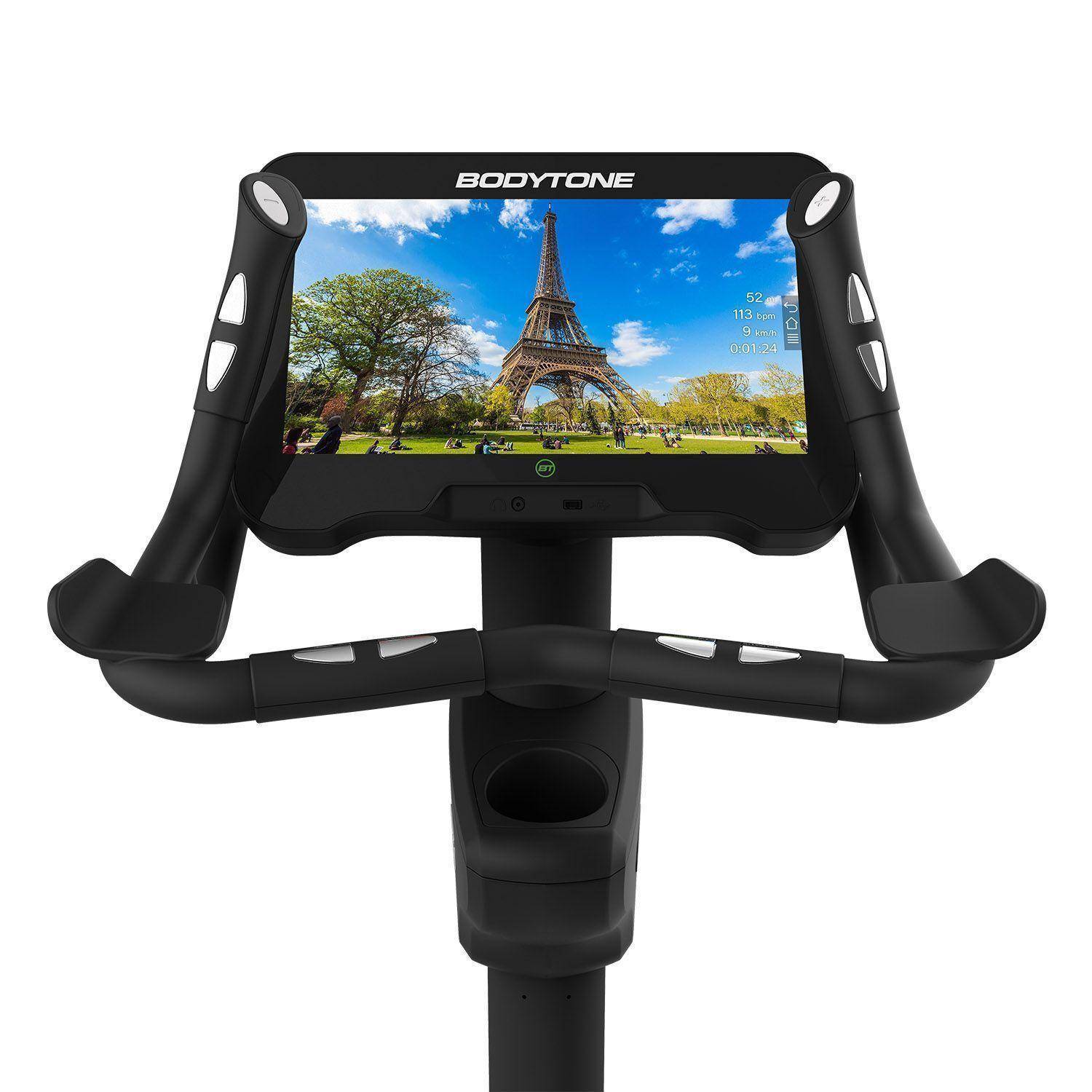
The console should display the working values a supervised session needs: time, distance, speed, cadence, power, estimated energy expenditure and heart rate. Note that energy expenditure figures from any console are an estimate, not a measurement, and should be presented to members as such.
Connectivity is now a specification item rather than a luxury. Bluetooth support lets the machine talk to training applications, to heart-rate belts and, in a growing number of clubs, to the operator’s own member platform. For a rehabilitation setting, the useful question is whether session data can be exported and attached to a patient record; for a hotel, whether a guest can pair their own phone without staff assistance.
Installation and daily handling
Transport wheels and a genuine tilt point matter on any floor that gets cleaned, reconfigured or hired out for classes. Check the machine’s own mass against the floor build-up if it is going above ground level, allow clearance behind a recumbent model for seat travel, and confirm whether the unit is self-powered or needs a socket, because that single detail dictates where it can be placed.
Frequently asked questions
Recumbent or upright for a commercial club?
Most clubs need both. Upright bikes serve general and interval training in a small footprint; recumbent bikes serve older members, rehabilitation and long low-intensity sessions. If you are buying a single machine for a mixed or older population, choose recumbent.
Does flywheel mass really matter?
Yes, for feel and for perceived quality. A heavier flywheel smooths the pedal stroke, particularly at low cadence and high resistance, which is exactly the profile a deconditioned or rehabilitating user works in.
What should a professional bike guarantee cover?
Ask specifically about the frame, the resistance unit and the console, and ask what commercial-use conditions apply. A warranty written for domestic use is void the moment the machine is placed in a club, which is one more reason to check the declared use class before ordering.
How many bikes does a club need?
There is no universal ratio; it depends on membership, peak occupancy and the balance of your cardio zone. Send us your floor plan and your member profile and we will size the zone against them.
Specifying your cardio zone
Light In Fitness supplies professional cardio equipment to clubs, hotels, residences, rehabilitation centres and public facilities. If you tell us who uses the room, how many hours a day it runs and how much space you have, we will come back with a machine mix rather than a catalogue. Request a quote to start from your own numbers.