Pickleball court surfacing: what to choose indoors and outdoors
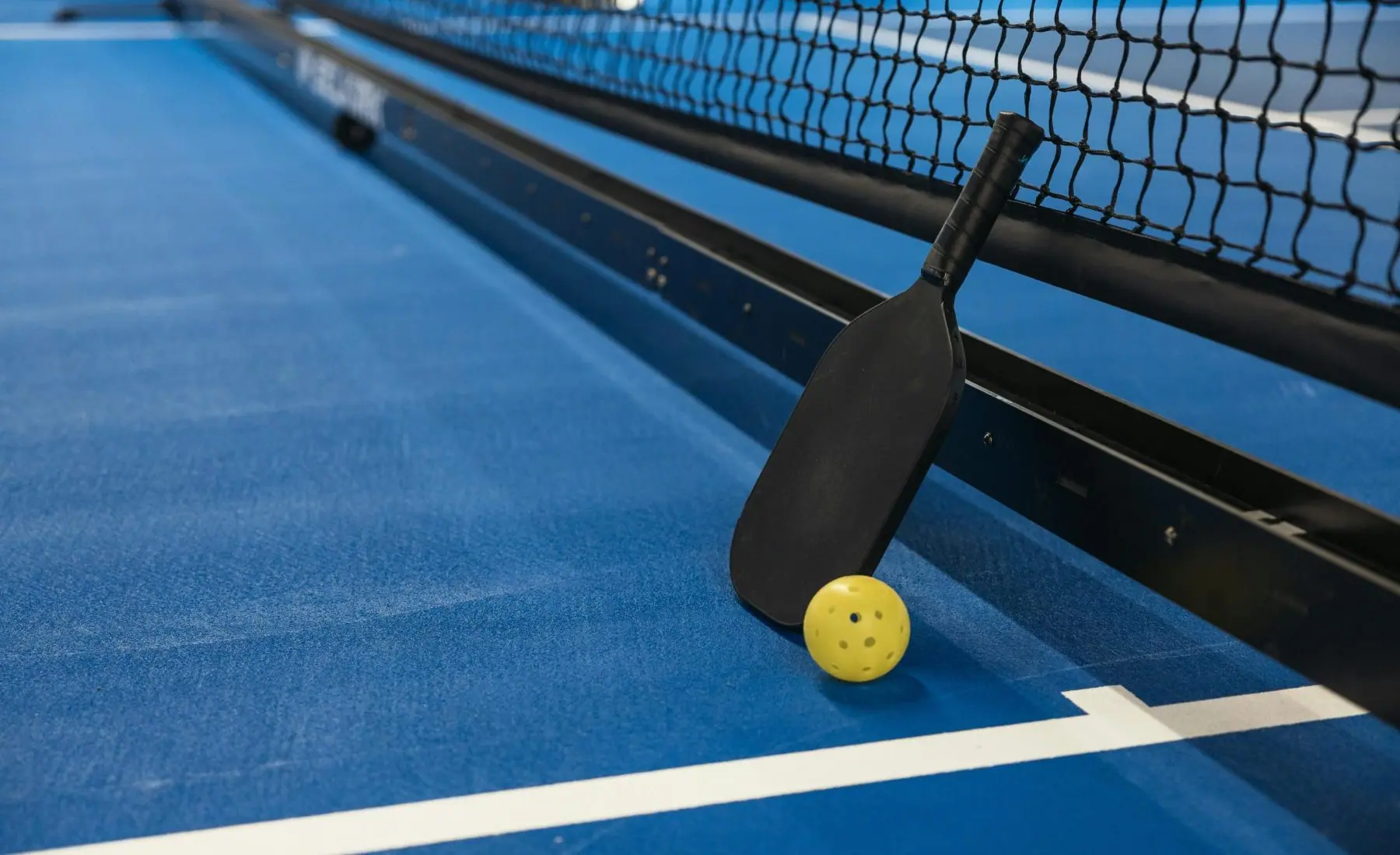
Pickleball is growing faster than the facilities that host it, and most operators discover the surfacing question only after they have committed to the space. The surface decides three things at once: how the ball behaves, how long the court lasts, and how much maintenance you inherit. Getting it right at the design stage costs no more than getting it wrong.
This guide is written for the people who commission courts: clubs, local authorities, campsites and holiday villages, hotels and resorts, schools and universities, and property developers adding an amenity that has to be used rather than admired.
Indoor and outdoor are two different problems
An indoor court is protected from the weather, which opens up surfaces that would not survive outside. Vinyl and cushioned sports floors give comfort, a controlled bounce and good acoustics, and they suit multi-purpose halls where pickleball shares the floor with other sports.
An outdoor court has to handle rain, ultraviolet exposure and temperature swings, all of which attack a surface differently. Outdoors the realistic options are concrete, asphalt and modular polypropylene tiles, chosen for durability and for how little attention they demand once installed.
Do not carry an indoor specification outside. It is the single most common and most expensive mistake in this category.
Court dimensions drive the surfacing area
A standard pickleball court measures 20 feet wide by 44 feet long, and that is the same for singles and doubles. The non-volley zone, universally called the kitchen, extends 7 feet from the net on each side.
Those figures are the playing area, not the paved area. Your surfacing quantity has to include the run-off around the court, and the run-off is what determines whether players can chase a ball safely. Decide the total surfaced footprint before you price anything, because a court laid out to the playing dimensions alone will be unusable at competitive level and unpleasant at every other level.
The options compared
| Surface | Best suited to |
|---|---|
| Concrete and asphalt | Outdoor courts |
| Vinyl and cushioned sports floors | Indoor courts |
| Modular polypropylene tiles | Indoor and outdoor courts |
Each of these changes the playing experience, so evaluate them against your users and your budget rather than against a general ranking. The pickleball court surfacing category groups the solutions we supply for this use.
Concrete and asphalt: the trade-off
Asphalt gives a slightly softer playing surface than concrete, which reduces player fatigue over long sessions. In exchange, it is more prone to cracking over time, particularly where temperature swings are wide.
Concrete is extremely durable and hard-wearing, and it is normally more expensive to install. Both need regular maintenance to prevent cracks from spreading and to keep the surface safe, and both can become slippery when neglected. Neither is a finished playing surface on its own: an acrylic or textured coating is what turns a slab into a court.
Modular polypropylene tiles
Interlocking tiles have become the default answer for a great many pickleball projects, indoor and outdoor alike, and for good reasons.
They install without specialist tooling and without a wet trade on site, which shortens the programme considerably. They are modular, so the court can be sized, extended or relocated without demolishing anything. They are formulated to resist weather and ultraviolet exposure, which is what makes them viable outdoors. Maintenance is straightforward, and an individual damaged tile is replaced rather than the whole surface. They also drain through the joints, which removes the standing water problem that ruins outdoor play after rain.
See the polypropylene interlocking tiles range, and the modular multi-sport courts category when the same footprint has to serve more than one sport.
Building the court: the parts nobody photographs
Most surfacing failures are base failures. Level and compact the sub-base properly, and design the drainage before the surface, not after. Outdoor courts need a fall across the surface so that water leaves rather than pools, and the fall has to be consistent across the whole playing area.
Orientation matters as much as construction. Align the court so that low sun is not in a player’s eyes during your busiest hours, which for most sites means the long axis running roughly north to south. Plan the lighting at the same time if evening play is part of the business case: retrofitting lighting to a finished court is always more expensive than installing the ducts while the ground is open.
For outdoor sites where the court sits within a wider sports area, the outdoor sports flooring and sports court rolls categories cover the surrounding zones.
Line marking and multi-sport use
Mark the lines to the official dimensions, accurately, and decide the colour scheme deliberately. Contrast between the playing surface, the kitchen and the surround is what makes a court readable at speed and photographs well for your marketing.
If the court has to host badminton or other racket sports, decide the line hierarchy before marking anything: too many line sets on one surface make every sport harder to play. With modular tiles you have a cleaner option, because colour changes can define zones without adding another set of painted lines.
How the surface changes the game
Ball bounce follows the surface directly. Concrete and asphalt give a faster, higher bounce that favours an aggressive game. Vinyl and modular tiles give a slightly slower, more controllable bounce that suits placement and strategy, and that is easier on the joints of an older membership.
Neither is objectively better. Match the surface to the people who will actually book the court, and be consistent if you build more than one.
Maintenance over the life of the court
Modular tiles need periodic cleaning and occasional individual tile replacement. Concrete and asphalt need crack monitoring, joint treatment and periodic recoating. Indoor vinyl needs a cleaning regime that does not degrade the surface finish.
Whatever you install, write the maintenance routine into the operating schedule on day one and keep a log. Courts are rarely lost to a single failure; they are lost to two seasons of nobody being responsible for them.
Frequently asked questions
What are the official pickleball court dimensions?
20 feet wide by 44 feet long, for both singles and doubles, with a non-volley zone extending 7 feet from the net on each side. Add run-off around the playing area when calculating the surfaced footprint.
Can we lay tiles directly on grass or soil?
No. Modular tiles need a stable, level, well-drained base such as concrete or asphalt. The tile solves the playing surface and the drainage at the surface, not the ground beneath it.
Can one court host pickleball and other racket sports?
Yes, with careful line planning and a surface that suits both. Decide which sport is primary and mark accordingly, and consider a modular tile surface where colour can define zones without extra painted lines.
Which surface needs the least maintenance?
Modular tiles are generally the lowest-maintenance outdoor option, with drainage through the joints and individual tile replacement. Concrete and asphalt need ongoing crack management and recoating.
How long does a court take to install?
That depends entirely on the base. Where a sound slab already exists, a modular tile court is fast; where the ground has to be excavated, drained and paved, the base works dominate the programme.
Decide the base, then the surface
Indoor or outdoor, base and drainage first, surface second, line marking third. Get that order right and the court will be playable for years with a maintenance routine anyone can follow.
Send us your site, your dimensions and whether the court is indoor or outdoor, and we will propose a surfacing solution and a costed configuration. Request a quote and we will work from your plan.
Réalisations documentées
- Cage street workout ultime, Carcassonne – armée française
- Cage street workout ultime, Tahiti – armée française, Polynésie
- Cage SP Max, centre EPIDE de Combrée – établissement public d’insertion
- Cage SP Max, lycée Saint-Bénigne de Dijon – établissement scolaire
Sources et références
- NF EN 16630 – modules fixes d’entraînement physique de plein air : exigences de sécurité et méthodes d’essai (AFNOR)
- Code du sport, article L322-2 – garanties d’hygiène et de sécurité des établissements d’activités physiques et sportives (Légifrance)