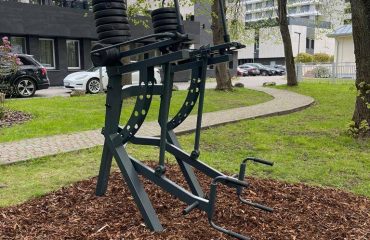
Outdoor Strength Training Structures: A Guide for Site Owners
La musculation en plein air repose sur des agrès au poids du corps et des machines à charge réglable conçues pour rester installées à demeure. Le matériel diffère de celui d'une salle par son traitement anticorrosion, l'absence de réglage complexe et la conformité à la norme EN 16630. Ces installations s'adressent aux collectivités, campings, résidences et entreprises.

Outdoor strength structures put a training facility where people already are: a park, a campsite, a residential courtyard, a company site, a school ground. They run on bodyweight and adjustable load, they need no staff and no opening hours, and they cost nothing to the person using them. For the organisation installing them, the question is not whether outdoor training works but which structures to buy, how to lay them out and what has to be true of the equipment before it goes in the ground.
Why outdoor strength training earns the investment
Physical benefit. Bodyweight work on fixed structures builds pulling, pushing and core strength with no instruction required. Outdoor ground is uneven and the environment varies, so balance and coordination get trained alongside strength in a way a flat gym floor does not deliver.
Mental benefit and adherence. Training in daylight and open air is consistently reported as less of a chore than training indoors, and that shows up as adherence. For a municipality or an employer, adherence is the whole point: equipment that is used three times a week by fifty people returns more than equipment used once a month by two hundred.
Zero barrier to entry. No membership, no fee, no appointment. That reaches exactly the population that never joins a gym: teenagers, shift workers, older residents and people who have been put off by indoor gym culture.
Site value. A structure activates a space. A courtyard or a green area with a calisthenics rig gets used across more hours of the day, which improves both the perceived safety and the perceived value of the site.
The essential structures
Four families of equipment cover the great majority of what an outdoor strength area needs.
Pull-up bars
The foundation of any outdoor strength installation. They work the back, shoulders and arms, they are self-explanatory and they take the heaviest traffic of anything you install. Specify several heights so that the same rig serves a beginner using an assisted or inclined position and an experienced user doing strict pull-ups.
Parallel bars
Dips, support holds and leg raises, loading the triceps and chest. Parallel bars also double as a progression surface for people who cannot yet hang from a bar, which makes them one of the most inclusive elements on a rig.
Dip stations
A dedicated dip station gives a cleaner, more stable position than parallel bars alone and is worth the separate footprint on a site with real traffic. Triceps and chest again, with a shoulder demand that makes correct height selection important.
Outdoor benches
The most underestimated item on the list. A fixed bench supports incline push-ups, step-ups, box squats, core work and stretching, and it gives users somewhere to rest between sets. On a public site it also serves the people who came to sit rather than train, which is part of what makes an installation feel welcoming rather than intimidating.
Beyond these four, adjustable-load outdoor strength machines extend the offer to users who want progressive resistance rather than bodyweight work, and inclusive stations designed for wheelchair users open the installation to residents a standard rig excludes.
What outdoor equipment has to be that indoor equipment does not
This is where specifications go wrong. Outdoor equipment is not indoor equipment moved outside. It differs on three points.
Corrosion protection. Hot-dip galvanising, stainless steel or a comparable treated finish, chosen for the exposure of the site. Coastal and poolside installations need a higher specification than an inland park.
No complex adjustment. There is nobody on site to explain a setting or reset a machine. The equipment has to work correctly for a first-time user with no instruction, which rules out most of what belongs on an indoor gym floor.
Compliance with EN 16630. Permanently installed outdoor fitness equipment for adults falls under EN 16630, which covers structural strength, entrapment, fall protection and the information the operator must display on site. Ask for the declaration of conformity as part of the tender, not after delivery.
If children’s equipment is included anywhere on the site, it is a separate category governed by EN 1176-1 for the equipment and EN 1177 for the impact attenuating surfacing. The two standards families are never interchangeable.
Planning the layout
Group the structures rather than scattering them, so that users can move between elements in a circuit and so that the fall zones can be surfaced as one area rather than several. Keep sightlines open from paths and buildings, because visibility deters vandalism far more effectively than fencing. Allow generous space around pull-up and dip stations, since the movements swing and the queueing space matters at peak times.
Surfacing follows from the equipment. Free-fall height and the fall zone around each element determine what goes underneath, and that is a specification item, not a finishing detail.
Who installs these
Municipalities and parks departments, campsites and holiday villages, residential developments and social housing landlords, employers building an on-site wellbeing offer, schools and sports clubs. The brief differs in each case, but the constraint is always the same: unsupervised public use, outdoors, for years.
Choosing your structures
Our street workout rigs range covers everything from a single pull-up frame to a full calisthenics park, and our outdoor gym equipment adds adjustable-load stations for users who want progressive resistance. For exposed or coastal sites, look at the stainless steel outdoor fitness range.
Send us the site plan, the exposure conditions and who the installation is for, and we will propose a structure mix, a layout and a costed proposal including surfacing. Request a quote to start.