Polypropylene Click Tiles for Outdoor Courts and Surrounds
Le sol clipsable en polypropylène se pose sans colle sur un support plan et draine l'eau par sa structure ajourée. Il convient aux terrains multisports extérieurs, aux terrains de padel et de pickleball. Sa durée de vie dépend de la qualité du polymère et du traitement anti-UV.
Polypropylene click tiles are laid without adhesive on a flat base and drain water through their open structure. They suit outdoor multi-sport courts, padel courts and pickleball courts. Their service life depends on the quality of the polymer and on the UV treatment. Everything else in a specification follows from those three facts, which is why this guide starts with them rather than with the colour chart.
What a polypropylene click tile is
The tile is a modular polypropylene element, moulded with an open grid structure and a lateral clip system that joins it to its neighbours. Assembled, the tiles form a continuous surface that is not bonded to the base and can be lifted, extended or relocated. The grid is what makes the surface drain: water passes through the tile and runs off on the base beneath rather than sitting on the surface, which is why a court fitted with these tiles is playable again within minutes of a shower.
Tiles come in several colours and surface textures, which is used in practice to mark out playing areas, run-off zones and circulation in one operation rather than painting lines onto a slab.
What the format actually gives you
| Property | What it means on site |
|---|---|
| Drainage | Water passes through the open structure; no surface pooling, faster return to play |
| Dry laying | No adhesive, no curing time; tiles can be lifted for access or moved to another site |
| Weather resistance | Designed for permanent outdoor exposure; UV treatment is what protects colour and mechanical properties |
| Wear | Takes heavy foot traffic and resists impact, scratching and staining without deforming |
| Maintenance | Sweeping or a hose; no chemical treatment required |
| Colours and marking | Several colours allow zones and lines to be built into the surface itself |
Where it belongs
Multi-sport, padel and pickleball courts
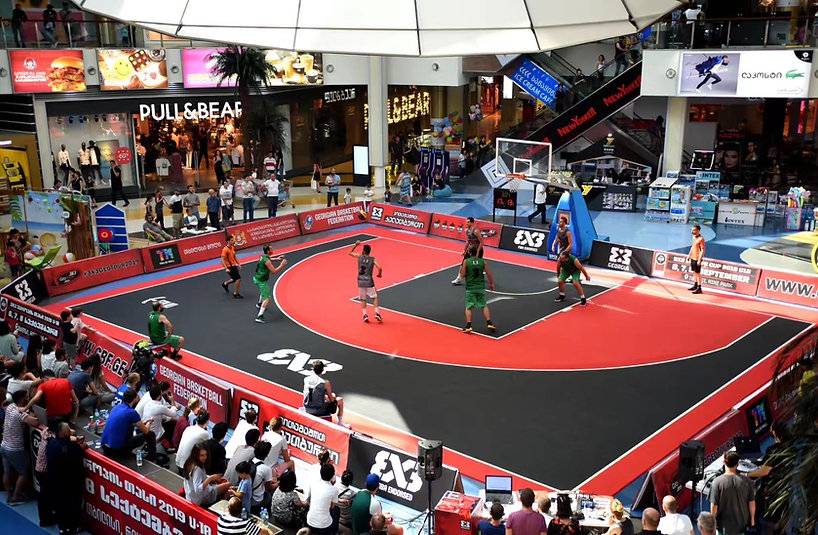
This is the core application. A modular surface gives consistent ball behaviour, drains after rain, and is laid over an existing slab without the closure period a bonded system imposes. Court markings are built from the tiles themselves, which removes repainting from the maintenance budget. The polypropylene interlocking tile range covers the usual court formats, and pickleball court surfacing uses the same principle with its own dimensions and colour scheme.
Pool surrounds and wet areas
Around a pool, the two properties that matter are drainage and grip. The open structure removes standing water and the textured surface limits slipping. The tiles also tolerate pool chemistry, which disqualifies a number of alternative coverings. Pool surfacing in this format is laid the same way, dry, over a flat base.
Terraces, circulation and temporary zones
Because nothing is bonded, the format suits paths, event circulation and areas that have to be dismantled at the end of a season. A tile lifted in October and stored is a tile relaid in April, which is not true of a bonded system.
The one application to be careful with
Polypropylene click tiles are sometimes presented as a safety surface for children’s play areas. They are not. Impact attenuating surfacing under playground equipment is governed by EN 1177, which sets out how a surface is tested and what critical fall height it can be certified for; the equipment itself falls under EN 1176-1. A rigid polypropylene tile is not tested to EN 1177 and provides no certified critical fall height, so it cannot be used under equipment from which a child can fall. It is perfectly usable for circulation around a play area, for a games court next to it or for a hard surface zone, provided the fall zones themselves receive a surfacing certified for the equipment installed.
What decides the service life
Two variables carry most of the outcome: the quality of the polymer and the UV treatment. A tile without effective UV stabilisation loses colour first and mechanical properties afterwards, which is what turns a ten year surface into a three year one. The rest is the base. Polypropylene tiles need a flat, stable and free draining support, and a base that holds water or moves defeats a good tile in a single winter.
Base preparation
- Flatness: check with a straightedge before ordering; the tile follows what is underneath it.
- Stability: concrete, asphalt or a properly compacted base. Soft or uncompacted ground deforms and opens the joints.
- Drainage: the tile drains, but the water then has to go somewhere. A base that traps it moves the problem rather than solving it.
- Falls: a slight gradient on the base is what evacuates run-off from a large court.
Frequently asked questions
How do these tiles compare with natural grass?
They need no watering, no mowing and no seasonal repair, they keep their appearance year round, and they take heavy traffic without wearing into bare patches. Grass remains grass; the tile is a court surface.
Are they slip resistant?
The textured surface provides grip, and the open structure prevents the film of water that causes most slips. That combination is why the format is used around pools.
Are they recyclable?
Polypropylene is a recyclable material and the tiles need no chemical maintenance products. Manufacture and end of life still carry an impact, so specifying from a documented source and arranging recycling at the end of the surface life is part of the decision.
Can they be used indoors?
They can, in some situations, but the format is designed for outdoor use and an indoor project usually has better options. It is worth checking the intended use before specifying them inside.
How long do they last?
Service life depends on the polymer, the UV treatment, the intensity of use and the base. Manufacturers state their own guarantee periods, and those figures rather than a general estimate are what should be compared between products.
How are they cleaned?
Sweeping or a hose removes dirt and debris, with a mild cleaner for stubborn marks. Regular cleaning is what keeps the drainage grid open, which is the part that matters.
Specifying a surface
The tile is only half the specification; the base, the falls and the intended sport decide the rest. Send the dimensions of the area, the state of the existing base and the use planned for it, and a surface can be specified and costed against them: request a quote.
Réalisations documentées
- Cage street workout ultime, Carcassonne – armée française
- Cage street workout ultime, Tahiti – armée française, Polynésie
- Cage SP Max, centre EPIDE de Combrée – établissement public d’insertion
- Cage SP Max, lycée Saint-Bénigne de Dijon – établissement scolaire
Sources et références
- Décret n° 96-1136 du 18 décembre 1996 – prescriptions de sécurité relatives aux aires collectives de jeux (Légifrance)
- NF EN 1176-1 – Équipements et sols d’aires de jeux, partie 1 : exigences de sécurité et méthodes d’essai générales (AFNOR)
- NF EN 1177 – revêtements de surface amortissants : détermination de la hauteur de chute critique (AFNOR)
- NF EN 16630 – modules fixes d’entraînement physique de plein air : exigences de sécurité et méthodes d’essai (AFNOR)