Outdoor Fitness Areas: How to Design and Equip One
An outdoor fitness area is one of the few installations that improves a site for almost everyone who uses it. It costs nothing to enter, it is open whenever daylight allows, and it turns an underused patch of ground into something people gather around. For a municipality, a campsite, a holiday village, a housing association or a corporate campus, that combination is unusual – most facilities serve one audience, this one serves several at once.
This guide covers what an outdoor fitness area delivers, how it builds use over time, how to site and equip one properly, and what it takes to keep it in service.
The health and wellbeing case
Training outdoors carries a set of benefits that indoor training does not. Exposure to fresh air and daylight during exercise is widely associated with better wellbeing, and users consistently report lower stress after outdoor sessions than after equivalent indoor ones. Regular outdoor physical activity is also linked to better sleep quality, which is the benefit users mention most often once an installation has been in place for a season.
There is an energy argument as well. People come away from an outdoor session reporting more vitality than after an indoor one, which is part of why outdoor areas hold their users through the year rather than being abandoned after the first month.
None of this replaces an indoor facility. What it does is reach the population an indoor facility never reaches: people who will not buy a membership, will not enter a gym, but will use equipment they walk past every day.
Community use is the real return
The strongest argument for an outdoor fitness area is not individual health – it is what happens around it. An open, visible training space becomes a meeting point. Users exchange advice, watch each other, and pull in people who arrived to sit on a bench and ended up on a machine.
That matters for the operator because it is self-reinforcing. An empty installation stays empty; a used one attracts more use. Siting the area where it will be seen, rather than tucked out of sight, is therefore the single highest-leverage decision in the whole project.
It also matters for the funding case. An outdoor fitness area that becomes a genuine community space is far easier to justify to a council, a board or a residents association than one that reads as gym equipment placed outdoors.
Designing an effective outdoor fitness area
Choose the location first. The site needs to be visible enough to attract use, but not so exposed to through traffic that users feel on display. Proximity to an existing path, a play area or a sports pitch usually works well, because it puts the equipment where people already are.
Then select the equipment. This is where projects most often go wrong. Equipment that looks impressive but trains nothing gets used once. What holds users is a mix that covers pushing, pulling, lower body and cardio, at a range of difficulty that lets a beginner and a regular use the same area. Choosing professional outdoor equipment rather than decorative fixtures is what determines whether the area is still busy in year three.
Plan for the sun. Shaded zones are not a luxury on an outdoor installation. A few well-placed trees, an existing tree line or a pergola makes the area usable in summer, which is exactly when it should be at its busiest. Without shade, use collapses through the middle of the day for four months of the year.
Keep the planting. Greenery around the area does real work: it softens the installation visually, it makes the space pleasant to spend time in, and it is a large part of why users prefer it to an indoor room. An outdoor fitness area laid out as a bare rectangle of surfacing rarely becomes the community space it was meant to be.
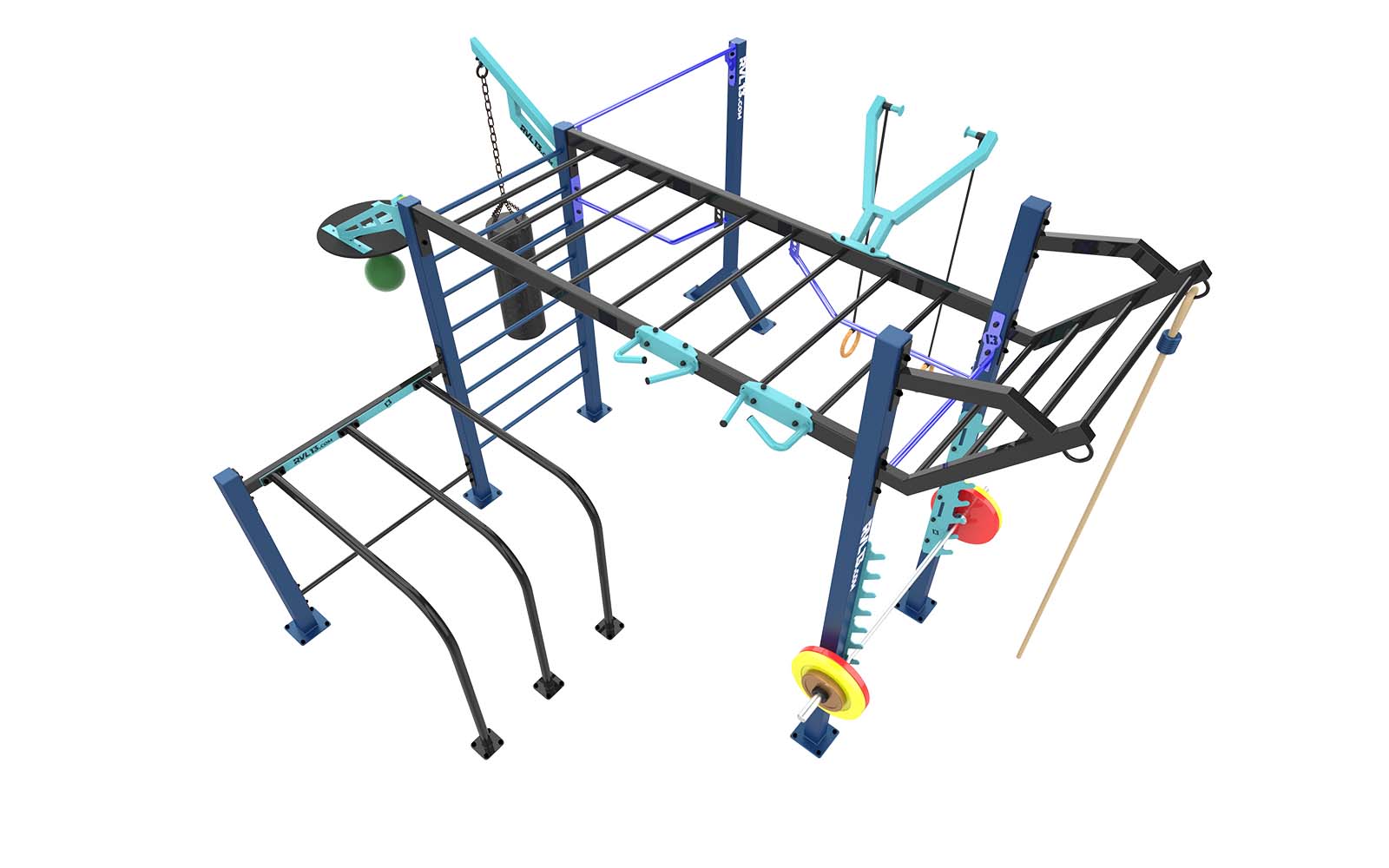
Our outdoor gym equipment range covers the individual stations. Where the brief is a larger destination installation, outdoor parkour and crossfit parks and Uruk street workout parks combine several disciplines in one structure.
Where these installations work
Public parks are the most visible application. A fitness area alongside a running route turns an incidental jog into a full session, and it puts strength equipment in front of a population that would never buy access to it.
Campsites and holiday villages are the second. Guests expect an activity offer, and an outdoor fitness area serves adults during exactly the hours when the rest of the site is aimed at children.
Residential developments and corporate campuses are the third and the fastest growing. In both cases the installation is a shared amenity: no queueing for equipment, no journey to reach it, and no ongoing membership to administer. For a residential operator it is one of the few amenities that adds value without adding staff.
Maintenance and cleaning
Keeping an outdoor fitness area in service is straightforward, but it has to be scheduled rather than improvised.
Set a regular inspection and maintenance interval from the outset – monthly, every two months, or according to observed use – and hold to it. The point is to catch wear, corrosion and loosened fixings before they become a safety issue rather than after.
Cleaning is simpler. Contact surfaces are what matter: handles, grips and seats. A damp cloth handles most of it, using products that are not aggressive towards the equipment finish. Where an installation is heavily used, cleaning contact points more often than the maintenance interval is worth doing.
Recording each inspection is what makes the whole thing defensible if a question is ever raised, and it takes minutes.
Frequently asked questions
How much space does an outdoor fitness area need?
It depends entirely on the number of stations and the safety clearances each one requires around it. A compact multi-station installation fits into a small corner of a park; a full street workout structure needs considerably more. Send us the available area and we will tell you what fits.
What surfacing is required underneath?
Surfacing is determined by the equipment, the fall heights involved and the intended users, so it is specified together with the structure rather than chosen separately. It is not an afterthought and it should not be priced as one.
Can one area serve both adults and children?
They are different installations with different requirements, and they should not be mixed on the same structure. What works is placing an adult fitness area adjacent to a children’s play area, so families use both at the same time while each remains appropriate for its users.
How long does an installation take?
That depends on the structure, the groundworks and the surfacing, and it is scoped project by project. Tell us the site and we will give you a realistic schedule with the quotation.
Planning your installation
An outdoor fitness area is a straightforward project when the sequence is right: choose the location for visibility, select equipment that trains the whole body, plan shade and planting, and set a maintenance schedule before the first user arrives.
Send us the available surface, the audience you are serving and any constraints on the site, and we will come back with a layout and a costed proposal. Request a quote and our team will work through it with you.
Réalisations documentées
- Cage street workout ultime, Carcassonne – armée française
- Cage street workout ultime, Tahiti – armée française, Polynésie
- Cage SP Max, centre EPIDE de Combrée – établissement public d’insertion
- Cage SP Max, lycée Saint-Bénigne de Dijon – établissement scolaire
Sources et références
- NF EN 16630 – modules fixes d’entraînement physique de plein air : exigences de sécurité et méthodes d’essai (AFNOR)
- Code du sport, article L322-2 – garanties d’hygiène et de sécurité des établissements d’activités physiques et sportives (Légifrance)
À lire aussi sur le même thème
- Décryptage Biomécanique : L’Impact de l’Espacement des Pieds sur la Performance du Squat
- Equipping a Strength Room for Clubs, Councils and Schools
- Comment Aménager un espace de loisirs pour adolescents : Guide complet pour créer une aire de jeux et de sport
- Dépassez le Surentraînement : Stratégies Efficaces pour une Meilleure Récupération Musculaire