Outdoor Fitness Trail Equipment: Specifying to EN 16630
Un parcours santé associe agrès fixes et signalétique le long d'un itinéraire, pour une pratique libre et non encadrée. Les équipements relèvent de la norme EN 16630 et se posent sur un sol de réception adapté. Light In Fitness fabrique et installe ces agrès pour communes, campings, hôtels et entreprises.
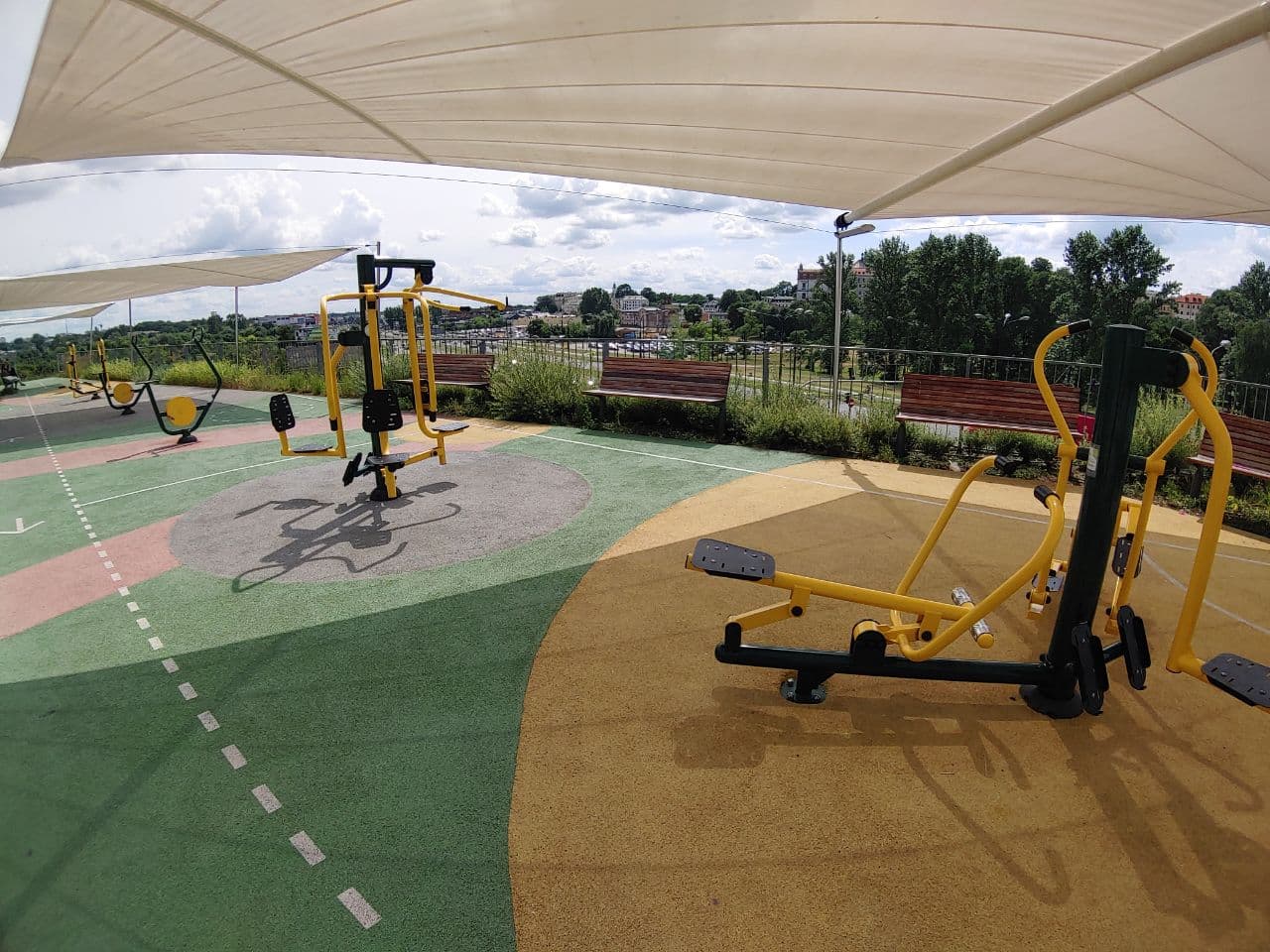
An outdoor fitness trail combines fixed exercise stations with signage along a route, for free and unsupervised use. It is one of the most cost-effective ways for a municipality, a campsite, a hotel or an employer to add a genuine sports facility to an existing green space: no membership, no staffing, no opening hours. The equipment falls under EN 16630 and must be installed on a suitable receiving surface.
What an outdoor fitness trail actually is
It is not a gym transplanted outdoors. A trail is a sequence of stations distributed along a walking or running route, each one designed for a single clear movement that an untrained user can perform correctly without instruction, from a sign alone. That constraint shapes every specification decision that follows.
Typical stations include pull-up and dip bars, abdominal benches, step and balance modules, upper-body cycling and rotation wheels, and seated press or pull stations. See the full outdoor fitness trail range and the individual fitness trail stations.
The standard: EN 16630
EN 16630 is the European standard for permanently installed outdoor fitness equipment for adults. It covers structural strength, entrapment and impact hazards, access, and the information that must be provided at each station. Any equipment intended for public, unsupervised adult use outdoors has to be designed, manufactured and installed to it – including the receiving surface beneath and around the station.
EN 16630 is not the standard for children’s playground equipment; that is a separate framework and the two must not be mixed on the same installation. If your project includes a children’s area, it is specified separately.
Choosing the stations
| Setting | Priority stations | Why |
|---|---|---|
| Municipal park | Mixed cardio, upper body and balance | Widest possible age range, unsupervised |
| Campsite or holiday village | Simple, visually obvious stations | First-time users, short stays, no induction |
| Hotel grounds | Compact multi-station units | Limited footprint, guest expectation of a fitness offer |
| Business park | Full-body circuit near the building | Short lunchtime sessions |
| Senior or rehabilitation setting | Low-impact, seated and accessible stations | Mobility range, safe entry and exit |
For installations that must serve users with reduced mobility, specify from the accessible and rehabilitation outdoor equipment range rather than adapting standard stations.
Materials and durability
Outdoor equipment is exposed continuously to weather, temperature swings, UV and, in coastal or urban settings, to corrosion and vandalism. The material choice drives the whole lifetime cost:
- Galvanised and powder-coated steel – the standard specification for most public installations; robust and repairable.
- Stainless steel – the choice for coastal or high-exposure sites, where corrosion resistance justifies the higher initial cost.
- Wood – visually appropriate in parks and natural settings, with a maintenance regime to plan for from the start.
Whatever the material, moving parts, bearings and fixings determine how the installation looks in year five. Ask for the maintenance schedule before ordering, not after.
Surfacing, layout and signage
- Receiving surface – each station needs an appropriate surface within its use zone. This is part of the specification, not an afterthought.
- Spacing – stations are distributed along the route so that users are not queueing at one point, with the required clearance around each unit.
- Signage – the instruction panel at each station is what makes unsupervised use safe and correct. It is a compliance item, not a decoration.
FAQ
How many stations does a trail need?
It depends on the route length and the expected number of simultaneous users rather than on a fixed number. A short circuit of well-chosen stations is used far more than a long trail of near-identical ones.
Can a fitness trail be installed on grass?
Only where the ground conditions and the receiving surface requirements for the specific stations allow it. This is determined station by station during the design, based on the equipment selected.
What does maintenance involve?
Routine visual inspection, periodic operational checks of moving parts and fixings, and an annual main inspection. The schedule depends on the equipment, the material and the level of use, and should be supplied with the installation.
Can adult and children’s equipment share the same area?
They can be adjacent but they are specified, certified and surfaced separately. Adult outdoor fitness equipment under EN 16630 is not interchangeable with children’s playground equipment.
Get your trail specified
Light In Fitness has designed and installed outdoor fitness equipment for municipalities, campsites, hotels and businesses since 2013. Send us the site plan, the intended user profile and your budget, and we will come back with a station-by-station proposal including surfacing and signage. Request a quote.