Outdoor Fitness and Street Workout: Building an Area That Lasts, Stays Safe and Pays Off
Un espace d'outdoor fitness durable repose sur quatre décisions : le matériau des structures, le sol de réception, l'implantation et le plan de maintenance. Les projets qui échouent négligent généralement le sol et la maintenance, deux postes invisibles au moment de l'achat. La conformité à la norme EN 16630 encadre l'ensemble.

On paper an outdoor fitness area looks straightforward: a few bars, a surface, done. In practice it is a project that has to reconcile real usage, safety, weather resistance, maintenance and, almost always, a tight budget. The areas that are still busy and intact after five years got four decisions right at the start. The ones that became expensive street furniture got them wrong.
This guide is written for the people who commission these spaces: municipalities, campsites, holiday parks, housing associations, schools, clubs, employers and hotels.
Outdoor fitness or street workout: what is the actual difference?
The two get used interchangeably, and they are not the same intention.
Outdoor fitness
- Aimed at the general public: conditioning, cardio, mobility
- Mixed users: beginners, older adults, trained athletes, workplace groups
- Stations tend to be more guided and more versatile
Street workout
- Bodyweight-oriented: pull-ups, dips, bar work, progressions
- More technical use, and a more self-selecting audience
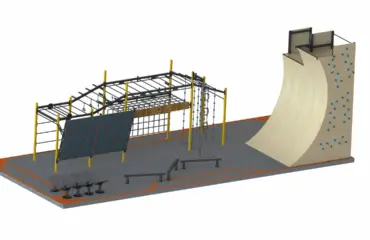
- Modular rigs: bars at several heights, ladders, add-on modules
The projects that perform best usually combine the two: a street workout rig for the technical users, and an accessible fitness zone that everybody else will actually use. An area that serves only one of the two audiences is half empty for most of the week.
The five pillars of an outdoor area that lasts
1. Get the level of use right
A campsite area, a freely accessible municipal area and a company site with a few dozen employees are three different specifications, even when they look similar in a brochure. Before selecting any equipment, be clear about who uses it, at what age and skill level and how often; how many people will be on it at the same time; and what type of practice you are actually programming for, whether that is strength, cardio or a circuit.
2. Lay it out intelligently
Layout is where most of the success is decided, and it costs nothing to get right at the design stage. Plan for clear circulation, distinct zones for pulling, core, cardio and mobility, proper safety clearance around each module, and comfort factors like shade, orientation and access. An area that reads clearly gets used; a vague one becomes scenery.
3. Specify materials made for outdoors
Outdoors means water, UV, temperature cycling and, in publicly accessible locations, vandalism. That points to galvanised steel or stainless steel structures, appropriate coatings and finishes, and fixings chosen for the environment rather than for the price list. Stainless steel is the answer in coastal and pool-adjacent sites, where galvanised steel has a harder life.
4. Treat safety and the surface as one decision
The surface is not a finishing detail. It governs grip, comfort, impact management, cleanliness and how long the whole installation lasts.
This is also where the standards live. Permanently installed outdoor fitness equipment for adults falls under EN 16630, which covers the equipment, the free space around it and the safety of the installation. If any part of the area is a children’s play facility, that is a different framework: the equipment is covered by EN 1176-1 and the impact-attenuating surfacing beneath it by EN 1177. Do not carry a specification from one to the other, and never apply EN 16630 to children’s play equipment.
5. Make maintenance realistic
The best equipment on a public site is the equipment that can be checked easily, needs no exotic tooling and stays stable over time. Write the inspection routine into the project before you buy, and confirm how spare parts are ordered and how long they take. A maintenance plan that only exists in theory is the reason an area is fenced off in year three.
What to install: a base that works
The following is a sound starting point for most projects, adapted afterwards to the site and the audience.
| Zone | Core equipment | Serves |
|---|---|---|
| Street workout | Pull-up bars at several heights, parallel bars for dips and L-sits, horizontal ladder or monkey bars, progression modules from beginner to advanced | Bodyweight training, technical users, teenagers and young adults |
| Outdoor fitness | Bench and core station, step or box for controlled step-ups and jumps, cardio and circuit stations, a mobility and warm-up area | General public, older adults, workplace groups, beginners |
| Accessibility | Stations usable from a wheelchair, level approach, clear transfer space | Inclusive public provision |
The more legible the circuit, the more it gets used. Signage that shows what each station is for, and a sensible order to move through them, does more for attendance than an extra module.
Budget and phasing
The budget is driven mainly by three things: the number of stations, the surfacing and the level of finish. The professional approach is to define a solid minimum viable installation and then extend it in phases, rather than spreading a fixed budget so thin that nothing is properly specified. Keep the surface and the safety clearances in phase one; those are the elements that are painful and expensive to retrofit.
To price a project quickly, we need the surface area, the location, the intended use and audience, and a target budget.
Frequently asked questions
Should we mix outdoor fitness and street workout in one project?
In most cases yes. It widens the audience across beginners, trained users, older adults and workplace groups, which is what makes the area busy rather than photogenic. The key is a legible layout with clearly separated zones.
What is the minimum surface area for a coherent project?
There is no single right figure, because it depends on the audience and the expected flow. What matters is a legible layout with dedicated zones and correct safety clearances around each module. Give us your actual available area and we will propose a layout that fits it.
Is a surfacing layer compulsory?
Not always, but it is usually recommended and it becomes essential depending on use and fall heights. Where impact attenuation is required, the surfacing is a safety component and must be specified against the actual fall height, not chosen for appearance.
Which standard applies to outdoor fitness equipment?
Permanently installed outdoor fitness equipment for adults is covered by EN 16630. Children’s play equipment is covered by EN 1176-1 with its surfacing under EN 1177. Beyond the product standards, planning permissions and accessibility requirements are set nationally and locally, so check them with the relevant authority for your site.
Stainless steel or galvanised steel?
Both are used in professional outdoor ranges. Galvanised and coated steel is the workhorse for most inland sites. Stainless steel is worth the premium in coastal, saline or pool-adjacent environments, and wherever maintenance access is difficult.
How do we avoid a good-looking area that nobody uses?
Three levers decide it: a legible circuit with clear zones, a level of use correctly matched to the audience, and maintenance that is genuinely simple. Getting those right at the layout stage costs nothing and is almost impossible to fix afterwards.
Can the project be made to measure?
Yes. Layout, dimensions, modules, options and finishes can all be adapted to the site, and a configurator approach lets a rig be built up from the modules that match your audience rather than from a fixed catalogue set.
Planning your outdoor area
Start from the audience and the site, then choose the hardware. Our street workout rigs cover the bodyweight side, from compact cages to complete parks, while the outdoor gym equipment range covers the accessible general-public stations. Whatever goes on top, specify the outdoor sports flooring at the same time rather than afterwards.
Send us the surface area, the location, the intended audience and your target budget, and we will come back with a layout, an equipment selection and a costed proposal. Request a quote.
Réalisations documentées
- Cage street workout ultime, Carcassonne – armée française
- Cage street workout ultime, Tahiti – armée française, Polynésie
- Cage SP Max, centre EPIDE de Combrée – établissement public d’insertion
- Cage SP Max, lycée Saint-Bénigne de Dijon – établissement scolaire
Sources et références
- NF EN 16630 – modules fixes d’entraînement physique de plein air : exigences de sécurité et méthodes d’essai (AFNOR)
- Code du sport, article L322-2 – garanties d’hygiène et de sécurité des établissements d’activités physiques et sportives (Légifrance)
- Décret n° 96-1136 du 18 décembre 1996 – prescriptions de sécurité relatives aux aires collectives de jeux (Légifrance)
- NF EN 1176-1 – Équipements et sols d’aires de jeux, partie 1 : exigences de sécurité et méthodes d’essai générales (AFNOR)