One-Stop Equipment Sourcing for Sports Sites
One-stop equipment sourcing means running your entire sports fit-out through a single expert partner: selection, range consistency, quotation, logistics and after-sales. For a club, a hotel, a corporate site, a public authority or an outdoor project, the aim is not to buy from fewer suppliers for its own sake. It is to end up with a space that is profitable, durable and coherent, delivered on the date you promised your users. This guide explains what the method covers, why professionals gain from it, and how a project runs from first brief to opening.
What one-stop equipment sourcing actually means
Working one-stop means one expert contact handling all, or most, of your equipment project:
- selecting equipment that matches the real use: intensive club traffic, hotel, corporate room, public-access facility
- keeping the ranges consistent in design, compatibility and user comfort
- optimising the total budget, not just the unit price
- centralising logistics, so fewer split deliveries and fewer surprises
- simplifying after-sales through a single point of entry
The difference from ordinary purchasing is that the specification is built by zone rather than as a shopping list, and that one party remains accountable for how the zones work together.
Why professional buyers gain from it
| Gain | What it changes on the project |
|---|---|
| Time | Multi-supplier sourcing multiplies conversations, lead times, stock-outs and incompatibilities. A well-run one-stop project keeps a single trajectory: budget, schedule, priorities. |
| Total budget control | Return on investment is decided by durability, maintenance, hidden costs (returns, mistakes, delays) and the coherence of the layout, which is what revenue per square metre really depends on. |
| A premium, consistent space | A coherent space sells better: the user experience is easier to read and more comfortable. This matters most when you combine cardio, strength, functional training, flooring and outdoor in one site. |
| Simpler after-sales | One point of entry for maintenance, spare parts, warranties and follow-up, instead of four suppliers pointing at each other. |
What can be sourced in one place
Cardio for clubs, hotels and corporate sites
A coherent cardio park: treadmills, bikes, cross trainers, rowers, climbers. The selection question is not which machine is best but which mix matches your attendance pattern and opening hours. Start from the cardio equipment range.
Strength: guided stations, free weights, complete zones
Guided machines for unsupervised use and beginners, free weights for experienced users, and the racks, benches and storage that hold the zone together. The complete strength training machines range covers both approaches.
Cross-training rigs and cages
Rigs and cages are structural: fixing method, ceiling height, anchoring and fall zones are project questions, not catalogue questions, and they should be settled before the order.
Outdoor and street workout
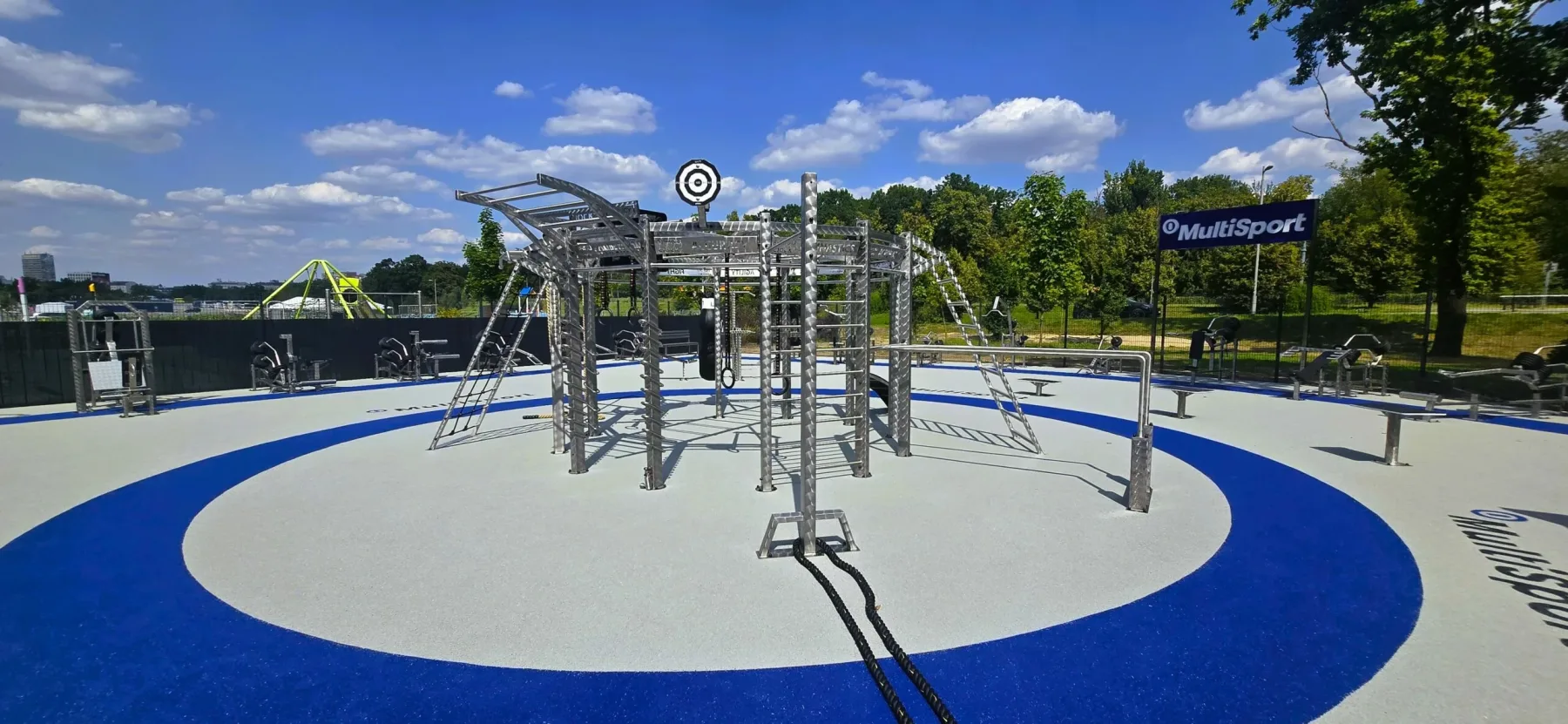
Outdoor structures extend the offer beyond the building and reach users who never buy a membership. Permanently installed outdoor fitness equipment for adults falls under EN 16630; where a children play area is part of the same scheme, EN 1176-1 applies to the equipment and EN 1177 to the impact-attenuating surfacing.
Sports flooring, the detail that prevents the biggest regrets
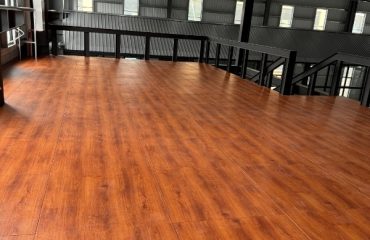
The floor governs safety, noise and vibration, protection of the building and the service life of the equipment itself. Specify it zone by zone, because free weights, cardio, combat sports and functional training do not need the same thickness or density. Where the room is a public-access building subject to national fire regulations, ask for the reaction-to-fire class in writing and reproduce it exactly in the tender, smoke index included, for example Dfl-s1. Start from the rubber gym flooring tiles range and refine per zone.
The project method, from brief to delivery
Step 1: fast framing
Use, floor area, budget, deadline. The most profitable way to think is by zone: cardio, strength, functional and cross-training, circulation, flooring, outdoor. That is what prevents scattered purchases and produces a layout you can actually operate.
Step 2: coherent selection, not a product list
Match the intensity level to the site, since a club, a hotel and a corporate room have very different traffic. Build in safety from the start: fixings, fall zones, floor choice. And optimise the ratio of investment to use, station by station.
Step 3: simplified logistics
Centralising limits split deliveries, incompatibilities and the opening delays they cause. Access for delivery, door widths and floor loading belong in this step, not in the last week.
Step 4: after-sales and follow-up
One point of entry for questions, maintenance and spare parts, with the availability period agreed before the order rather than discovered later.
Professional checklist before you buy
- Which users? Beginners, experienced members, a mix, coached groups, public access.
- Which intensity? Attendance, turnover per station, opening hours.
- Which constraints? Floor, acoustics, delivery access, public-access building rules.
- Which zoning? Cardio, strength, functional, circulation, outdoor.
- Which floor per zone? Free weights, cardio, combat sports and functional training each need a different specification.
- Which business objective? Premium positioning, revenue per square metre, member retention.
Frequently asked questions
Does one-stop sourcing suit a small project?
Yes. On a small floor, the consistency of the equipment and the flooring is often what separates a room that works from one that wears out badly.
Is centralising necessarily more expensive?
Not necessarily. Total cost is driven largely by hidden costs: mistakes, returns, delays, after-sales and logistics. Centralising usually removes those losses.
Which purchases should never be neglected?
The floor, for safety, noise and building protection; the coherence of the zones; and the circulation logic that governs how people move through the space.
Can one project cover indoor and outdoor?
Yes. Cardio, strength and cross-training indoors together with street workout rigs outdoors, handled as a single project with one schedule.
How do I get a fast, coherent recommendation?
Send the floor area, the intended zones, the budget and the target opening date. That is enough to return a zoning proposal and a costed selection.
Getting a one-stop proposal
One-stop sourcing is a method, not a discount: zone the space, select consistently, centralise the logistics and keep one point of contact for the years that follow. Send us your floor area, zones, budget and deadline and we will return a zoning plan with a coherent selection and options by budget level: request a quote.
Réalisations documentées
- Cage street workout ultime, Carcassonne – armée française
- Cage street workout ultime, Tahiti – armée française, Polynésie
- Cage SP Max, centre EPIDE de Combrée – établissement public d’insertion
- Cage SP Max, lycée Saint-Bénigne de Dijon – établissement scolaire