Equipping a hotel wellness area: sauna, steam room, spa and pool specification
A hotel wellness area is built from five modules, sauna, steam room, spa, pool and aquatic activities, and two technical decisions decide whether it survives: waterproofing and ventilation. Two more decide whether it is profitable to run: water treatment with its sanitary record keeping, and energy consumption, which is the largest operating cost of any wellness area. This is the brief we work through with hotel operators before a single item of equipment is selected.
What wellness actually delivers for a hotel
Four effects, of varying intensity depending on positioning and location. It supports the average room rate, in the same way as any other service facility. It lifts weekend occupancy, and the effect is clearest on the leisure segment out of season. It can generate direct revenue through private sessions, treatments and add on services, provided it is organised to do so. And it moves online reviews, in both directions: a clean, working relaxation area is a recurring reason for a positive comment, while a spa switched off for repairs produces exactly the opposite.
One clarification worth making early. Wellness facilities are not what promotes a hotel from one star category to the next. National classification schemes across Europe work on points based criteria grids in which sauna, steam room and fitness facilities are optional items: they earn points, they are not mandatory. A four star hotel can be classified without any wellness area at all. The argument for building one is commercial and competitive, not regulatory, which on a local market is usually more than enough.
The five modules
Sauna
The most universal module and the simplest technically. A traditional sauna runs at 80 to 90 degrees Celsius at low humidity, with a stove holding heated stones. An infrared cabin works at 45 to 60 degrees by radiation and is better tolerated by guests who dislike dry heat.
| Capacity | Floor area |
|---|---|
| 2 to 3 people | 4 to 6 m2 |
| 4 to 6 people | 8 to 12 m2 |
| 8 to 12 people | 15 to 20 m2 |
Stove power is sized on volume, around 1 kW per cubic metre, adjusted for insulation and glazed surfaces. The choices that matter are the timber, abachi, cedar or thermally treated wood, the quality of the insulation, bench ergonomics, and programmable controls so the cabin is not heated all day for three uses.
Steam room
A steam room runs at 40 to 50 degrees in a saturated atmosphere. The experience is gentler than a sauna and often better received by guests who cannot tolerate dry heat. Technically it is the least forgiving module in the building. It needs absolute waterproofing of the enclosure, a steam generator sized on volume, a heated stone bench, fully sealed lighting, a floor drain for condensate, and controlled ventilation able to change the air without destroying the atmosphere. A poorly sealed steam room damages the structure around it.
Spa and cold immersion
The most requested module by hotel guests: a heated bath at 36 to 38 degrees with hydromassage jets and mood lighting. Two formats in practice. A built in spa is integrated into the building for a premium finish. A rigid self supporting spa sits on a slab with services connected, is far quicker to install and can be removed. Filtration, water treatment, an insulating cover, which halves the cost of holding temperature, and technical access for maintenance are the operating essentials. A hotel spa is designed with its plant room, not after it. Recovery focused properties increasingly pair the hot module with a cold plunge bath, which needs the same water treatment discipline.
Pool
The most structuring module economically, both to build and to run. Three families, three uses. A masonry pool in concrete with tiling or a liner has a very long life and full architectural integration, but means heavy works and a long programme; this is the indoor hotel pool solution. A one piece shell pool installs quickly after excavation and is a good compromise between longevity and lead time, mainly outdoors. An above ground pool assembles without major excavation and can be dismantled, which makes it the right answer for holiday parks, campsites and seasonal projects, and not a substitute for an indoor hotel pool. Around the pool, plan for a barefoot rated non slip deck surface, secure access, a shower and a plant room sized for filtration, heating and treatment.
Aquatic activities
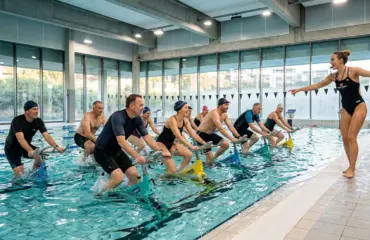
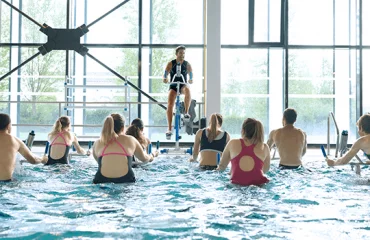
The cheapest module and the highest return in hotels, because it activates a pool that already exists without any building work. Professional aquabikes in marine grade stainless steel, aqua fitness equipment and class accessories turn a passive basin into a programmed activity. One caution: anything destined for immersion or a humid atmosphere needs an appropriate ingress protection rating, and marine grade stainless steel rather than painted steel. Chlorinated water is a far more aggressive environment than a gym floor.
Configuration by hotel category
| Category | Modules | Dedicated area |
|---|---|---|
| Three star | Sauna or steam room, possibly a spa | 25 to 50 m2 |
| Four star | Sauna and steam room, spa, pool depending on the building | 60 to 120 m2 |
| Four star superior, resort | Full circuit, pool, relaxation and treatment area | 150 to 300 m2 |
| Five star and palace | Thermal circuit, indoor and outdoor pools, treatment area, premium fitness | 400 m2 and above |
The technical constraints specific to wellness
Waterproofing and humidity
A saturated atmosphere attacks everything around it. Three non negotiable requirements: sealed walls and floors, extract ventilation sized on volume and usage, and surrounding equipment with an ingress protection rating matched to its position, whether that is splashing, direct exposure or immersion. This is the item where an initial saving is repaid within a few years in degraded timber, failed joints and damaged structure.
Slip resistance: use the right classification
A frequent and expensive specification error. The R9 to R13 classes describe slip resistance when walking in footwear, tested to the shod ramp method, and apply to plant rooms, kitchens and circulation. In wet areas walked barefoot, pool surrounds, showers, steam rooms and the area around a spa, the barefoot classification in classes A, B and C applies. Specifying R11 on a pool deck does not answer the actual risk. The two systems are complementary, not interchangeable.
Water hygiene and traceability
Pools and spas open to the public fall under public bathing water regulations in every European jurisdiction: treatment and water quality standards, operator self monitoring, laboratory analysis at the frequency the regulator sets, inspection by the competent health authority, and a sanitary register kept up to date and available. Add daily disinfection of contact surfaces and displayed user instructions. This is the point on which a facility gets closed mid season, and the traceability counts as much as the treatment itself.
Energy
Energy is the first operating cost of a wellness area, well ahead of maintenance. Orders of magnitude per year: a few thousand kilowatt hours for a spa held at temperature, a similar figure for a sauna in daily use, and a substantially higher figure for a heated indoor pool. The effective levers are known and pay back quickly: an insulating cover, a heat pump, heat recovery on extracted air, and above all time scheduling. A spa held at temperature twenty four hours a day for three uses a week is the most common waste in the sector.
Frequently asked questions
Sauna or steam room, if we can only install one?
The sauna, in most cases. It is simpler technically, far less demanding on waterproofing and lighter on maintenance, which matters in a property without dedicated technical staff. The steam room offers a gentler experience and is often better received, but it tolerates no approximation on sealing and ventilation. From four star superior upwards, both usually coexist.
Can wellness be added to an existing hotel without major works?
Partly. A prefabricated sauna installs in a few days with a suitable electrical supply. A rigid self supporting spa needs a slab and connections but no structural intervention. An above ground pool assembles without heavy excavation. A steam room and an indoor pool, by contrast, require significant second fix works: waterproofing, ventilation, plant room. A working wellness area can therefore be created out of season in a few weeks, provided the right modules are chosen.
What does Light In Fitness supply?
The equipment: outdoor saunas, rigid acrylic spas, above ground pools, cold plunge baths, pool deck surfacing and aquatic equipment, together with the whole fitness floor. Second fix building works, waterproofing, ventilation and plant rooms, remain with your building contractors; we work upstream with them to define the technical requirements.
Planning a wellness project or a refurbishment?
We advise on positioning, module selection, the link with the fitness floor, the technical points to hand to your contractors, and full costing and installation. Light In Fitness has been equipping hotels, resorts and holiday properties from Tours, France, since 2013, with more than 2,500 customers equipped. Request a quotation and we reply within 24 working hours, or see our hotel and resort fitness pages, the wellness equipment range and our turnkey projects service.
Réalisations documentées
- Dalles et sols sportifs : livraisons documentées – plusieurs chantiers
- Sol sportif extérieur, square Georges-Vallerey – Taverny (95)
- Functional Rig inox – installations sur trois continents
- iGreenMill, tapis de course extérieur – installations sur trois continents
À lire aussi sur le même thème
- Vente de matériel aquatique aquabike, paddle, sauna , jaccuzzi professionnelles
- Sauna After Training: How Long Should You Wait Before the Heat?
- Créez votre espace de functional training avec Light In Fitness
- Commercial aquabike and aquatic fitness equipment: a specification guide
- Sports compression garments: support, performance and recovery