Commercial aquabike and aquatic fitness equipment: a specification guide
Le fitness aquatique regroupe aquabike, aquagym, aquajogging et aquazumba, quatre formats aux besoins d'équipement distincts. Le matériel immergé en permanence doit résister au chlore ou à l'eau de mer, ce qui impose l'inox 316L ou l'aluminium anodisé. La manutention et le stockage hors bassin conditionnent autant le choix que la performance.
An aquatic fitness space is decided by three specifications, in this order: pool depth, the marine grade of the equipment, and water temperature. Aquabike requires 1.10 to 1.40 m of water, which fixes everything downstream. Frames must be AISI 316L stainless steel or anodised aluminium, never painted steel. Water sits at 30 to 32 degrees Celsius, some 4 to 5 degrees above a swimming pool. Budget 1,400 to 3,800 EUR excluding VAT per bike in commercial ranges, and 10,000 to 65,000 EUR for a complete hotel installation.
Aquafitness has moved from a municipal pool side activity to a commercial segment in its own right, with boutique aqua studios, integrated ranges in four and five star hotels, and strong growth in thermal and balneotherapy centres. Professional equipment resists chlorinated water, lasts 10 to 15 years under intensive use, and offers calibrated resistance for dynamic classes.
Why operators are adding aquatic programmes
Water reduces joint impact by 80 to 90 per cent while allowing intense cardiovascular work, which opens the activity to older members, pregnant women, people carrying excess weight and post injury clients, all groups for whom a conventional gym floor can be intimidating. Commercially, a 30 minute aquabike class generates 12 to 18 EUR per participant, and boutique aqua studios report class occupancy above 80 per cent. Exercise referral schemes across Europe frequently point at water based activity for osteoarthritis, low back pain and stabilised cardiac conditions.
The five aquatic disciplines and what each demands
| Discipline | Water depth | Main audience | Equipment implication |
|---|---|---|---|
| Aquabike | 1.10 to 1.40 m | General adult, 400 to 600 kcal per session | Structural investment: 8 to 15 bikes in a semicircle, 30 to 45 minute classes |
| Aquagym | 1.00 to 1.30 m | Active older adults, post rehabilitation, pre and post natal | Consumable kit: foam noodles, dumbbells, boards. Life of 1 to 2 years |
| Aquajogging | 1.80 m and above | Runners in recovery, athletes returning to load | Flotation belts, zero impact, deep water zone required |
| Aquatraining and aqua HIIT | 1.10 to 1.40 m | 25 to 50 age band seeking intensity | Hardest on accessories. Plan faster replacement than aquagym |
| Aquazumba and aquadance | 1.10 to 1.30 m | Family and social groups | No heavy equipment, but the most demanding on sound. Do not underbudget audio |
Water resistance multiplies muscular effort by three to five times compared with a land bike, while removing joint shock. Allow 3 to 4 square metres of water per aquagym participant, and 25 to 100 square metres of pool surface for an aquabike class depending on bike count.
Material specification for chlorinated water
A pool hall, whether chlorine, ozone or salt treated, is a severely corrosive environment. A low cost aquatic bike degrades in two to three years; a professional unit lasts 10 to 15. The specification points that matter:
- AISI 316L stainless steel frame, the professional reference for corrosion resistance in chloride environments, or anodised aluminium as a lighter alternative that is easier to handle daily.
- Critical components, axles and bearings, in stainless steel or high resistance polymers.
- Saddle and grips in antibacterial foam or polyurethane rated for permanent humidity.
- Fasteners in stainless steel throughout. This is the number one failure point on cheap models: a stainless frame held together with zinc plated bolts rusts within a season.
Three resistance systems are in use. Paddle resistance uses adjustable immersed blades, set by a mechanical dial, with no electronics at all. Sealed magnetic resistance is the premium option, precise and quiet, and allows a digital console. Hybrid systems combine both on top ranges. The paddle versus magnetic trade off mirrors the same debate in indoor cycling bikes: mechanical simplicity and easy servicing against measurement precision.
Stability comes from 8 to 15 kg of stainless ballast distributed across the base, non slip pool specific feet, and a widened footprint. Ergonomic adjustment should cover users from 1.50 m to 2.00 m: 8 to 12 saddle height positions, adjustable handlebar height, adjustable saddle to handlebar reach, and pedals with straps or wide platforms for bare feet.
The criterion buyers forget: storage and handling
A studio alternating aquabike classes and open swimming has to lift 10 to 16 bikes in and out of the water several times a day. Two parameters decide whether the timetable is workable. Unit weight comes first: an aluminium frame of 20 to 25 kg can be handled by one member of staff, a ballasted stainless unit of 40 kg needs two. Stackability comes second: models designed to nest cut the storage footprint by roughly two thirds, which is often the deciding factor in buildings with no dedicated plant room.
Budget per unit and per project
| Range | Specification | Unit price excl. VAT |
|---|---|---|
| Entry professional | Treated steel, paddle resistance, 2 to 3 year warranty | 800 to 1,400 EUR |
| Mid range commercial | Partial stainless, adjustable paddle resistance, 5 year warranty | 1,400 to 2,200 EUR |
| Boutique studio | Full 316L stainless, magnetic resistance, console, 10 year warranty | 2,200 to 3,800 EUR |
| Five star hotel premium | Exclusive design, luxury finishes, customisation available | 3,500 to 6,000 EUR |
Aquagym relies on consumable kit: foam noodles at 5 to 15 EUR each, foam dumbbells at 8 to 25 EUR a pair, kickboards at 8 to 20 EUR, webbed gloves at 15 to 40 EUR a pair, flotation belts at 25 to 60 EUR, plus aquatic bands, weighted steps and aquatic trampolines. A full accessory package for a 40 place studio runs 1,500 to 4,000 EUR excluding VAT.
Running aquabike without an existing pool
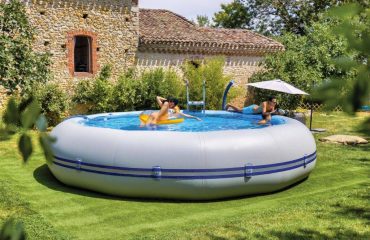
Urban clubs ask this constantly, and the answer is yes, through a demountable self supporting pool. The structure uses rigid high density insulating foam side panels, installed without excavation and, in most cases, without planning consent. It lets a club without a pool create a dedicated aquafitness zone and test local demand before committing to construction. Commissioning is measured in days rather than months, and the installation is fully reversible at lease end. Three checks are non negotiable. Floor loading comes first: a filled pool weighs several tonnes, so have the permissible load validated by a structural engineer, particularly above ground level. Humidity comes second: a pool heated to 30 to 32 degrees in an unventilated room damages both the building fabric and surrounding land based equipment, so specify dehumidification or air treatment at design stage. Water treatment and the sanitary logbook apply exactly as for any pool open to the public.
Pool surrounds, flooring and sound
Specify R12 minimum slip resistance around the water. Treated timber or polypropylene grating suits wet decks, with rubber tiles in dry circulation, shower and changing areas. A pool hall is highly reverberant, with hard surfaces, an open water plane and no absorbent furniture, so audio needs professional acoustic calibration rather than a consumer system. Waterproof Bluetooth instructor headsets in professional ranges cost 200 to 500 EUR per unit and are worth specifying from the start.
Frequently asked questions
What water depth does aquabike require?
Between 1.10 and 1.40 m, so the water reaches chest height on a seated rider. Shallower water removes the resistance that makes the discipline work; deeper water destabilises the bike and the rider. Where an existing pool has a variable profile, position the class in the band that falls inside this range.
Why 316L stainless steel rather than 304?
316L contains 2 to 3 per cent molybdenum, which 304 does not, and this markedly improves resistance to the pitting corrosion caused by chloride ions. In a chlorinated pool hall that difference decides whether a frame lasts three years or fifteen. Specify the grade explicitly and ask for a material certificate.
What water temperature should an aquafitness pool run at?
30 to 32 degrees Celsius, against 26 to 28 for a conventional swimming pool. The higher setting lets participants stand still during coaching explanations without cooling down. It is the temperature used in thermal centres.
How many bikes fit a typical class?
Eight to fifteen bikes arranged in a semicircle facing the instructor, over 25 to 100 square metres of water. Sessions run 30 to 45 minutes. Sizing above fifteen usually creates sightline and audio problems rather than extra revenue.
What lead times and warranties apply?
Light In Fitness returns quotations within 24 working hours and ships stock items in 5 to 10 working days. Warranties run from 2 to 5 years depending on the range, and longer on selected boutique specifications.
Specify your aquafitness space
Send us your pool dimensions, depth profile, water treatment method and class format, and we will return a bike count, a material specification and a storage plan. Request a quote within 24 working hours, or browse our aquatic fitness equipment and wellness equipment ranges. Delivery across France, Belgium, Switzerland and Luxembourg, with export quoted per project.
Réalisations documentées
- Functional Rig inox – installations sur trois continents
- iGreenMill, tapis de course extérieur – installations sur trois continents
Sources et références
- Code du sport, articles R322-4 à R322-43 – garanties d’hygiène et de sécurité applicables aux établissements d’activités physiques et sportives (Légifrance)
- Code de la commande publique – texte intégral en vigueur (Légifrance)
- Direction des affaires juridiques, ministère de l’Économie – réglementation de la commande publique et fiches techniques