Outdoor Ninja Playground Structures: The Complete Buyer Guide
Une structure ninja d'aire de jeux combine modules de suspension, de franchissement et d'équilibre sur un parcours continu. Elle relève de la série EN 1176 en aire de jeux, ou de l'EN 16899 pour les équipements de parkour. Le sol de réception se calibre sur la hauteur de chute libre de chaque module.
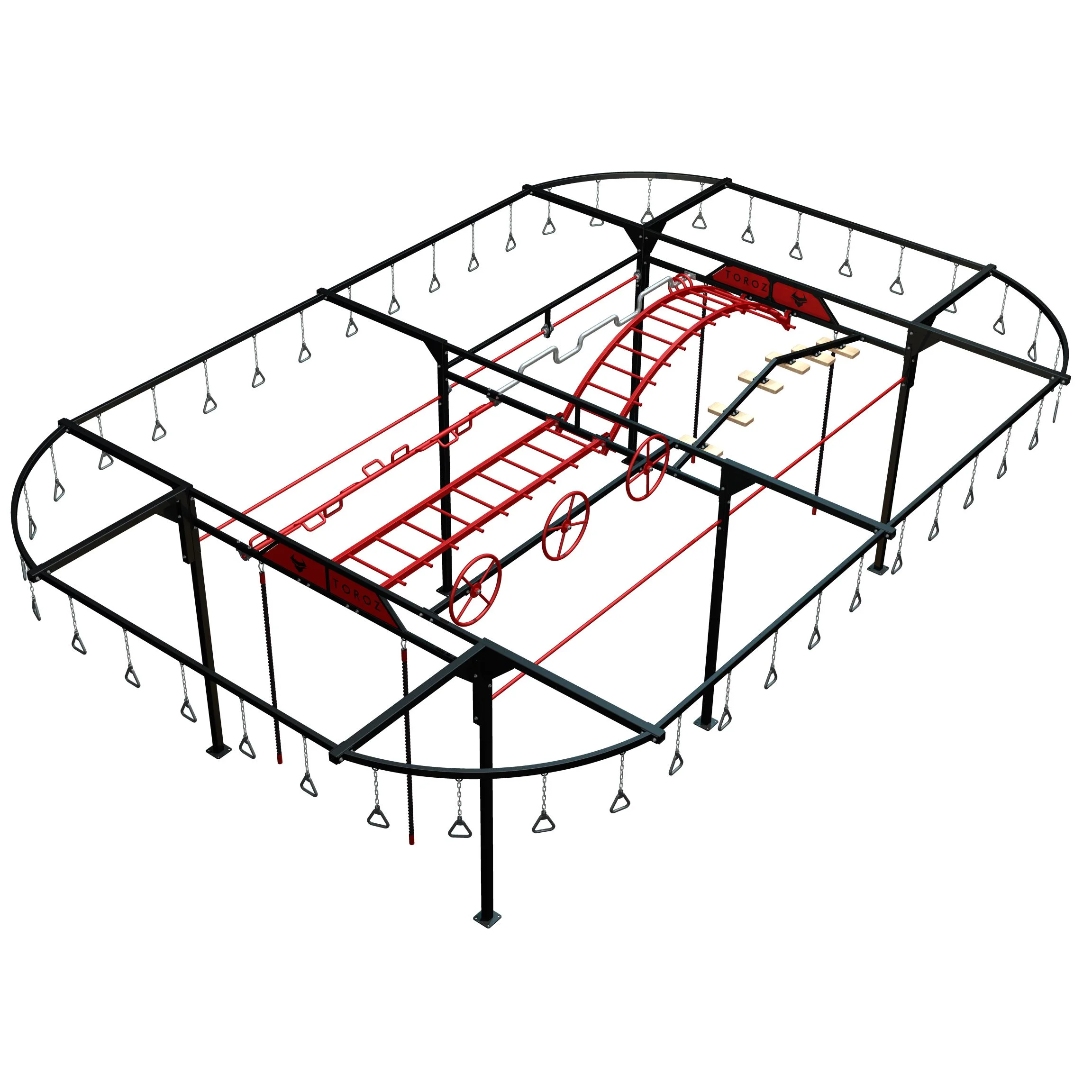
Ninja structures have moved from television screens to public parks, campsites, schools and holiday villages, and they are now one of the most requested pieces of outdoor play equipment. They keep children moving for far longer than a conventional climbing frame, and they are equally attractive to teenagers, a group that most playgrounds lose completely. This guide is written for the people who specify and buy them: local authorities, campsite and holiday village operators, schools, sports clubs, hotels and property developers.
What an outdoor ninja structure is
A ninja structure is a continuous obstacle course built around three families of movement: hanging and traversing, crossing and balancing, and climbing. In practice that means monkey bars and hanging rings, suspended ropes and cargo nets, moving steps and swinging platforms, rope bridges, climbing walls and inclined ramps, arranged so that a user moves from one module to the next without touching the ground.
The format works because it is self-scaling. A younger child uses the easy line along the ground; an older child or a teenager takes the harder route through the hanging modules; and an adult on a campsite or in a sports club can use the same rig for genuine training. That range of use per square metre is what makes the format attractive to an operator, compared with equipment that is outgrown at eight years old.
What it delivers for the users
Physical development. Hanging, traversing and climbing load grip strength, the shoulder girdle and the trunk, which very few other pieces of play equipment do. Balance and coordination are trained continuously because the surfaces move.
Cognitive engagement. A course has to be read before it is attempted. Children choose a route, judge a gap, adapt after a failure and try again, which is exactly the kind of graded risk-taking that a well-designed play area is supposed to offer.
Social use. Courses generate queues, turn-taking, timing and informal competition. In a campsite or a holiday village that translates directly into activity programming; in a school it translates into a playground that occupies a large group with one supervisor.
Retention of older children. This is the argument that usually decides a municipal project. A ninja course is one of the few installations that a twelve or fifteen year old will still use, which reduces the pressure on other facilities and the incidence of equipment being misused.
Standards, surfacing and free height of fall
This is where a professional specification differs from a consumer product. Equipment installed on a play area accessible to children falls under the EN 1176 series, with EN 1176-1 covering the general safety requirements for the equipment itself. The impact-attenuating surfacing beneath and around it is covered by a separate standard, EN 1177, and the two are never interchangeable. Equipment intended for parkour installations is covered by its own standard, EN 16899.
Three points follow from that, and they are the ones most often missed at the specification stage:
- The surfacing is driven by the free height of fall of each module, not by the overall look of the area. A high hanging module needs a deeper or more performant surface than a low balance beam, and the calculation is made module by module.
- The impact area extends beyond the footprint of the rig. The falling space has to be kept clear of benches, fencing, planting and adjacent equipment.
- EN 16630, the standard for outdoor fitness equipment for adults, does not apply to children’s play equipment. If a supplier answers a playground enquiry with EN 16630, the equipment is being proposed for the wrong user group.
Surfacing options range from loose fill such as wood chips through to bonded rubber and rubber tiles, each with its own certified critical fall height. Our playground surfacing range covers the usual specifications.
Choosing the right structure
Available area. Measure the full area, not just the strip the rig will stand on. The structure plus its falling space and a circulation margin is what determines the size you can install, and this is the single most common reason a project has to be redesigned late.
User age and profile. A school playground, a campsite open to families and a municipal park used by teenagers do not need the same course. Decide the age range first and let it drive module height and difficulty, rather than choosing modules and hoping they suit.
Module selection. Build the course around a progression: an easy entry, two or three technical modules in the middle, and an exit that most users can complete. A course on which nobody finishes is abandoned within a season.
Materials. Hot-dip galvanised or stainless steel structures, marine-grade ropes with a steel core, and hardware that can be inspected without dismantling the rig. Coastal and mountain sites have their own corrosion and temperature constraints and should be specified accordingly.
Budget. Budget the whole installation, not just the equipment: groundworks, foundations, surfacing, delivery, installation and the first inspection. Surfacing in particular is frequently underestimated and can represent a substantial share of a project.
Our ninja warrior rigs section covers the complete range, and the models designed specifically for permanent open-air installation are grouped under outdoor ninja structures.
Installation, inspection and maintenance
A ninja structure for public or collective use is not a self-assembly product. The anchoring, the foundations and the clearance around the modules are part of the safety of the installation, and they are verified against the manufacturer’s instructions and the applicable standard on commissioning. Plan for a professional installation and for a post-installation inspection before the area is opened.
Once open, the routine is straightforward and should be written down. A quick visual check on the operator’s normal frequency for missing parts, vandalism and surfacing displacement. A more detailed operational inspection at intervals, covering rope wear, fixings, moving parts and the condition of the surfacing. And an annual main inspection covering structure, corrosion and foundations. Keeping that log is the simplest way for an operator to demonstrate that the installation has been maintained.
Frequently asked questions
Which standard applies to a ninja structure in a play area? The EN 1176 series applies to the equipment, and EN 1177 to the impact-attenuating surfacing. Parkour equipment falls under EN 16899. EN 16630 covers adult outdoor fitness equipment and does not apply here.
What ages is it suitable for? That depends on the modules and their heights, which is why the age range should be fixed before the course is designed. A single rig can serve a wide range if it includes an easy line and a harder line.
What surfacing should be installed underneath? The one whose certified critical fall height matches the free height of fall of the modules above it. That is a calculation, not a preference, and it is done module by module.
Can our own technical team install it? Installation, anchoring and the pre-opening inspection are part of the safety of a public installation. We install and hand over the technical file, which is also what a public operator needs on record.
How much space should be allowed? The rig footprint plus the falling space around every module plus a circulation margin. Send us the plan of the area and we will size it precisely.
Planning your play area
Every ninja project comes down to the same four inputs: the area available, the age range to serve, the surfacing constraints and the budget. Send us the site plan and those parameters and our team will return a course layout, the surfacing specification with its fall heights and a costed proposal. Request a quote and we will take the project from plan to commissioned installation.
Réalisations documentées
- Parcours ninja sur mesure, Rennes – îlot des Hautes-Ourmes
- Double mur ninja extérieur, Sallanches – Haute-Savoie