OCR and Ninja Warrior Training with the Elite Combo 3.3.3 Bizon Cage
In this guide: what the Elite Combo 3.3.3 Bizon is | obstacle configurations | training levels, from beginner to competitor | siting the cage indoors and outdoors | how it compares with other structures | FAQ | requesting a quote
An obstacle course racing rig built for commercial operators
Obstacle course racing and Ninja Warrior training have moved out of the specialist niche and into mainstream commercial programming. Gyms in Manchester, cross-training boxes in Rotterdam, holiday resorts on the Costa del Sol and municipal sports departments across Europe are all being asked the same question by their members: where can we train the obstacles? The Elite Combo 3.3.3 Bizon cage is Toroz’s answer to that question for operators who need one structure to serve a whole membership rather than a handful of elite athletes.
This guide is written for the person who signs the purchase order: the club manager, the facility director, the hotel or campsite operator, the local authority technician. It sets out what the cage actually does, who it suits, where it can be installed, and which points to settle before you ask for a price.
What the Elite Combo 3.3.3 Bizon is
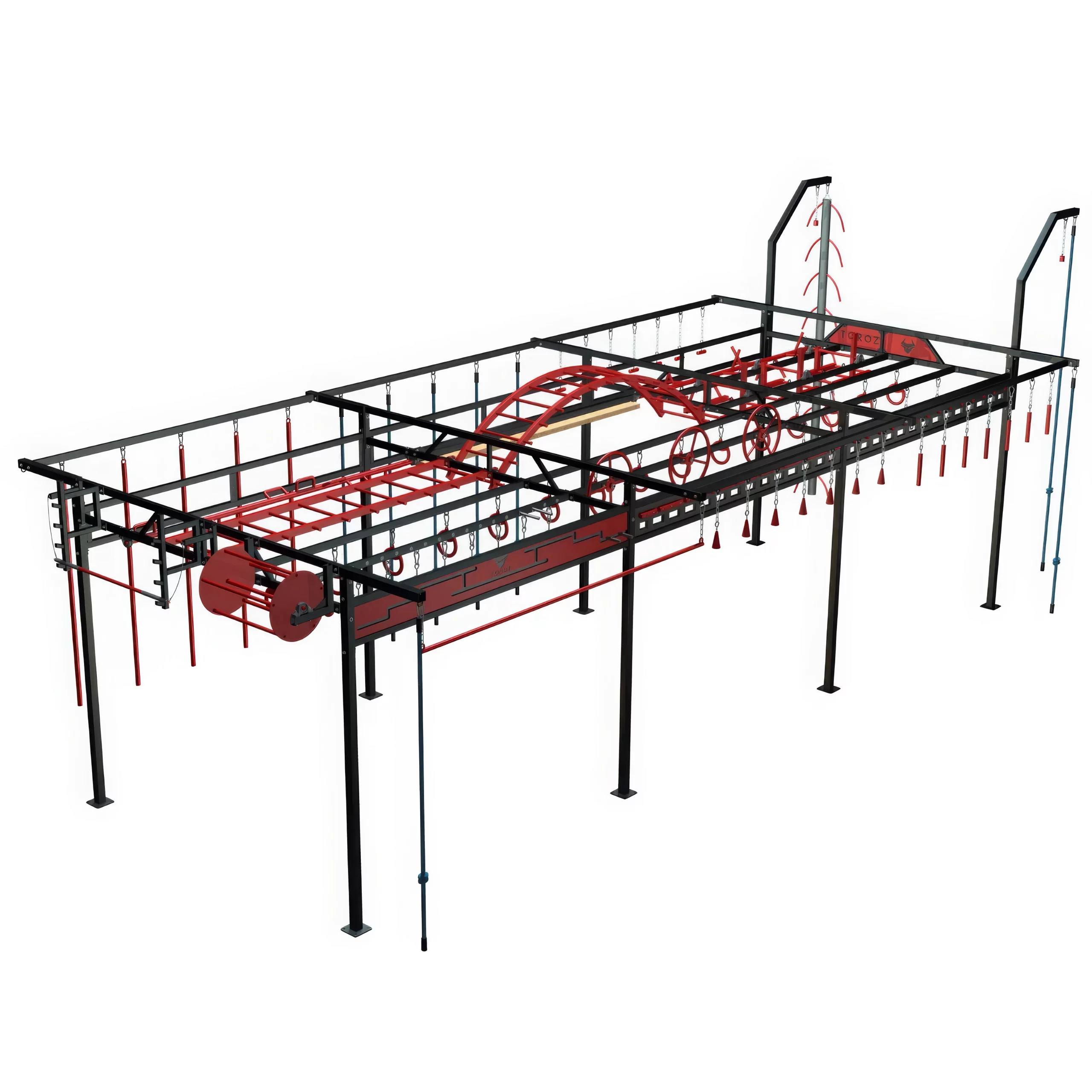
The Bizon is a self-contained steel obstacle cage. Its frame is engineered for continuous commercial use rather than occasional sessions, which is the single most important distinction when you compare obstacle structures. A rig that is specified for a private garden will not survive a full timetable of coached classes, school groups and open training; a rig specified for a commercial site will.
Three characteristics matter to a buyer:
- Steel construction. The load-bearing structure is steel, sized for repeated dynamic loading from swinging, hanging and landing rather than for static hanging alone.
- Modularity. Obstacles mount on the frame and can be added, removed, raised or lowered. The cage you buy this year is not the cage you are stuck with in three years.
- Indoor or outdoor siting. The structure is designed to stand up to weather exposure, which opens up courtyards, rooftop terraces, resort grounds and municipal sports areas as well as indoor halls.
The Bizon sits in the wider Toroz Ninja Warrior and OCR rig range, alongside larger and smaller configurations built on the same design logic.
Obstacles and training configurations
The obstacles that define competitive OCR are the ones members expect to find: inclined walls, monkey bars, rings, hanging traverses, grip and peg elements. The Bizon carries this vocabulary of obstacles on a single frame, which is what makes it viable for a commercial timetable. One structure supports a warm-up circuit, a technique session on grip and transition, a conditioning block and a timed run.
The same frame is equally suited to Ninja Warrior style programming, where the emphasis shifts from endurance to grip strength, body control and transition speed. In practice most operators run both: OCR-oriented sessions for members training towards a race, Ninja-oriented sessions for members who want the technical challenge without the mud.
Because obstacles can be repositioned, the cage supports progression. Heights and difficulty can be set for a first-time adult group in the morning and reset for an advanced session in the evening. That flexibility is what keeps a rig in use twelve months after installation instead of becoming an expensive photo backdrop.
From first sessions to competitive athletes
A common objection from operators is that an obstacle rig only serves the fittest ten per cent of a membership. That is a programming problem, not an equipment problem. On a modular cage, the same obstacle can be presented three ways: assisted or lowered for a first attempt, at standard height for a regular member, and at full difficulty with reduced grip aids for someone training for competition.
This matters commercially. An obstacle cage that only elite members can use generates a small number of highly visible sessions. An obstacle cage that a beginner can complete generates repeat attendance, coached class revenue and retention, which is where the return on the investment actually comes from. Operators who treat the rig as a coached product rather than as open equipment consistently report better utilisation.
Siting the cage: indoor and outdoor installations
The question that decides most projects is not whether the cage is good but whether it fits the site. The table below sets out the typical settings and what each one demands.
| Setting | What the cage delivers | Points to settle before ordering |
|---|---|---|
| Commercial gym or cross-training box | A differentiating feature that supports coached classes and small-group programming | Ceiling height, free space around the structure, floor build-up and impact protection |
| Hotel, resort or holiday village | A visible activity offer for families and active guests, usable outdoors | Supervision arrangements, access control, weather exposure of the chosen position |
| Municipal sports area | An open-access training facility that serves clubs and residents | Applicable national rules for public sports facilities, inspection regime, impact-absorbing surfacing |
| Club, school or armed forces site | A structured obstacle circuit for group instruction and testing | Group sizes, rotation through obstacles, supervision ratios |
For adult outdoor fitness installations open to the public, EN 16630 is the reference framework in Europe, and the surfacing under and around the structure has to be specified alongside the structure itself rather than as an afterthought. Our team specifies the two together as a matter of course.
How the Bizon compares with other obstacle structures
Buyers usually compare the Bizon against three alternatives: a fixed single-obstacle module, a larger multi-lane rig, and a lightweight structure sold on price.
- Against a single obstacle module. A standalone warped wall or hanging traverse does one job well. The Bizon replaces several such modules with one footprint and one foundation, and lets you change the circuit without buying new equipment.
- Against a larger rig. Bigger structures such as the Elite Combo 4.3.3 Godzilla cage take more athletes simultaneously and suit high-throughput sites or competition training. The Bizon is the right answer where floor area or budget will not carry the larger frame.
- Against a low-cost structure. The failure mode of underspecified rigs is predictable: welds and fixings degrade under the dynamic loading that obstacle training generates, and the structure is out of service exactly when demand for it peaks. Specify for the use you will actually put it to.
If you are planning a full circuit rather than a single cage, the complete OCR obstacle course range covers multi-station layouts.
Frequently asked questions
Can the Bizon be installed outdoors permanently?
Yes. The structure is designed for outdoor exposure. What changes outdoors is the groundwork and the surfacing: the foundation and the impact-absorbing surface have to be specified for the position and the expected use.
Is the cage suitable for members with no obstacle experience?
Yes, provided the circuit is set up for them. Obstacle heights and grip elements are adjustable, so a beginner session can be run on the same frame as an advanced one.
Can obstacles be added later?
Yes. The frame is designed to accept additional obstacles, which is the main reason operators choose a modular cage over a fixed structure.
What space do we need around the cage?
Clearance depends on which obstacles are fitted and how the circuit runs. Send us the dimensions of your space and the intended use and we will confirm the required footprint and safety zones for your configuration.
Can the cage be used for Ninja Warrior as well as OCR?
Yes. The same obstacle set supports both. The difference is in how sessions are programmed, not in the hardware.
Specifying your installation
An obstacle cage is a structural purchase, not a piece of equipment you drop into a corner. The specification, the surfacing, the clearances and the supervision model all need to be settled together. Send us your floor plan or site dimensions, your intended user groups and your timetable, and we will come back with a configuration and a costed proposal.
Réalisations documentées
- Parcours ninja sur mesure, Rennes – îlot des Hautes-Ourmes
- Double mur ninja extérieur, Sallanches – Haute-Savoie