Monkey Dome: What It Adds Over Straight Monkey Bars
Le dôme de singe remplace l'échelle monkey rectiligne par une coupole : plusieurs lignes de traversée au lieu d'une seule, et trois échelles d'accès aux inclinaisons différentes qui intègrent la progression à l'équipement. Il accueille donc plusieurs enfants en même temps, de niveaux différents, sans aucun réglage. Il existe en agrès seul ou comme structure centrale du Parc Sportif Enfants 97, indiqué à partir de 5 ans.
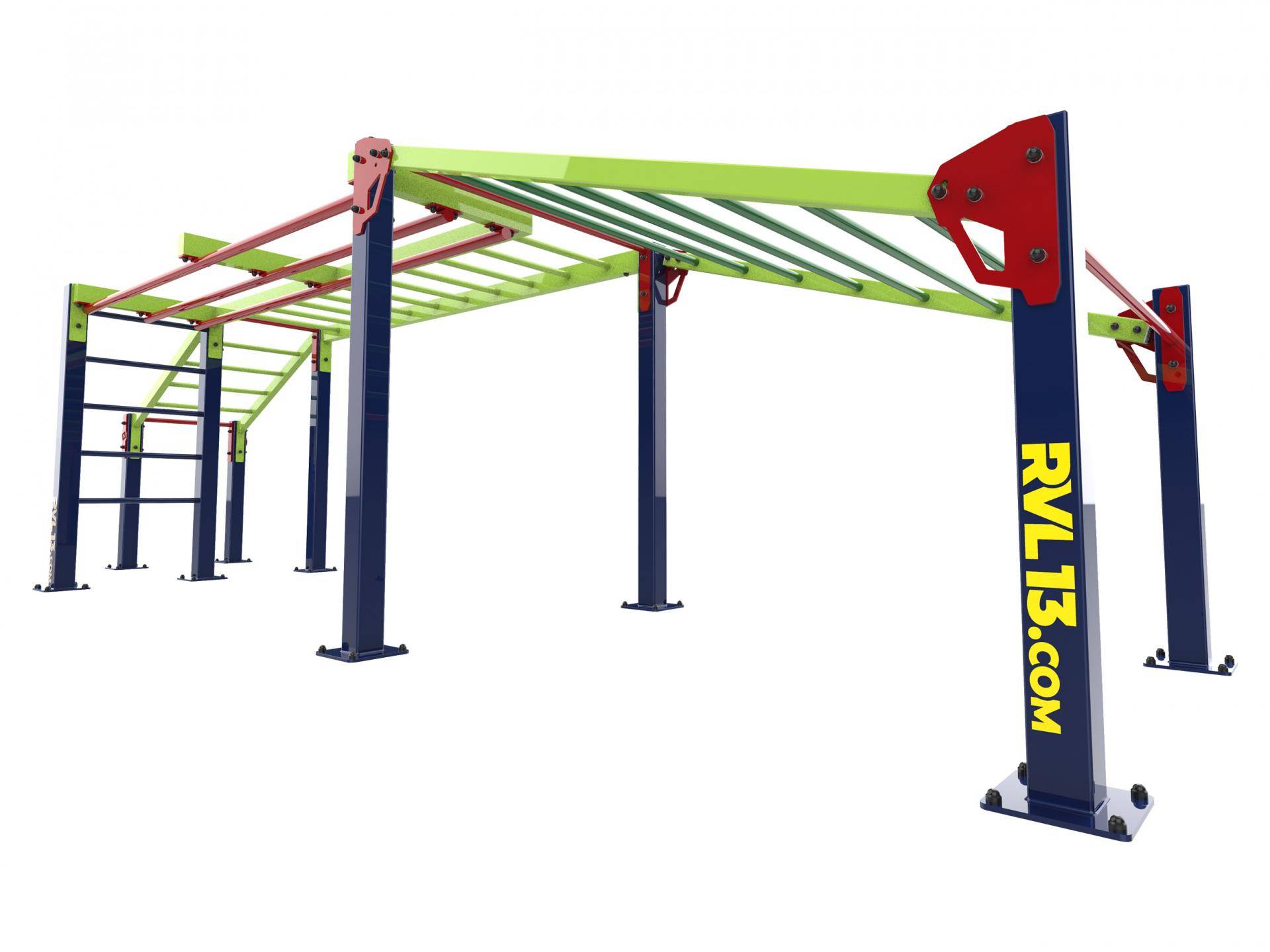
The monkey dome takes the principle of the classic monkey bar ladder and gives it a dome shape. Instead of a single straight line of rungs, the child gets routes in several directions and three access ladders at different angles. This guide explains what that geometry changes in practice on a playground, and when to choose a dome rather than a straight ladder.
What the dome shape changes
A straight monkey bar ladder offers one route: you start at one end and arrive at the other. The path is identical every time, and throughput is limited to roughly one child at a time.
The dome opens several crossing lines on the same structure. The child chooses a route before committing to it, which turns an exercise in pure strength into an exercise in movement skill where anticipation matters.
The central section of the dome allows the classic hand-over-hand crossing, and also allows the child to travel along two parallel bars without losing contact with the structure. Combining the two techniques varies the sessions and avoids the boredom of a single-movement item.
Three access ladders, three levels
This is the most useful feature in practice: the structure is reached by three ladders at different angles. Beginners take the gentlest slope, more confident children take the steepest routes to reach the top.
The progression is built into the equipment. One item serves different ages and different ability levels with no adjustment at all, which matters in a school playground where the youngest and the oldest primary years share the same space.
What the child is working on
| Action | What it develops |
|---|---|
| Climbing the access ladders | Posterior chain, arm and leg coordination |
| Hanging from the bars | Grip strength, shoulder girdle |
| Crossing hand over hand | Shoulder stability, core control |
| Choosing a route across the dome | Movement skill, anticipation, decision making |
Hanging and crossing are the two movements that reappear later in suspended movement work on a pull-up bar and a horizontal ladder, and then, in teenagers and adults, in calisthenics and street workout. A monkey dome installed for a primary school is therefore the first rung of a much longer progression.
Standalone item or part of the 97 park
The dome exists in two forms in the catalogue. The kids monkey dome training structure is installed on its own, with a compact footprint that fits into an existing playground or sports area.
The Kids Sports Park 97 uses it as the central structure, surrounded by pull-up bars, parallel bars and inclined benches, over a usable area of 97 square metres for 18 participants and more, from 5 years old.
The choice follows the project. Completing an already equipped play area calls for the standalone item; creating a complete sports zone calls for the park. It is worth noting that the dome is what gives the 97 park the best area-per-child ratio of the children’s park range, because several children use it at once in different directions. The full range of children’s outdoor sports parks shows how the dome sits within the larger configurations.
Installation and surfacing
The structure is designed for permanent outdoor installation and is assembled on site. Like any equipment on which a child moves at height, it requires an impact-attenuating surface sized on the free height of fall, certified to EN 1177.
The applicable equipment standard is EN 1176-1, since this is children’s play equipment, and that standard determines the inspection regime for the area. EN 16630, which covers permanently installed outdoor fitness equipment for adults, does not apply to a monkey dome and is not interchangeable with it. The safety zone is set out on the layout plan issued with the quotation.
Which sites it suits
- Primary school. The progression across the three access ladders serves every year group with a single piece of equipment.
- Public park, leisure centre. Higher throughput than a straight ladder keeps queues down at peak times.
- Campsite, residential development. The standalone item completes an existing play area without redesigning the site.
On a mixed site where parents train while children play, the dome sits naturally alongside an adult outdoor fitness zone, with the two areas specified, surfaced and inspected separately.
Frequently asked questions
What is a monkey dome?
It is a climbing and crossing structure in the shape of a dome, derived from the classic monkey bar ladder. It offers routes in several directions instead of a single line of rungs.
How does it differ from straight monkey bars?
A straight ladder offers one route, identical every time. The dome opens several crossing lines, allows movement along two parallel bars in the central section, and takes several children at the same time.
From what age?
The Kids Sports Park 97, which incorporates the dome, is indicated from 5 years old. For the standalone item, the age range is confirmed according to the configuration chosen at quotation stage.
How do children of different levels use it?
Through the three access ladders at different angles: beginners take the gentlest slope, more confident children take the steeper routes. The progression is built into the equipment, with no adjustment needed.
Is impact-attenuating surfacing required?
Yes, sized on the free height of fall and certified to EN 1177. The area to be treated is shown on the layout plan supplied with the quotation.
Planning your installation
Light In Fitness designs and supplies outdoor play and sports equipment for schools, local authorities, campsites, leisure centres and residential developments. Tell us the available area, the age groups and whether the dome is going into an existing playground or a new sports zone, and we will return a layout plan with the safety zone and the surfacing specification. Request a quote for a siting study.
Sources et références
- Décret n° 96-1136 du 18 décembre 1996 – prescriptions de sécurité relatives aux aires collectives de jeux (Légifrance)
- NF EN 1176-1 – Équipements et sols d’aires de jeux, partie 1 : exigences de sécurité et méthodes d’essai générales (AFNOR)
- NF EN 1177 – revêtements de surface amortissants : détermination de la hauteur de chute critique (AFNOR)
- NF EN 16630 – modules fixes d’entraînement physique de plein air : exigences de sécurité et méthodes d’essai (AFNOR)