Larry Scott Bench: Technical Specifications Explained
Le banc Larry Scott, ou pupitre à biceps, immobilise le bras contre un plan incliné pour supprimer la compensation par le tronc. Cette position accentue le travail du brachial antérieur et de la portion courte du biceps. Le réglage de la hauteur d'assise conditionne l'alignement de l'aisselle sur le pupitre.

The Larry Scott bench, better known internationally as the preacher curl bench, is one of the few pieces of gym equipment named after the athlete who popularised it. Its purpose is narrow and very deliberate: it immobilises the upper arm against an inclined pad so that the trunk cannot compensate during an elbow flexion. Everything else about the bench, its geometry, its adjustment range and its build, follows from that single function. This article sets out the technical characteristics that matter when a facility specifies one.
What the bench actually does
The user sits, places the back of the upper arms flat on the angled pad with the armpits resting at the top edge, and curls the bar or the dumbbells through elbow flexion alone. Because the humerus is fixed, the swing of the torso that normally hides a heavy curl is impossible. The load transfers to the brachialis and to the short head of the biceps, and the exercise becomes measurable rather than approximate.
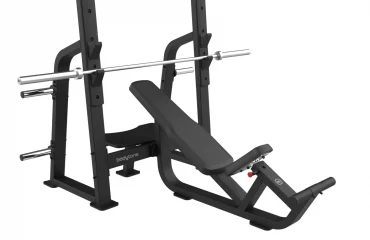
It is worth being explicit about what the bench is not, because the point is frequently confused. A preacher curl bench is not an adjustable incline and decline bench: it is not designed for pressing, and it is not a multi-station. If a facility needs pressing angles, that is a separate item from the weight benches range.
Geometry and adjustment
Three adjustments determine whether the bench works for a given user.
- Seat height. The decisive setting. The armpit has to sit at the top edge of the pad; too low and the shoulder rides up, too high and the elbows leave the surface at the bottom of the movement.
- Pad angle. A steeper angle increases the stretch at the bottom and the difficulty at the start of the movement; a shallower one shifts the peak resistance towards the middle of the range. Fixed-angle and adjustable-angle models both exist, so check which you are ordering.
- Bar rest position. Where the bar is racked determines whether the user can pick it up and return it without leaving the position, which matters for heavy sets and for supervised rehabilitation work.
Materials and durability
A commercial preacher bench takes eccentric load from a fixed position all day, so the frame section and the pad are the two components that decide its service life. Look for a heavy steel structure, welded rather than bolted at the load-bearing junctions, with a powder-coated finish. The pad should use high-density foam under a hard-wearing cover: ergonomic padding is not a comfort feature here, it is what keeps the arms in position under load.
Stability under off-centre loading matters more than raw mass. A user curling from one side of the bar, or leaning into the pad to squeeze the last repetition, applies force the frame has to absorb without lifting a foot off the floor. Non-slip floor pads and a wide base footprint are the practical answer.
Bars, accessories and compatibility
The bench is used with an EZ curl bar, a straight bar or dumbbells, and the choice changes the wrist position rather than the muscle worked. Some models include a bar holder, some are supplied bare. Where a facility already runs a plate-loaded or selectorised biceps station, the preacher bench remains useful as a free-weight complement rather than a replacement, because it allows unilateral work and a genuinely free bar path.
Specifying one for a commercial facility
Indoor equipment installed in a gym open to members has to be certified to EN ISO 20957-1 class S. Ask for the certificate for the exact reference. Beyond that, the practical criteria are the seat adjustment range, so that users of very different statures can be positioned correctly, the availability of replacement pads, and the footprint including the space a user needs behind the bench to sit down and stand up.
The complete range of strength training machines covers the stations a biceps corner is usually built around, and the preacher bench is generally specified alongside them rather than on its own.
Frequently asked questions
Which muscles does a Larry Scott bench work?
Principally the brachialis and the short head of the biceps brachii, with the brachioradialis involved depending on the grip. The fixed arm position is what makes the isolation possible.
Can it be used for bench pressing?
No. It is a preacher curl bench, not an adjustable pressing bench. Pressing requires a different bench with the appropriate incline and decline positions and, in most cases, a rack.
What is the correct seat height?
The one that places the armpits at the top edge of the pad with the shoulders relaxed. Set it per user rather than leaving it at a default position.
Straight bar or EZ bar?
An EZ bar reduces wrist strain for most users, which is why it is the usual choice on a preacher bench. A straight bar increases supination and suits users without wrist limitations.
Is it suitable for rehabilitation settings?
Under supervision, yes. The fixed arm position and the controlled range make it a useful station for progressive elbow flexion work, provided the load is set appropriately.
Specifying your biceps station
A preacher curl bench is a small purchase with a disproportionate effect on how a free-weight area is used, provided the adjustment range and the build quality match the traffic. Send us your floor plan and your user profile and our team will return a documented specification with the certification data attached. Request a quote to get started.