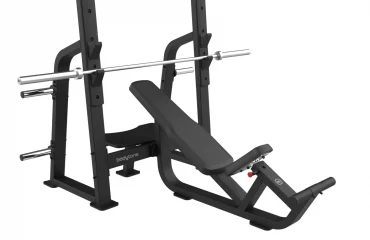
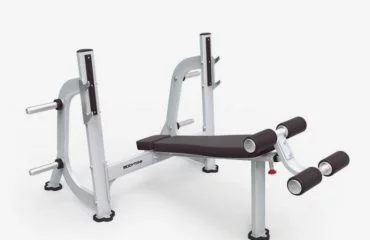
Olympic Bench Press: The Technical Specifications That Matter
Un banc de développé couché olympique se caractérise par des supports de barre à hauteur réglable, un écartement adapté à une barre de 2,20 m et des barres de sécurité. La stabilité du châssis conditionne la sécurité sous charge lourde. La densité de la sellerie évite l'écrasement qui dégrade le placement des omoplates.

The Olympic bench press is the single most contested station in a commercial gym: it is used at peak hours, under the heaviest loads in the room, and by members whose technique ranges from national-level to first week. That combination is what separates a professional bench from a light-duty one. Below are the technical characteristics that actually decide whether a bench belongs on a club floor, and what to check on a specification sheet before you order.
1. Frame construction and rigidity
An Olympic bench press is built to take maximal loads, and its structural strength is what keeps users safe. Professional frames are made from reinforced steel, typically heavy-gauge box section, welded rather than bolted at the load-bearing joints. What you are looking for on the datasheet is section size, wall thickness and the footprint of the uprights, because those three figures determine whether the frame stays still under a heavy unrack.
Rigidity matters for a reason members feel before they can explain it: any lateral movement in the uprights changes the bar path. A frame that flexes under load makes a lifter unconsciously correct mid-rep, which is where shoulders get hurt. For indoor professional installations, specify equipment built to EN ISO 20957-1 class S. Padding should be high-density foam, dense enough to keep the torso stable and durable enough to survive continuous commercial use rather than compressing into a hollow within a season.
2. Adjustment: angle and height
Most Olympic benches on a club floor are adjustable in backrest angle and in bar-support height. The angle adjustment turns one station into three: flat, incline and decline pressing, each loading the chest, front deltoids and triceps in a different proportion. The height adjustment is the one that gets overlooked and matters more for safety, because a rack height set for a 1.90 m member forces a 1.60 m member to press the bar up and forward out of the hooks, at the exact moment their shoulder is least able to do it.
Check the number of positions, not just the range. A bench with five backrest positions and a bar support that indexes every 25 mm will fit a mixed membership. One with a broad range and three coarse stops will not. Check also that the adjustment can be made by one person without tools and without unloading the bar, because anything else is ignored in practice at 18:30.
3. Compatibility with Olympic barbells
Olympic bench presses are designed to take 2.2 m Olympic barbells of standard weight. That single dimension governs the geometry of the whole station: the spacing of the uprights, the usable sleeve length outside them, and how much plate the bench can accept before the collars foul the frame. Verify the upright spacing against the Olympic barbells you already run, particularly if your floor mixes bar lengths.
Bar supports, or hooks, should give an easy lift-off at every height setting. Dumbbell work is equally part of the station in practice, so the bench should be usable free of the uprights as well: seat and backrest geometry has to suit pressing with dumbbells, not only inside a rack.
4. Racks, stations and complementary attachments
Some models are supplied as a bench alone, others integrated into a rack or a strength station. An integrated version adds squats, rows and other barbell work at the same station, which raises the throughput of a given square metre. High and low pulleys and parallel bars extend the range further, covering lats, biceps and triceps with pulldowns, rows, extensions and dips.
The trade-off is straightforward. A dedicated bench is simpler, cheaper per station and never occupied by someone doing something else. A combined station covers more movement patterns per square metre but creates a queue. In a club with a well-populated free-weight area, dedicated benches usually win; in a compact studio, a hotel gym or a corporate facility, a combined station is often the better answer. Machines such as attachable leg extensions or leg press units follow the same logic: they broaden the station to the lower body but they add complexity to a piece of equipment whose main job is pressing.
5. Safety features
Safety catches or weight stoppers are the non-negotiable specification on any bench used without a spotter, which in a commercial gym means most of the time. They should be adjustable independently of the bar hooks, positioned so that a failed rep is caught above the chest, and rated for the same load as the frame.
Padding contributes to safety as well as comfort. The upholstery has to hold the torso and elbows in position throughout the movement; foam that compresses unevenly moves the shoulder blades and degrades the setup that makes a heavy press safe. An adjustable backrest also serves warm-up, mobility and rehabilitation work between heavy sets.
6. What one bench can and cannot cover
A well-specified Olympic bench press covers the entire pressing family: flat, incline and decline, barbell and dumbbell, chest, front deltoids and triceps, plus core work supported on the pad. Combined with a rack or a station, it extends to pulling and, where the configuration allows, to lower-body barbell work. It is a central station in any free-weight area and should be specified as such.
It is not, on its own, a complete strength solution. A club floor needs the bench alongside a proper selection of professional weight benches and machine stations to spread traffic and to serve members who will never load a barbell. Sizing the mix is a planning question, and it is best settled before the equipment list is signed off.
Specifying the right bench for your facility
Investing in an Olympic bench press means buying a robust, adjustable and versatile station that will absorb the most demanding programmes on your floor for years. The model that fits depends on your membership profile, your peak-hour throughput and the space you have around the station. The Bodytone FBC08 Olympic bench press is a typical reference point for a commercial free-weight area. Send us your floor plan and your member numbers and we will propose a configuration. Request a quote for a costed proposal.