Professional Strength Training Equipment for Gyms and Clubs
Un matériel de musculation professionnel se distingue par sa structure, ses roulements, ses câbles et la disponibilité de ses pièces détachées. Ces éléments déterminent la durée de vie en usage collectif, avant toute considération esthétique. Light In Fitness fournit ces gammes avec devis, livraison, installation et SAV.
Professional strength training equipment is defined by its frame, its bearings, its cables and the availability of spare parts. Those four things decide how long a machine survives in collective use, long before any consideration of finish or styling. Everything else in a specification follows from them.
That distinction matters because the market is full of equipment that looks the part. A club buying its first full strength line, a hotel refitting a fitness room, a municipal sports hall replacing a twenty-year-old station: all three face the same catalogues, the same photography and very different service lives. This article sets out what actually separates professional-grade strength equipment from everything else, and how to turn that into a specification you can put out to tender.
What professional grade actually means
Equipment intended for supervised commercial use is built to EN ISO 20957-1 class S, the class for professional installations. That is the first line of any serious specification, and it is not a marketing label: it sets requirements for stability, structural loading, entrapment and the safety of moving parts under the duty cycle a paying facility imposes.
Beyond the class, four components carry the load of daily use.
- The frame. Section thickness and welding quality decide whether a machine still tracks true after five years of heavy sets. Powder coating protects it, and the coating specification matters more in humid rooms and near pools.
- The bearings and guide rods. These are what a user feels. Smooth, silent travel under load is the difference between a station members queue for and one they avoid, and it is the first thing to degrade on under-specified machines.
- The cables and pulleys. Cable diameter, sheathing and pulley material determine replacement intervals on selectorised stations. On a busy floor these are consumables, so plan for them.
- Spare parts availability. A machine you cannot repair is a machine you replace. Ask for the parts list and the availability commitment before signing, not after a pad splits.
Upholstery, chrome and colour matching are real considerations for the look of a room, but they never compensate for a weak frame or a bearing that will not survive its first year of full occupancy.
Covering every training need on one floor
A complete strength offer usually rests on three families, and most facilities need some of each rather than all of one.
Free weights, racks and benches. Squat racks, power racks, olympic benches and dumbbell sets remain the backbone of strength training. They serve experienced members, cost less per training station than machines, and take heavy use with almost no moving parts to fail. Their constraint is supervision: they need space, flooring rated for dropped loads and a member base that knows what to do with them.
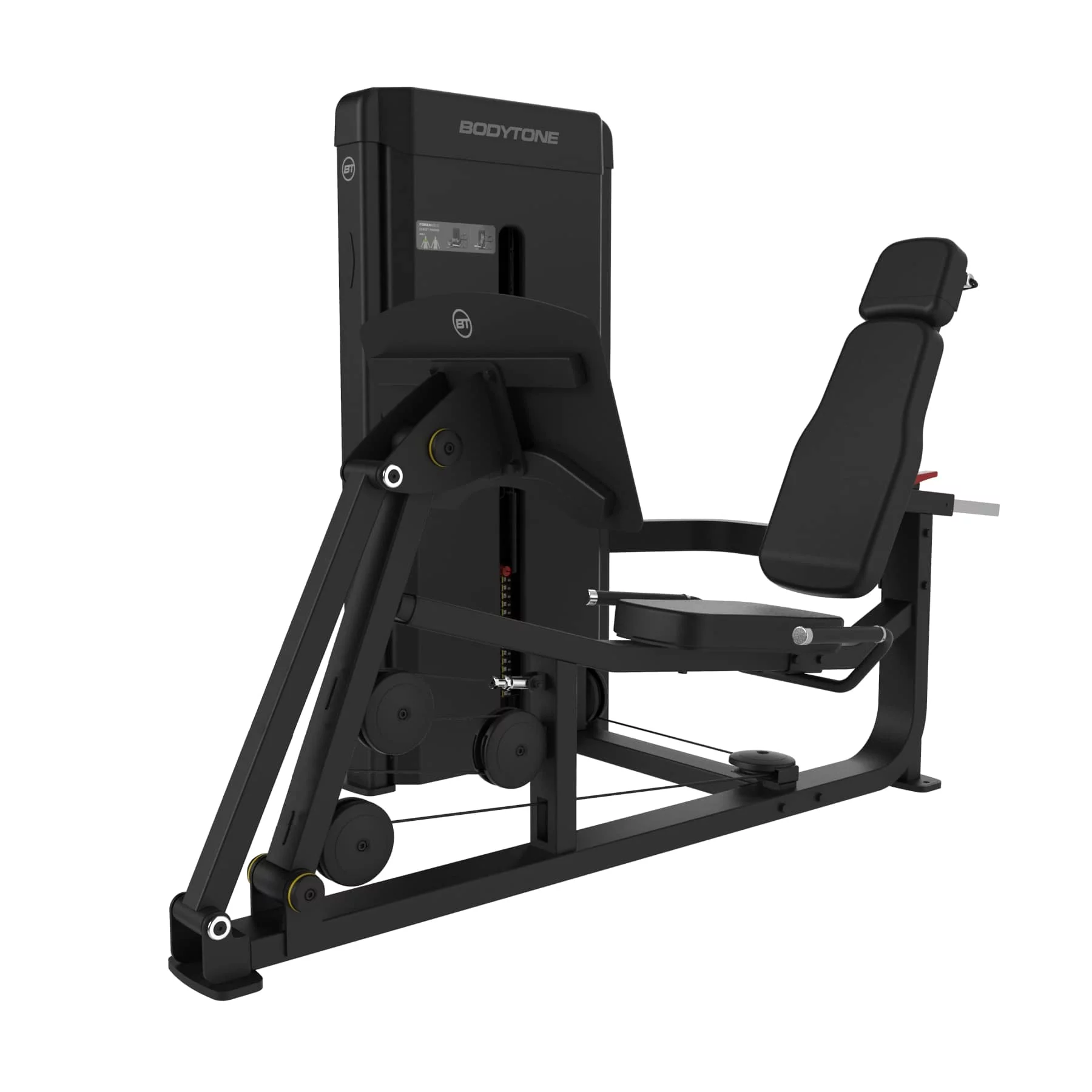
Selectorised machines. Pin-loaded stations are the entry point for the general membership. They guide the movement, allow fast load changes between users and make circuit programming possible. A line such as the Bodytone SRX selectorised range shows how a full body split is covered station by station, from biceps curl and triceps extension through to standing calf and squat work.
Plate-loaded machines. Converging and diverging plate-loaded stations sit between the two: the guided path of a machine with the loading feel of free weights. Converging plate-loaded machines are popular in cross-training and strength-focused clubs precisely because they suit heavy work without needing a spotter.
The mix is what makes a floor work. A hotel fitness room with a treadmill and fifteen square metres needs one multi-station, not five machines. A large club needs enough duplicate stations that a circuit does not jam at peak hour. The right answer comes from headcount, opening hours and the profile of the membership, not from the catalogue.
Flexibility and customisation
Professional ranges are specified, not simply bought off a shelf. Upholstery colour, frame colour and, on some ranges, weight stack capacity are chosen at order. That is what allows a club to match a brand identity across a full line, or a rehabilitation centre to pick lighter increments than a strength club would.
Two practical points are worth raising early with a supplier. First, custom colours and non-standard configurations affect lead time, so decide them at specification stage rather than after the order is placed. Second, ask which options are genuinely available on the model you are quoting, since option lists differ between ranges within the same brand. Our quotations confirm exactly which choices apply to the machines listed rather than to the range in general.
Technology on the gym floor: what to check
Connectivity and console features vary enormously between ranges, and they are one of the areas where marketing runs ahead of reality. Rather than assume, check three things on the specific model you are considering.
- What the console does without a subscription. Some functions depend on an active service contract; confirm what remains available if the contract lapses.
- Whether load and repetition data can be exported. Facilities that run coaching programmes need data out of the machine, not only on its screen.
- Whether heart rate is measured or estimated. Contact and belt-based measurement are not equivalent, and coaching decisions should not be built on the wrong one.
Everything on this list is model-specific. We confirm the answers reference by reference on the quotation rather than at range level, because that is where the differences actually sit.
Matching equipment to what members are trying to do
Member goals are varied, and the equipment list should reflect that rather than the preferences of whoever specifies it. Members training for general fitness need accessible, guided stations and clear signage. Strength-focused members need racks, benches and plates, plus flooring that tolerates them. Older members and rehabilitation users need low starting loads and easy entry and exit, which is a machine selection question, not a programming one.
The commercial consequence is straightforward: a floor that covers all three groups retains all three groups. A floor built around one of them loses the other two to the club down the road. That is the argument for auditing the membership before the equipment list is written, and for keeping a duplicate of the two or three most used stations rather than adding an exotic one nobody queues for.
Frequently asked questions
How long does professional strength equipment last?
Service life depends on the duty cycle, the maintenance routine and the environment far more than on the badge. What a specification can control is the frame quality, the bearing type and the availability of the parts that wear. Machines with a documented parts supply stay in service; machines without one leave the floor when the first component fails.
Can professional machines be installed in a small room?
Yes, but the selection changes. Multi-station units and compact selectorised machines exist precisely for hotel rooms, residential schemes and corporate fitness spaces. The limiting factor is usually access, not floor area: check door widths, lift dimensions and floor loading before choosing the model.
Is class S equipment necessary for a private or corporate gym?
Whenever a facility is used by people other than a single household, class S is the appropriate reference. It is written for exactly that situation: multiple unknown users, varied competence and a duty cycle no domestic product is designed for.
What flooring does a strength area need?
Free weight zones need rubber flooring rated for dropped loads, with thickness chosen for the loads actually being lifted. Machine areas can use thinner rubber. Getting this wrong is expensive twice over, since the floor fails and the slab underneath takes the impact.
Specifying your strength line
Professional strength equipment is a long-term asset, and the decisions that matter are made before the order: the class, the frame, the moving parts, the spare parts commitment and the mix of families across the floor. Tell us the site, the member profile and the space you have, and we will build the equipment list around them. Browse the full range of professional strength training machines, then request a quote and our team will come back with a layout, a specification and a price.