Free weights, selectorised machines or cables: how to build a strength floor
La progression en musculation dépend d'abord de la surcharge progressive et de la régularité, avant tout choix de matériel ou de complément. Les comparatifs utiles portent donc sur la fiabilité du matériel et la composition réelle des produits, pas sur les promesses. Cet article contient un lien sponsorisé vers un partenaire compléments alimentaires.
For hypertrophy and strength, the research is consistent: free weights, plate-loaded machines and selectorised machines all produce comparable muscle growth when load, proximity to failure and total weekly volume are matched. The choice between them is therefore not a physiological question but an operational one — who is training, how supervised the space is, how many people must be served per square metre, and what each station costs per user. This guide sets out the four families, published prices excluding VAT, and how to allocate a strength floor budget.
The four families and what each is actually for
| Family | Strength | Limitation | Best in |
|---|---|---|---|
| Free weights (barbell, dumbbell) | Maximal load, stabiliser recruitment, transfer to sport, lowest cost per kilogram | Needs technique, needs supervision, needs floor area and drop zones | Supervised clubs, functional boxes, performance centres |
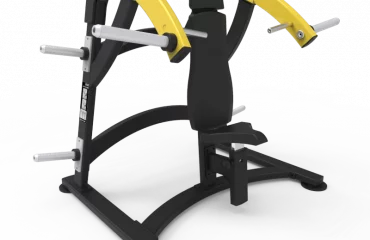
| Plate-loaded machines | Heavy loading on a fixed path, no spotter required, fast plate changes | One movement per machine, footprint per exercise | Strength-focused clubs, barracks, performance floors |
| Selectorised machines | Self-explanatory, fast load changes, safe to failure, ideal for unsupervised use | Highest cost per movement, load ceiling on the stack | Hotels, residences, corporate gyms, general-membership clubs |
| Cables | Constant tension, any angle, multiple users per frame, rehabilitation friendly | Free-column versions need coaching to be used well | All floors — the highest-utilisation category |
Whatever the family, specify EN ISO 20957-1:2024 class S for professional and commercial use, or class I for inclusive professional equipment. Class H is domestic. There is no “semi-professional” class under the standard, whatever a sales tier is called.
Published prices: what each family costs
| Equipment | Family | Price excluding VAT |
|---|---|---|
| Olympic bar, 20 kg, 220 cm, black chrome | Free weights | 220.00 EUR |
| Professional olympic bar, 2000 lb rating | Free weights | 380.00 EUR |
| Competition coloured rubber bumper plate | Free weights | from 59.00 EUR |
| Decline bench with dumbbell holder | Free weights | 1,290.00 EUR |
| Half rack with storage | Free weights | 1,590.00 EUR |
| Wall-mounted modular rig, 9 ft | Free weights | 1,750.00 EUR |
| Floor-mounted squat rack | Free weights | 1,890.00 EUR |
| Power rack | Free weights | 2,340.00 EUR |
| Squat cage | Free weights | 2,450.00 EUR |
| Dumbbell set, 20 pairs, 2.5 to 50 kg, urethane | Free weights | 6,950.00 EUR |
| Shoulder press, olympic plate loaded | Plate loaded | 1,650.00 EUR |
| Calf machine, olympic plate loaded | Plate loaded | 1,650.00 EUR |
| Glute machine, olympic plate loaded | Plate loaded | 1,950.00 EUR |
| 45-degree leg press, olympic plate loaded | Plate loaded | 1,980.00 EUR |
| Smith machine | Guided bar | 3,495.00 EUR |
| Chest press, selectorised | Selectorised | 4,500.00 EUR |
| Shoulder press, selectorised | Selectorised | 4,550.00 EUR |
| Leg press, selectorised | Selectorised | 5,850.00 EUR |
| Two-station cable crossover | Cables | 4,950.00 EUR |
| Four-station cable multi-gym | Cables | 7,250.00 EUR |
| Ten-station cable tower | Cables | 14,500.00 EUR |
Cost per movement pattern: the calculation that matters
A strength floor must cover six movement patterns: horizontal push, horizontal pull, vertical push, vertical pull, hip hinge and knee-dominant. Compare the cost of covering all six in each family.
| Approach | What it takes | Approximate cost excluding VAT | Users served simultaneously |
|---|---|---|---|
| Free weights | Rack, bar, plates, adjustable bench, dumbbell set | Approx. 11,000 EUR | 2 to 3 with supervision |
| Plate loaded | Six dedicated machines plus plates | Approx. 12,000 EUR | 6 |
| Selectorised | Six dedicated machines | Approx. 28,000 EUR | 6 |
| Cables | Ten-station tower plus one rack | Approx. 16,400 EUR | 10 to 12 |
Free weights are the cheapest capital cost and the most expensive in floor area and supervision. Selectorised machines are the most expensive per movement and the only family that works reliably with no staff on the floor. Cables serve the most users per euro. These are project estimates for budgeting; final quotations depend on configuration, delivery and installation.
Allocating the budget by venue
| Venue | Free weights | Machines | Cables | Rationale |
|---|---|---|---|---|
| Hotel or residential gym, unsupervised | 10% | 50% selectorised | 40% | Nothing that needs instruction; observed loads are modest |
| General-membership club | 30% | 35% | 35% | Beginners need machines, regulars need bars |
| Performance or strength club | 55% | 25% plate loaded | 20% | Load and technique are the product |
| Functional training box | 60% | 10% | 30% | Rigs, bars and bumpers dominate; cables for accessories |
| Rehabilitation or care setting | 5% | 45% selectorised, low starting loads | 50% | Fine increments and constant tension matter more than maximum load |
Floor area and safety, the numbers to design with
- Squat rack or power rack: allow 6 to 8 m2 including the lifting zone and plate access. A rack pushed against a wall loses half its usable movement patterns.
- Deadlift and drop zone: 40 mm rubber minimum. Below that, you are paying for sub-floor repairs.
- Dumbbell run: 1.5 m clear in front of the rack, plus a bench per 8 to 10 pairs.
- Selectorised machine: 3 to 4 m2 each including access and exit.
- Cable multi-gym: 3.20 x 2.80 m assembled and a minimum 2.50 m ceiling including stack travel.
- Circulation: keep 1.2 m of clear route between zones. Members do not use equipment they have to squeeze past someone to reach.
Home gym or commercial gym?
For an individual, the honest arithmetic is that a credible home strength set-up — rack, bar, plates, adjustable bench, flooring — starts around 3,000 EUR excluding VAT and rises quickly once machines are added. That is several years of club membership, and it buys no cable station, no selectorised range and no supervision. Home gyms win on convenience and lose on breadth. For an operator, the relevant conclusion is that the categories a member cannot replicate at home — cable stations, selectorised ranges, heavy plate-loaded machines and a properly specified floor — are where the differentiating budget should go.
Five checks before you sign the order
- Declaration of conformity, per item. Ask for the EN ISO 20957-1:2024 class S declaration for each machine on the quotation, not a general statement about the range. Class and range are not the same thing, and a tender file needs the document, not the claim.
- Weight stack increments. On selectorised machines, 5 kg jumps are the practical maximum for a general membership. Coarser increments strand beginners and older members between two loads they cannot use.
- Adjustment under load. Seat, back pad and start position must be adjustable one-handed by a seated user. If a machine needs two hands and a standing position to adjust, it will be used at the wrong setting.
- Upholstery cleaning compatibility. Confirm in writing which disinfectants the manufacturer approves. Aggressive products destroy stitching and vinyl faster than use does, and cracked upholstery is a warranty argument nobody wins.
- Spare parts and lead time. Cables, bushings, pulleys and grips are consumables on a busy floor. Get the availability period in years and the typical lead time in days, in the order confirmation.
These five checks cost nothing at quotation stage and are almost impossible to enforce after delivery.
Frequently asked questions
Free weights or machines for building muscle?
Both work. When load, proximity to failure and weekly volume are matched, free weights, plate-loaded machines and selectorised machines produce comparable hypertrophy. Choose on supervision level, floor area and cost per user rather than on an assumed physiological advantage.
What is the cheapest way to cover all six movement patterns?
Free weights: a rack, an olympic bar, plates, an adjustable bench and a dumbbell set covers everything for roughly 11,000 EUR excluding VAT. It is also the option that needs the most floor area and the most supervision, so it is cheapest only where staff are present.
Which equipment works in an unstaffed gym?
Selectorised machines and defined-station cable multi-gyms. Each station is self-explanatory, load changes take seconds, and a user can train to failure safely without a spotter. Avoid free-column crossovers and heavy free weights where nobody is present to coach or supervise.
How much floor space does a strength area need?
Allow 6 to 8 m2 per rack including the lifting zone, 3 to 4 m2 per selectorised machine, 1.5 m clear in front of a dumbbell rack, and 1.2 m circulation between zones. A cable multi-gym needs 3.20 x 2.80 m and a 2.50 m ceiling.
What flooring does a weight room need?
20 to 25 mm rubber under machines and dumbbell areas, and 40 mm or more under drop zones and lifting platforms. Prices are published from 26.00 EUR excluding VAT per m2 at 20 mm to 60.00 EUR at 40 mm.
Specifying a strength floor? Send us the room dimensions, the ceiling height, your supervision model and your expected peak attendance. Light In Fitness returns a costed layout across all four equipment families, with flooring, delivery, installation and prices excluding VAT within 24 working hours. See also our guides to cable machine architectures and rubber sports flooring.
Related guides: what actually works for abdominal fat.
Réalisations documentées
- Dalles et sols sportifs : livraisons documentées – plusieurs chantiers
- Sol sportif extérieur, square Georges-Vallerey – Taverny (95)
Sources et références
- ANSES – avis et rapport sur les compléments alimentaires destinés aux sportifs
- NF V94-001 – prévention du dopage dans le sport : bonnes pratiques visant l’absence de substances dopantes (AFNOR)