Flat Bench Press: The Complete Guide for Gym Operators
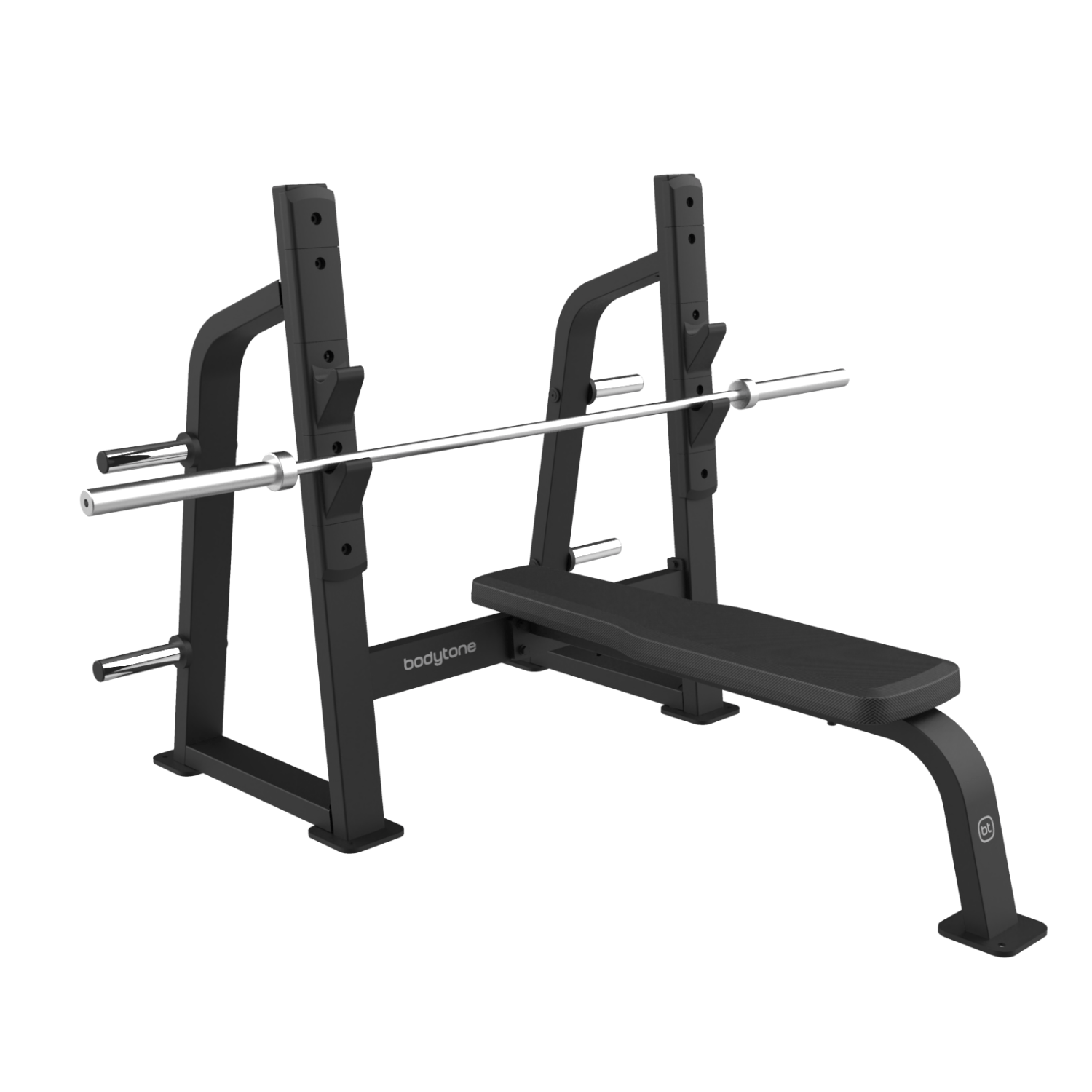
The flat bench press is the most requested station on almost every commercial strength floor. It is the movement members use to benchmark themselves, the exercise coaches build upper-body programmes around, and one of the few pieces of equipment whose availability decides whether a free-weight area is genuinely used or quietly avoided. For a gym operator, a cross-training box owner, a hotel fitness manager, a club or an armed-forces training centre, understanding the movement is the first step towards specifying the right bench, bar and safety hardware. This guide covers what the flat bench press is, the muscles it develops, the equipment a supervised facility needs, correct technique, safety rules and a sample progression.
What the flat bench press is
The flat bench press is one of the foundation movements of strength training and powerlifting, valued for how efficiently it develops the upper body. Before specifying equipment, it is worth being precise about what the exercise actually asks of the lifter and of the hardware.
The movement
The flat bench press is performed lying on a horizontal bench, feet flat on the floor and the spine in a neutral position. The lifter takes a loaded barbell from its rest position on the supports, lowers it under control towards the chest, then drives it back up to full arm extension. It is a compound movement, which means it recruits several muscle groups at once: principally the pectoralis major, the triceps brachii and the anterior deltoid.
Muscles involved
- Pectoralis major: the primary muscle trained by the flat bench press. It is responsible for flexion, adduction and internal rotation of the arm.
- Triceps brachii: involved in extension of the forearm, driving the bar upwards.
- Anterior deltoid: contributes to the press and stabilises the shoulder throughout the movement.
These are the prime movers, but the flat bench press is a complete exercise that also recruits secondary muscles, improving overall upper-body strength and stability.
Bench and press variations
Several variations of the press let a coach focus on specific muscle groups or on specific qualities of strength:
- Flat bench with a barbell: the classic and most effective version for building strength and mass.
- Flat bench with dumbbells: allows a greater range of motion and places more demand on the stabilising muscles.
- Incline bench press: shifts the work towards the clavicular fibres of the pectoral and the anterior deltoid.
- Decline bench press: targets the lower fibres of the pectoral more directly.
The flat bench press is therefore a versatile and powerful way to build upper-body mass and strength. Correct execution and an attentive approach are essential to get the most from it and to prevent injury.
Why the flat bench press earns its floor space
Bench press training is not only a route to a strong chest and powerful triceps. It offers a range of other benefits that contribute to general wellbeing and to athletic performance, which is exactly why it belongs in the equipment specification of a commercial facility.
Upper-body strength
The flat bench press is one of the key exercises for developing upper-body strength. It improves not only the strength of the pectoral muscles, but also that of the triceps, the anterior deltoids and the stabilising muscles.
Muscle mass
Regular bench press training stimulates muscle growth, particularly in the pectorals, triceps and anterior deltoids. It is an essential exercise for anyone looking to increase upper-body mass.
Transfer to athletic performance
The strength and power developed on the bench translate into performance gains across many sports, contributing for example to more powerful throws in baseball or harder punches in boxing.
Stronger stabilising muscles
The flat bench press also works the stabilising muscles of the trunk, shoulders and back, improving whole-body stability and reducing the risk of injury during other physical activities.
Programming versatility
The versatility of the flat bench lets coaches vary the training stimulus, using different bench types (flat, incline, decline) and different tools (barbell, dumbbells) for complete and balanced sessions.
Confidence and adherence
The confidence and discipline gained from improving bench press performance can also have a positive effect on mental health, encouraging a positive attitude and the determination to pursue goals. For an operator, that translates into members who stay.
Bench press training is therefore a foundation element of a complete fitness programme, delivering benefits not only in strength and muscle mass, but also in general health, athletic performance and psychological wellbeing.
The equipment a supervised facility needs
Effective bench press training requires specific equipment, which not only allows the exercises to be performed correctly but also protects the user during training. Here is what a professional installation calls for.
The bench
- Flat bench: essential for the standard flat bench press. It must be stable and robust, able to support the user and the loads being lifted.
- Adjustable bench: allows incline and decline work, varying the bench angle to load the pectorals differently.
The bar
- Olympic barbell: ideal for the flat bench thanks to its robustness and its length, allowing a stable and secure grip.
The plates
- Weight plates: available in a range of sizes and materials, they allow the working load to be matched to each user’s ability and progression.
Safety hardware
- Bar supports: essential for positioning the bar before and after the set, keeping the movement safe and avoiding unnecessary strain.
- Safety bars or spotter arms: useful for training safely, particularly with heavy loads, as they prevent the lifter from becoming trapped under the bar.
Optional accessories
- Dumbbells: for variations of the exercise or for accessory work.
- Belt: can provide lumbar support during the set, particularly under heavy loads.
- Gloves or wrist wraps: offer protection and support for the hands and wrists during training.
Using the right equipment matters for the effectiveness of the training, but above all for user safety and injury prevention. In a supervised commercial facility, specify benches, bars and racks built to EN ISO 20957-1 class S, the class intended for equipment used in supervised environments. Light In Fitness supplies the full station: browse the professional weight benches, the Olympic barbells and the racks and cages that carry the bar and its safety arms.
Correct technique
Correct technique is essential when performing the flat bench press, both to maximise the effectiveness of the exercise and to minimise the risk of injury. The stages below are what floor staff should be coaching.
Starting position
- Position on the bench: lie down on the bench making sure the head, back and glutes are properly supported and the feet are firmly anchored on the floor.
- Grip on the bar: grip the bar with both hands, keeping the grip firm and placing the hands wider than the shoulders.
- Bar position: the bar should be positioned above the chest with the arms fully extended.
Eccentric phase (lowering)
- Control: lower the bar slowly towards the chest, controlling the movement throughout.
- Depth: the bar should lightly touch the chest at its centre, below the line of the sternum.
Concentric phase (pressing)
- Drive: push the bar upwards, extending the arms fully without locking the elbows.
- Bar path: the bar should follow a slightly arced path, travelling from the lower chest towards the upper chest.
Coaching points
- Do not throw the head back: keep the head firmly on the bench throughout the exercise.
- Maintain tension: keep the pectorals, shoulders and triceps under tension for the whole set.
- Avoid excessive arching: a slight lumbar curve is normal, but excessive arching of the back should be avoided.
- Use a spotter: especially when lifting heavy loads, having someone assisting is essential for safety.
By following these points and paying attention to technique, users get the full benefit of the flat bench press, encouraging optimal muscle growth while considerably reducing the risk of injury.
Safety rules for a supervised gym floor
Safety is fundamental when performing the flat bench press. Making sure the rules below are followed is essential to avoid injuries and problems that can appear in the short and the long term.
- Use a spotter. Having a spotter, someone assisting during the exercise, is essential, especially with heavy loads. The spotter can step in if the lifter struggles, preventing potential injury.
- Hold the correct position. Keep the correct position throughout the exercise: feet flat on the floor, back and glutes in contact with the bench, head resting on the pad.
- Do not overload the bar. Do not lift more than the current strength level allows. Increase the load progressively and only when every repetition can be completed with correct technique.
- Warm up properly. Do not skip the warm-up before starting the session. A good warm-up prepares the muscles and joints for the effort and reduces the risk of injury.
- Use appropriate equipment. Always use suitable equipment in good condition. Check the stability of the bench and the integrity of the bar and the plates.
- Listen to the body. If pain or discomfort appears, stop the exercise immediately and, if necessary, consult a doctor or a physiotherapist.
- Programme rest. Include rest periods in the programme to let the muscles recover and to avoid overtraining, which can increase the risk of injury.
A sample bench press session
A well-structured training programme is essential to see consistent and safe progress on the flat bench press. Here is an example programme that can be followed as it stands or adapted to individual needs.
Phase 1: warm-up (10 to 15 minutes)
- Perform a general warm-up to raise body temperature (light jogging or skipping, for example).
- Continue with a specific warm-up, performing light sets on the flat bench and increasing the load progressively.
Phase 2: main exercise, flat bench press (4 sets)
- Set 1: 12 repetitions with a load representing around 50 per cent of maximum.
- Set 2: 10 repetitions with a load representing around 70 per cent of maximum.
- Sets 3 and 4: 6 to 8 repetitions with a load representing around 80 per cent of maximum.
Phase 3: accessory exercises (3 sets each)
- Dumbbell bench press: isolates the pectoral muscles more directly.
- Dumbbell flyes: encourage stretch and contraction of the pectorals.
- Dips: strengthen the triceps and the pectorals.
Phase 4: recovery and stretching (10 minutes)
- Perform recovery and stretching work on the muscles trained, to aid recovery and prevent stiffness and soreness.
Programming notes
- Make sure every exercise is performed with correct technique and adapt the programme to the individual fitness level.
- Use a spotter or safety bars, particularly on the heavier sets.
- Rest 1 to 2 minutes between sets and 2 to 3 minutes between exercises.
- Run this programme 1 to 2 times per week, allowing at least 48 hours of rest between two bench press sessions.
This programme is a baseline for anyone looking to improve bench press performance. It remains essential to listen to the body and, where necessary, to adapt the programme to specific needs, taking into account the advice and supervision of a fitness professional.
Getting more out of bench press training
Maximising results on the bench does not depend only on the load lifted, but on how and when the training is done. The points below help optimise sessions.
- Periodisation. Organise training in cycles, varying intensity, volume and exercise selection to avoid stalling and to encourage continuous muscle growth.
- Adequate nutrition. Make sure nutrition supports recovery and muscle growth, with protein, carbohydrates and good fats in balanced proportions.
- Recovery. Allow time to recover between sessions. Rest is essential for muscle growth and injury prevention.
- Complementary training. Complement bench press work with accessory exercises for the shoulders, triceps and back to improve performance and stability.
- Consistency. Stay consistent, keeping a regular frequency and giving full effort in every session.
- Review of results. Assess progress periodically and adjust the training programme according to the results obtained.
Frequently asked questions
How often should the flat bench press be trained?
The sample programme above is run 1 to 2 times per week, with at least 48 hours of rest between two bench press sessions, so that the muscles trained have time to recover.
How long should users rest between sets?
Rest 1 to 2 minutes between sets and 2 to 3 minutes between exercises. Programming those rest periods is part of the session, not an optional extra.
Does a facility need spotter arms if members train with a partner?
Both matter. A spotter can intervene if the lifter struggles, and safety bars or spotter arms prevent the lifter from becoming trapped under the bar when no partner is available. In an open-access facility, the hardware is what protects the user at quiet hours.
Flat, incline or decline: which bench should be specified?
A flat bench covers the standard press. An adjustable bench adds incline work, which shifts the load towards the clavicular fibres of the pectoral and the anterior deltoid, and decline work, which targets the lower pectoral. Facilities offering a full upper-body programme usually specify both.
Barbell or dumbbells?
The barbell version is the classic route to strength and mass. The dumbbell version allows a greater range of motion and places more demand on the stabilising muscles, which is why it appears as an accessory exercise in the programme above.
Specify the right bench press station
The flat bench press is a foundation exercise for building base strength and muscle mass. Correct execution, a safety-first approach and a properly planned strategy are what maximise results and minimise the risk of injury. For a facility, the same logic applies to the equipment: a stable bench, a robust Olympic bar, plates that allow fine progression and safety arms that work even when nobody is watching.
Light In Fitness has supplied professional fitness equipment to gyms, clubs, hotels, local authorities and training centres since 2013. Tell us the surface area, the number of stations and the profile of your users, and we will build the specification with you: request a quote.