Converging Strength Machines: A Complete Buyer's Guide
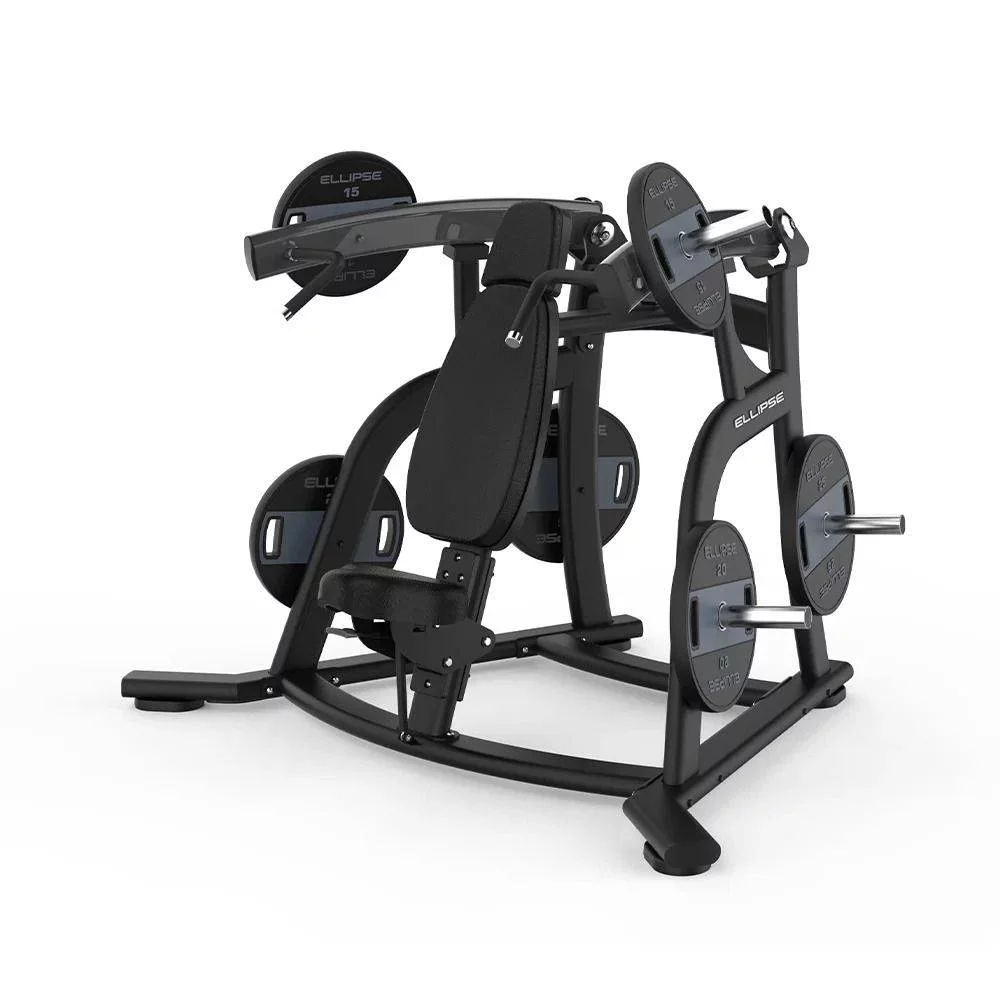
In short: a converging machine brings the handles towards the mid-line of the body during the push, following the natural line of pull of the pectorals far more closely than a machine with parallel arms. It recruits the inner fibres more strongly and keeps the shoulder joint in a safer position under load. On a commercial gym floor it is the piece that lets an untrained member press heavy without a spotter.
Why converging machines earn their floor space
Every square metre of a commercial gym has to justify itself. A converging chest press or shoulder press does that on three counts at once: it is used by beginners on their first induction, it is used by advanced members as a finisher after the barbell work, and it needs almost no supervision. For an operator running a staffed peak and an unstaffed off-peak, that last point is the one that matters.
The mechanical argument is simple. On a flat bench the bar travels in a straight line and the pectorals shorten along an arc. A converging path lets the arc happen. The result is a fuller contraction at the top of the movement and less compensation from the anterior deltoid, which is where most shoulder complaints on a gym floor come from.
The commercial argument is just as simple. Guided-path stations absorb the members who will never touch a squat rack. In a club, a hotel gym, a corporate facility or a rehabilitation centre, those members are the majority.
How a converging machine works
The architecture is deliberately plain: two independent pivoting arms, an adjustable seat, and either a selectorised weight stack or plate-loaded horns. The arms rotate around pivots set behind and outside the shoulder, so that as they travel forward they also travel inward. The seat height sets which portion of the chest takes the work: low seat, upper chest; high seat, lower chest.
Independent arms matter more than the brochure suggests. Because each side moves on its own, a member with a strength imbalance cannot let the strong side carry the weak one. For a physiotherapy or return-to-sport setting that is not a detail, it is the reason the machine is specified.
Technique is short to teach: back flat against the pad, feet planted, elbows slightly below shoulder height, controlled push, controlled return. Two minutes at induction and the member is autonomous.
Converging or diverging: two mechanics, two jobs
The two words describe opposite paths and they are not competing. A converging path closes the arms towards the centre and suits pushing patterns: chest press, shoulder press, incline press. A diverging path opens the arms outwards and suits pulling patterns: lat pulldown, seated row, rear delt. Choosing one over the other is a question of which muscle group you are equipping for, not a question of which is better engineered.
A well-planned strength area carries both. Our Gold Line converging plate-loaded machines cover the pushing side; the pulling stations sit alongside them on the same aisle.
The stations you will actually specify
| Station | Primary muscles | Typical role on the floor |
|---|---|---|
| Converging chest press | Pectorals, triceps, anterior deltoid | Core station, highest traffic of the pushing zone |
| Converging shoulder press | Deltoids, triceps | Vertical push without overhead barbell risk |
| Converging incline press | Upper pectorals, anterior deltoid | Complements the flat press, avoids duplicate stations |
| Diverging seated row | Lats, rhomboids, biceps | Pulling counterpart, balances the programme |
| Diverging lat pulldown | Lats, teres major, biceps | Entry-level back station, very high turnover |
Each station has its own range of motion and its own adjustment points. Whatever the mix, specify units built to EN ISO 20957-1 class S and check that the class marking appears on the frame plate, not only in the catalogue. Class S is the professional class for equipment placed in supervised or unsupervised commercial premises; class I is the professional class for inclusive access, which is a different requirement and not a higher intensity tier.
Converging machines and free weights
A converging press does not replace a barbell bench press, and specifying it as a substitute is how gyms end up with a strength area their advanced members leave. The barbell recruits stabilisers, teaches bracing and carries the progression that serious lifters come for. The machine isolates, allows a heavy load without a spotter, and stays usable when a member is fatigued or coming back from injury.
The practical layout answer is to put them in the same zone rather than in different rooms. Members move from the racks and power cages to the guided stations inside a single session, and a floor plan that forces them to cross the building loses that flow.
Selectorised or plate-loaded?
Selectorised stacks are faster to change, safer for a mixed membership and better suited to circuits and to unstaffed hours. Plate-loaded frames are usually more robust, cost less per station, and are preferred by strength-focused clubs and by cross-training boxes that already own plates. Facilities with a broad membership normally run selectorised for the pushing zone and plate-loaded for the heavy corner.
Frame construction is the durability question, not the mechanism: steel section, weld quality, bearing type at the pivots, and the grade of the upholstery. A pivot bearing that fails at year four on a high-traffic chest press is the whole cost of the machine again.
Mistakes we see on commercial floors
Loading beyond controlled range is the first: members chase the pin position rather than the contraction, the range shortens, and the training effect disappears. The second is a seat that no one adjusts, because the adjustment is stiff or unlabelled; a converging press set at the wrong height is a shoulder press with bad geometry. The third is buying pushing stations only, which produces the rounded-shoulder posture the equipment was supposed to prevent. The fourth is spacing: leave the manufacturer’s clearance around each frame or two adjacent members will collide at the top of the movement.
Frequently asked questions
What is the difference between a converging and a diverging machine?
A converging machine brings the arms towards the mid-line of the body during the push, matching the line of pull of the pectorals. A diverging machine moves them apart, which suits pulling movements. The choice depends on the muscle group you are equipping for, not on one being superior to the other.
Are converging machines suitable for beginners?
Yes. Because the path is guided, execution errors are limited and a member can load the machine without a spotter. That is one of the main reasons these stations appear in almost every open-access strength area.
Does it replace the barbell bench press?
It complements it rather than replacing it. The free barbell recruits the stabilisers; the machine allows more isolated and safer work at the end of a session or during a return to training.
How many converging stations does a club need?
That depends on your membership and floor area, and there is no universal ratio. The usable method is to count peak-hour occupancy per station in your existing layout and specify from that; we build the station count into the layout study rather than applying a rule of thumb.
Specifying your strength area
Converging machines are a structural part of a professional strength area, not an accessory. The choice of stations, the balance between pushing and pulling, the split between selectorised and plate-loaded, and the spacing on the plan are decisions that are much cheaper to make before delivery than after.
Browse the full range of Titan converging strength machines or send us your floor plan and membership profile and we will come back with a specified layout: request a quote.