Commercial Strength Equipment: The Essentials for an Effective Gym Floor
Fitting out a strength floor for a commercial site is a procurement exercise before it is a training one. A gym operator, a hotel leisure manager, a municipal sports department and a rehabilitation centre all buy the same category of product for very different reasons: hours of use per day, user profiles, supervision levels and maintenance budgets are never the same. This guide walks through the essentials of professional strength equipment and explains how each family of machines earns its place on the floor.
Three families carry most of a commercial strength offer: cable stations, multi-station gyms and weight benches. Each answers a different constraint of footprint, supervision and throughput. Understanding what separates them is what turns a shopping list into a coherent training floor.
Why specialised commercial equipment is not optional
Equipment installed in a facility open to third parties sits under a different regime from equipment bought for a private space. Indoor strength machines intended for professional use are specified to EN ISO 20957-1 class S. That classification covers the structural, stability and safety requirements expected of machines used without individual supervision, by users of unknown training background, for many hours a day.
The practical consequences show up in the details: frame gauge and welding, bearing and bushing quality on every moving joint, guarding around weight stacks, upholstery that survives repeated cleaning, and cable and pulley assemblies rated for continuous cycling rather than occasional use. None of this is visible in a product photograph, which is why specification matters more than appearance when you are comparing quotes.
The second reason is programming. Professional machines are designed to load a defined movement pattern with a repeatable range of motion. That is what allows a coach to prescribe the same exercise to a beginner and to an experienced lifter, and to progress the load without changing the technique. On a mixed-ability floor, that predictability is worth more than any single feature.
What professional-grade strength equipment brings to the floor
1. Controlled movement patterns. Guided machines fix the plane of movement, which lets an operator offer strength training to members who are not ready for free weights, and lets a physiotherapist load a joint without loading the ones either side of it.
2. Safety without a spotter. Selectorised stacks, enclosed guards and end stops allow a member to train close to failure without a partner. On an unsupervised floor or during off-peak hours, this is the difference between a usable machine and a liability.
3. Ergonomics that fit a real population. Adjustable seats, back pads and start positions let one machine serve users from around 1.50 m to well over 1.90 m. The adjustment range, and how quickly it can be changed between sets, directly affects how many people can pass through a station in an hour.
4. Measurement and traceability. Clear load indication, repetition counters where fitted, and consistent stack increments make progression legible to the member and to the coach. They also make equipment usage measurable, which is what justifies the next investment.
5. Coverage of the whole body. A properly composed line covers pushing, pulling, hip and knee extension, hip and knee flexion, and trunk work. Gaps in that coverage are what push members towards a competitor rather than towards your personal training offer.
Cable stations: the backbone of the strength floor
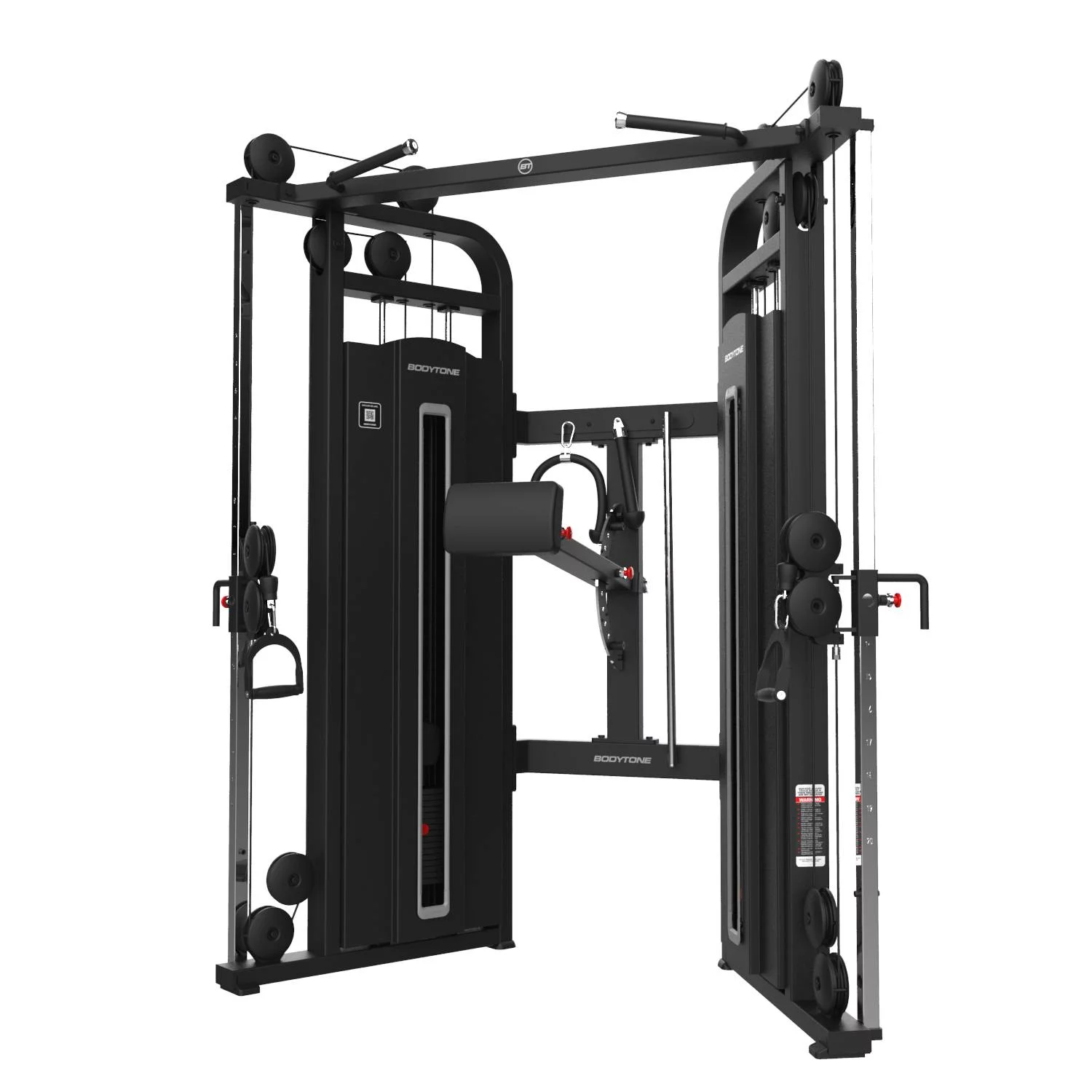
Cable stations are the most versatile single item you can install. One frame with two or more adjustable pulleys covers pressing, pulling, rotation, anti-rotation, and a large part of the shoulder and rotator cuff work that a rehabilitation or return-to-sport programme relies on. For a site with limited floor area, this is the highest ratio of exercises to square metres available.
They also age well commercially. A cable station does not date the way a single-function machine does, because the exercise catalogue it supports keeps expanding with whatever attachments and coaching methods come into fashion. Our cable stations are used across gyms, hotel fitness rooms and rehabilitation units for exactly that reason.
What to look for in a cable station
Adjustable pulleys. The number of positions on the upright, and how easily the carriage is released and re-locked under one hand, determines whether members actually use the full range of exercises or default to two or three.
Pull-up and dip provision. Many stations integrate a pull-up bar or dip handles into the frame. This adds bodyweight work without adding footprint, and gives the station a use during the busiest hours when the stack is occupied.
Stack increments and travel. Fine increments matter for return-to-training populations. Long cable travel matters for tall users and for full-range pulldowns. Both are specification points worth asking about explicitly.
Guarding and cable routing. Fully enclosed stacks, protected cable runs and accessible service points reduce both incident risk and downtime. Ask how a cable is replaced and how long it takes.
Multi-station gyms: coverage in a fixed footprint
A multi-station gym combines several loading stations around a shared frame, so that two to six members can train different movements at once without moving between machines. For a hotel, a residence, a company gym or a small municipal facility, it is often the only way to offer full-body strength training in the space available.
The trade-off is specialisation. A dedicated leg press will always load the legs better than the leg station of a multi-gym. The question is not which is better in the abstract, but which serves the population you actually have. A site with two hundred members and one strength room is served better by broad coverage; a strength-focused club with a dedicated lower-body zone is not.
How multi-station gyms change floor management
1. Footprint discipline. Several stations share one frame and, in many configurations, one set of circulation space. That leaves room for the free-weight or functional zone that members increasingly expect.
2. Predictable induction. Because the stations are grouped, a new member induction can be run in one place. Shorter inductions mean more of them, which correlates directly with retention.
3. Low supervision requirement. Enclosed stacks and fixed movement paths make the unit suitable for hours when no coach is on the floor, which is precisely when hotel and residential gyms are busiest.
4. One maintenance contract. A single frame with a known parts list is simpler to maintain than the equivalent number of standalone machines, and simpler to budget for.
You will find the full range on our multi-station gyms page, alongside the selectorised and plate-loaded lines that complement them.
Weight benches: the item that is always underspecified
Benches are the cheapest item on the strength floor and the one that fails first when it is bought on price. They take the highest number of daily contacts of any product in the room, they are dragged rather than carried, and they are loaded well beyond the weight of the user sitting on them.
A professional bench is judged on four points: frame stability under an off-centre load, upholstery density and its resistance to repeated disinfection, the locking mechanism on an adjustable backrest, and the footprint of the base relative to the pad. A bench that slides, rocks or bottoms out will be avoided by members long before anybody reports it.
Features of a professional weight bench
Adjustable backrest. Multiple locked positions from decline through flat to near-vertical let one bench serve pressing, supported rows, shoulder work and arm work. The number of positions matters less than the reliability of the lock.
Upholstery. High-density foam with a welded or reinforced cover holds its shape under load and survives the cleaning regime that a shared facility requires.
Structural stability. Heavy-gauge frames, wide feet and non-marking pads keep the bench where it was put, including when it is used alongside a rack.
Rated load capacity. Commercial benches are rated for combined user and load. Check the figure against the heaviest realistic use on your floor rather than against the average member.
Our professional weight benches range covers flat, adjustable and specialist benches for commercial installation.
Composing the equipment mix
| Family | What it does best | Typical fit |
|---|---|---|
| Cable station | Widest exercise catalogue per square metre, rehabilitation and rotational work | Small and medium floors, physiotherapy and return-to-sport units |
| Multi-station gym | Full-body coverage with low supervision requirement | Hotels, residences, company gyms, small municipal facilities |
| Selectorised machines | One movement loaded precisely, fastest station turnover | Commercial clubs with high peak-hour throughput |
| Plate-loaded machines | Heavy loading, strength and athletic populations | Strength-focused clubs, academies, armed forces |
| Weight benches | Free-weight support, pressing and arm work | Every floor, in greater numbers than most plans allow for |
The proportions between these families are what defines the character of a site. A club that wants to be known for strength buys racks, plate-loaded machines and benches. A hotel that wants no complaints buys one multi-station gym, a cable station and cardio. Both are correct answers to different questions.
Getting the most out of the installed base
Plan the layout before the purchase order. Circulation width, loading zones, mirror positions and sightlines from the desk change which machines you can actually install. Retrofitting a layout around equipment that has already arrived is expensive.
Zone by movement, not by brand. Grouping pushing, pulling and lower-body stations shortens the route a member walks during a session and makes the floor read as a programme rather than as a warehouse.
Write the maintenance schedule at handover. Cable inspection, bolt torque checks, upholstery condition and stack guide cleaning belong on a calendar, not in somebody memory. Equipment that is visibly maintained is used more.
Train the team on adjustment. Most complaints about a machine are complaints about a seat that was never adjusted. Ten minutes of staff training recovers more perceived quality than any single purchase.
Match the load range to the population. A floor serving older adults or post-injury users needs light increments far more than it needs a heavier top weight. Specify the stack range before you specify the machine count.
Frequently asked questions
What standard should commercial indoor strength equipment meet?
Indoor equipment installed in a facility open to third parties is specified to EN ISO 20957-1 class S. Ask your supplier to state the classification in writing on the quotation, not only in the marketing material.
Cable station or multi-station gym for a small site?
If the floor will be supervised and the population is mixed or includes rehabilitation, the cable station gives the wider exercise catalogue. If the room is unsupervised for most of its opening hours, the multi-station gym is the safer specification.
How many benches does a strength floor need?
More than the initial plan usually allows. Benches are used alongside racks, dumbbells and cable stations at the same time, so count them against your peak simultaneous users rather than against the number of pressing stations.
Are plate-loaded machines worth it alongside selectorised ones?
They serve a different population. Selectorised machines maximise throughput and suit members who change load between sets quickly. Plate-loaded machines suit heavier training and athletic populations, and they are typically simpler to maintain. Many floors carry both.
What should be checked before installation?
Floor loading capacity, ceiling height for pull-up and cable stations, door and lift dimensions on the delivery route, and the flooring specification under any machine that will be loaded dynamically.
Specifying your strength floor
Professional strength equipment is chosen on three criteria: the population it will serve, the hours it will run, and the supervision available while it runs. Every other question, including budget, follows from those three. A floor specified that way stays relevant for a decade; one specified from a catalogue alone rarely does.
Light In Fitness has equipped more than 2,500 customers since 2013, from commercial clubs and cross-training boxes to hotels, municipalities, schools and rehabilitation centres. Our steel structures carry a warranty of up to 20 years, and our stainless steel structures a lifetime warranty.
Send us your floor plan, your opening hours and your member profile, and we will come back with a specified equipment list rather than a catalogue extract. Request a quote and we will work from your constraints.