How to Choose a Professional Strength Machine in 5 Steps
Le choix d'une machine professionnelle suit cinq étapes : définir le public, vérifier la classe d'usage, contrôler l'amplitude des réglages, mesurer l'emprise au sol et vérifier la disponibilité des pièces. Chacune élimine une partie des modèles. Le prix n'intervient qu'après ce filtrage.
In brief: Choosing a professional strength machine follows five steps: define the user profile, verify the usage class, check the range of adjustment, measure the footprint, and confirm that spare parts will be available. Each step eliminates part of the field. Price only enters the decision once that filtering is done.
Most equipment lists are built the wrong way round. A budget is set, a catalogue is opened, and the machines are chosen by name and price before anyone has written down who will use them or how many square metres are actually free. The result is predictable: machines that fit the budget, do not fit the room, and do not fit the members. The sequence below inverts that. It is the order our specification team uses with club operators, hotels, rehabilitation centres, schools, municipalities and armed forces facilities, and it works because each step removes options rather than adding them.
Step 1. Define the user profile before anything else
Everything downstream depends on who is on the machine and whether anyone is watching them. Four questions settle it.
Who trains here? A student sports hall, a hotel gym used by guests with no induction, a rehabilitation ward and a strength-focused club produce completely different machine lists from the same budget.
Is the floor supervised? Unsupervised access pushes the specification towards machines that are self-explanatory, hard to set up incorrectly and hard to misuse. Supervised floors can carry equipment that rewards technique.
What is the throughput? A machine used continuously across a peak period is a different purchase from the same machine used twice a day, even though the datasheet is identical.
What is the spread of body sizes and abilities? This is what step three will measure, and it needs to be written down here, in the brief, rather than discovered after installation.
Step 2. Verify the usage class
This is the step that removes the largest number of models in the shortest time, and it is the one most often skipped. Indoor strength equipment installed in a facility open to users is specified to EN ISO 20957-1 class S, the professional class. A machine that does not carry it is not a cheaper version of the right machine; it is a different product built for a different duty cycle.
Two points are worth stating plainly, because they cause repeated confusion in tender meetings. Class I is a professional class covering inclusive access, not a level of intensity ranked above class S. And a machine that carries the correct class is not automatically the right machine for your site, it has simply earned the right to be considered in steps three to five.
Write the class into the specification document itself, not into the covering email. It is the single line that makes offers comparable.
Step 3. Check the range of adjustment
A strength machine only works for the users its adjustments can accommodate. Everyone else either trains out of position or stops using it. This is where the user profile from step one becomes a measurement.
Seat and pad travel. Look at the number of positions and, more importantly, at the distance between the first and the last. A long travel with coarse steps serves a mixed population better than a short travel with fine ones.
Starting position under load. On pressing and pulling machines, whether a user can reach the start position safely without help decides whether the machine is usable unsupervised.
Weight increments. Increments that are too large stall progression for lighter users, which in practice means the machine is used by half the membership. Selectorised stacks with an add-on increment cover a much wider population than the stack alone.
Adjustment under load. Whether a setting can be changed while seated, one-handed, without unloading, is the difference between an adjustment that gets used and one that gets ignored.
Step 4. Measure the real footprint
The footprint in a datasheet is the machine. The footprint on your floor is the machine plus the user, plus the space needed to get on and off it, plus the space the moving parts sweep through, plus the circulation route that has to stay clear behind it. On a plate loaded machine it also includes the space to load and unload the plates, and the storage horn that holds them.
Two practical habits prevent most layout failures. Set out the machines on the plan with their working envelope drawn, not just their outline; and check the delivery route, doorways, lift dimensions and floor loading before the order rather than on the morning of the installation. A machine that cannot reach the room is a total loss, and it happens more often than anyone admits.
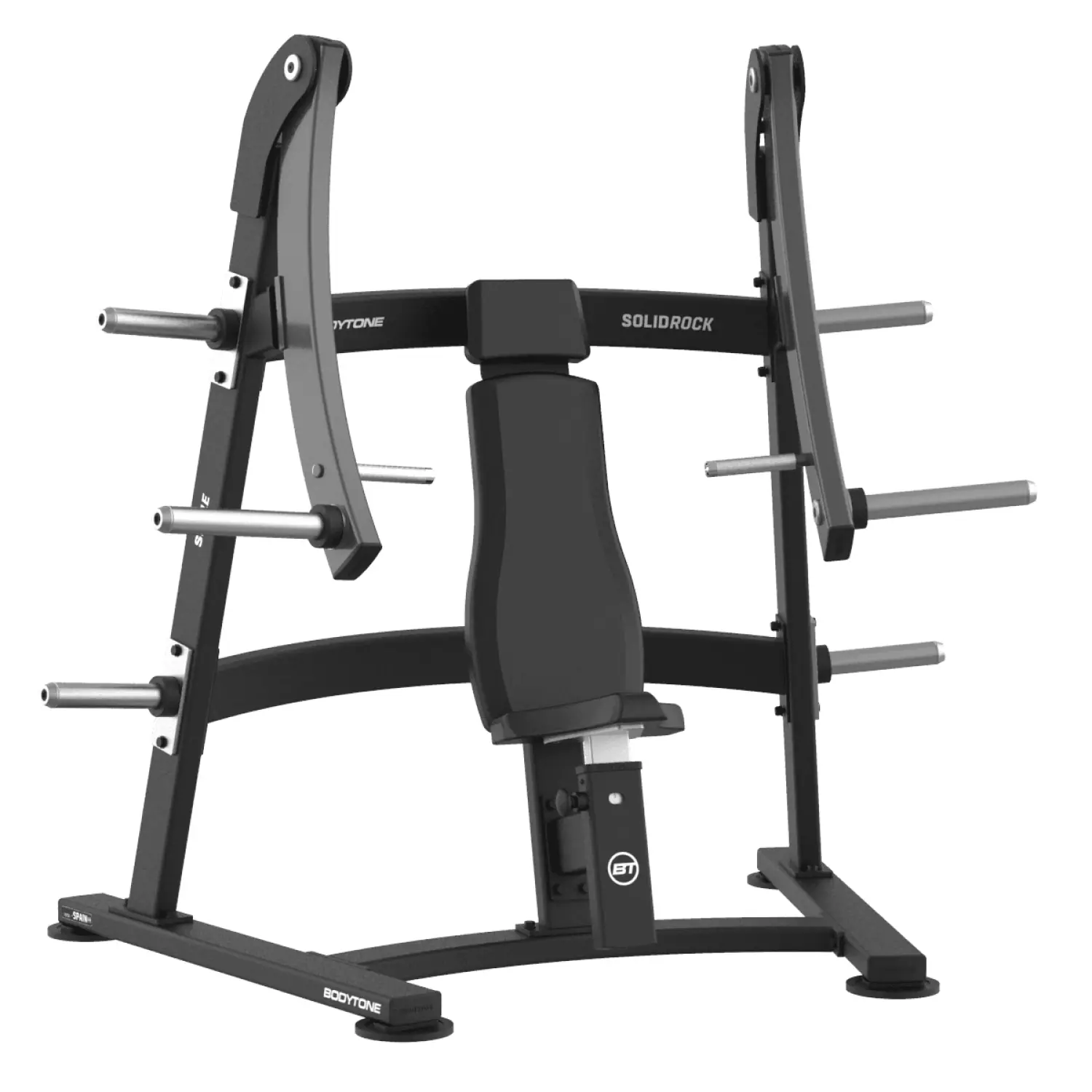
Footprint is also where the choice between machine families is really made. A selectorised machine carries its own weight stack and needs no plate storage; a plate loaded machine such as the Gold Line 45 degree leg press costs less per station but needs plates, horns and the floor area that goes with them.
Step 5. Confirm spare parts availability
This is the step that separates a ten-year asset from a five-year one, and it is invisible at the point of purchase. A professional machine will need cables, bushes, pads, grips and pulleys long before it needs replacing. The question to put to the supplier, in writing, before ordering, is simple: which wear parts are held, how are they ordered, and how long is the model supported after it leaves the range?
Upholstery deserves a specific answer. Pads are the first thing to fail on a busy floor and the first thing members notice. A machine whose pads can be reordered individually, in the original colour, years later, stays presentable; one whose pads are unavailable is retired early for cosmetic reasons while it is still mechanically sound.
Only now does price become useful. Comparing prices across machines that have all passed steps one to four is a real comparison; comparing them beforehand is comparing different products.
The five steps at a glance
| Step | What it settles | What it eliminates |
|---|---|---|
| 1. User profile | Who trains, supervised or not, throughput, body sizes | Machines built for another duty |
| 2. Usage class | EN ISO 20957-1 class S | Everything outside the professional class |
| 3. Adjustment range | Seat travel, start position, increments | Machines that fit only part of your users |
| 4. Footprint | Working envelope, circulation, delivery route | Machines the room cannot take |
| 5. Spare parts | Wear parts, upholstery, support duration | Machines retired early |
Frequently asked questions
Which standard applies to a professional strength machine?
EN ISO 20957-1 class S for indoor equipment in a facility open to users. Outdoor adult equipment falls under EN 16630, and children’s outdoor equipment under EN 1176-1 with EN 1177 for the surfacing.
Does class I mean a higher level than class S?
No. Class I is a professional class covering inclusive access. It describes who can use the machine, not how hard it can be used.
Selectorised or plate loaded?
Selectorised machines suit unsupervised floors and high throughput because the load changes in a second and nothing is left lying around. Plate loaded machines cost less per station and suit supervised strength areas, provided the plate storage and the floor area are planned with them.
When should price enter the decision?
After the first four steps. Once every candidate machine matches the user profile, the class, the adjustment range and the available floor area, comparing prices compares like with like.
Building your machine list
Run the five steps in order and the equipment list writes itself: the user profile sets the brief, the class filters the market, the adjustments match the population, the footprint matches the room, and the spare parts decide how long the investment lasts.
Send us your floor plan, your expected attendance and your user profile and we will return a laid-out machine list from our professional strength training machines range. Request a quote and our team will work through it with you.
À lire aussi sur le même thème
- Quels avantages une ceinture vous apporte-t-elle à la salle de sport ?
- Pump track cost: what drives the price and how to budget
- The Essential Machines for a Gym: A Complete Equipment Checklist
- Chest press : Les muscles sollicités et pourquoi cet exercice est incontournable (Spoiler : c’est votre meilleur allié pour un torse en béton)