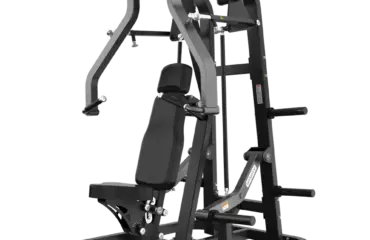
Buying Professional Gym Equipment: The Complete Guide
Un achat d'équipement professionnel s'évalue sur le coût de possession sur dix ans, pas sur le prix d'achat. Les postes déterminants sont le taux d'immobilisation, le coût des pièces d'usure et la durée de vie réelle. Ces paramètres se vérifient avant commande, auprès du fournisseur.

Buying professional strength equipment is a strategic decision for any gym, fitness club or rehabilitation centre. The right selection does more than satisfy members: it determines the profitability and the service life of the whole installation. And the honest way to evaluate it is the cost of ownership over ten years, not the purchase price. The parameters that decide that figure are downtime, the cost of wear parts and the real service life, and all three can be checked with the supplier before the order is placed. This guide sets out how to work through the decision.
1. Define what the facility is for
Before selecting a single machine, settle three questions.
- Target users. Beginners, competitive athletes, older adults, patients in rehabilitation? The answer changes the load ranges, the adjustment ranges and the supervision model.
- Type of training. Cross-training, conventional strength work, rehabilitation, or a mix.
- Budget and available floor area. How much is available to invest, and is the space constrained or generous?
Where floor area is tight, favour versatile, compact machines rather than a longer list of single-purpose stations.
2. The equipment categories a facility needs
| Category | Examples | What it delivers |
|---|---|---|
| Cardio machines | Treadmills, exercise bikes, rowing machines | Builds endurance and supports weight management |
| Selectorised machines | Chest press, leg extension, pec deck | Ideal for beginners and for rehabilitation |
| Free weights | Dumbbells, barbells, kettlebells | Builds strength and improves balance |
| Multi-station and rigs | Cross-training cages, cable stations | Saves floor area, allows many exercises |
For a commercial gym, the workable answer is a combination of guided machines and free weights, so that every level of member has somewhere to train. The full range of strength training machines and of cardio equipment is documented reference by reference.
3. Standards and certification
Safety is not a differentiator, it is a condition of entry. Indoor strength and cardio equipment installed in a facility open to third parties must be certified to EN ISO 20957-1 class S, the professional class for stationary training equipment. Class I is a separate professional class covering inclusive access, not a level above class S, and equipment offered outside this classification does not belong in a commercial facility.
- EN ISO 20957-1 class S for stationary indoor training equipment.
- CE marking, confirming that the product meets the applicable European directives.
- Bfl-s1 reaction-to-fire classification where required for rubber gym flooring. Reproduce the classification exactly as certified, smoke index included.
Ask for the certificate for the exact reference. A mention in a brochure is not a certificate.
4. Budgeting the purchase
Equipment is a long-term investment, and three cost lines have to be planned together: the initial cost, meaning machines, delivery and installation; maintenance, which is what keeps the equipment in service; and depreciation, which is where robust equipment pays for itself.
Illustrative budget for a standard gym floor
| Equipment | Quantity | Unit price | Line total |
|---|---|---|---|
| Professional treadmills | 3 | On quotation | On quotation |
| Chest press | 2 | 1,800.00 EUR excluding VAT | 3,600.00 EUR excluding VAT |
| Multi-station gym | 1 | 5,000.00 EUR excluding VAT | 5,000.00 EUR excluding VAT |
| Free weights | 200 kg | 5.00 EUR excluding VAT per kg | 1,000.00 EUR excluding VAT |
| Documented subtotal | 9,600.00 EUR excluding VAT |
Treadmill pricing is quoted per reference, because the range spans several very different specifications; ask for a quotation on the exact models rather than budgeting from a generic figure. Treat every figure above as an illustration of how a budget is structured, not as a price list.
5. Durability and maintenance
- Materials. Choose frames in heavy-gauge steel, stainless steel where corrosion is a factor, and steel cables with a hard-wearing polyurethane coating.
- Preventive maintenance. Plan a monthly check of moving parts, cables and fixings rather than waiting for a failure.
- Warranty. Check the duration and, more importantly, what the warranty actually covers and how quickly parts are supplied.
6. Laying out the gym floor
A good layout improves the member experience and gets more use out of the same square metres. Place cardio machines near windows for ventilation and daylight. Keep a genuinely clear area for dumbbell and kettlebell work. Group selectorised machines by muscle group so that a member can follow a logical circuit. And use rubber gym flooring matched to each zone, with heavier protection where loads are dropped.
Recommended zoning
| Zone | Equipment | Recommended area |
|---|---|---|
| Cardio | Treadmills, bikes | 30 m2 |
| Selectorised strength | Chest press, leg curl | 40 m2 |
| Free weights | Dumbbells, barbells, racks | 50 m2 |
| Stretching and mobility | Mats, rubber tiles | 20 m2 |
7. Why buy from Light In Fitness
Light In Fitness has specialised in professional fitness equipment since 2013 and has equipped more than 2,500 customers. Our commitment is to supply certified equipment meeting the applicable standards, robust products suited to every type of user, configurations adapted to your specific requirements, and support that continues after the installation rather than ending at the invoice.
Frequently asked questions
Which standard should professional gym equipment meet?
EN ISO 20957-1 class S for stationary indoor equipment in professional use, with CE marking. Request the certificate for each reference you order.
How should a first equipment budget be built?
From the zoning plan and the target user profile, then quoted reference by reference. Add delivery, installation and the first year of maintenance before comparing suppliers.
Is it better to buy fewer, better machines?
Generally yes. Under-specified equipment on a commercial floor fails earlier, and the replacement cost usually exceeds the initial saving.
How much floor area does a gym need per zone?
Use the zoning table above as a starting point and adjust it to your building, your circulation routes and the clearances stated on each datasheet.
Getting a documented quotation
The best equipment decision is the one made against your plan, your members and your operating model. Send us your floor plan and your user profile and our team will return a documented equipment list with certification data and pricing per reference. Request a quote for your project.
Réalisations documentées
- Dalles et sols sportifs : livraisons documentées – plusieurs chantiers
- Sol sportif extérieur, square Georges-Vallerey – Taverny (95)
Sources et références
- NF EN ISO 20957-1 – équipement d’entraînement fixe, partie 1 : exigences générales de sécurité et méthodes d’essai (AFNOR)
- AFNOR Normalisation – dossier thématique sur les appareils d’entraînement fixes et leurs classes d’usage