Why Choose the Bodytone ZROT4 Professional Curved Treadmill?
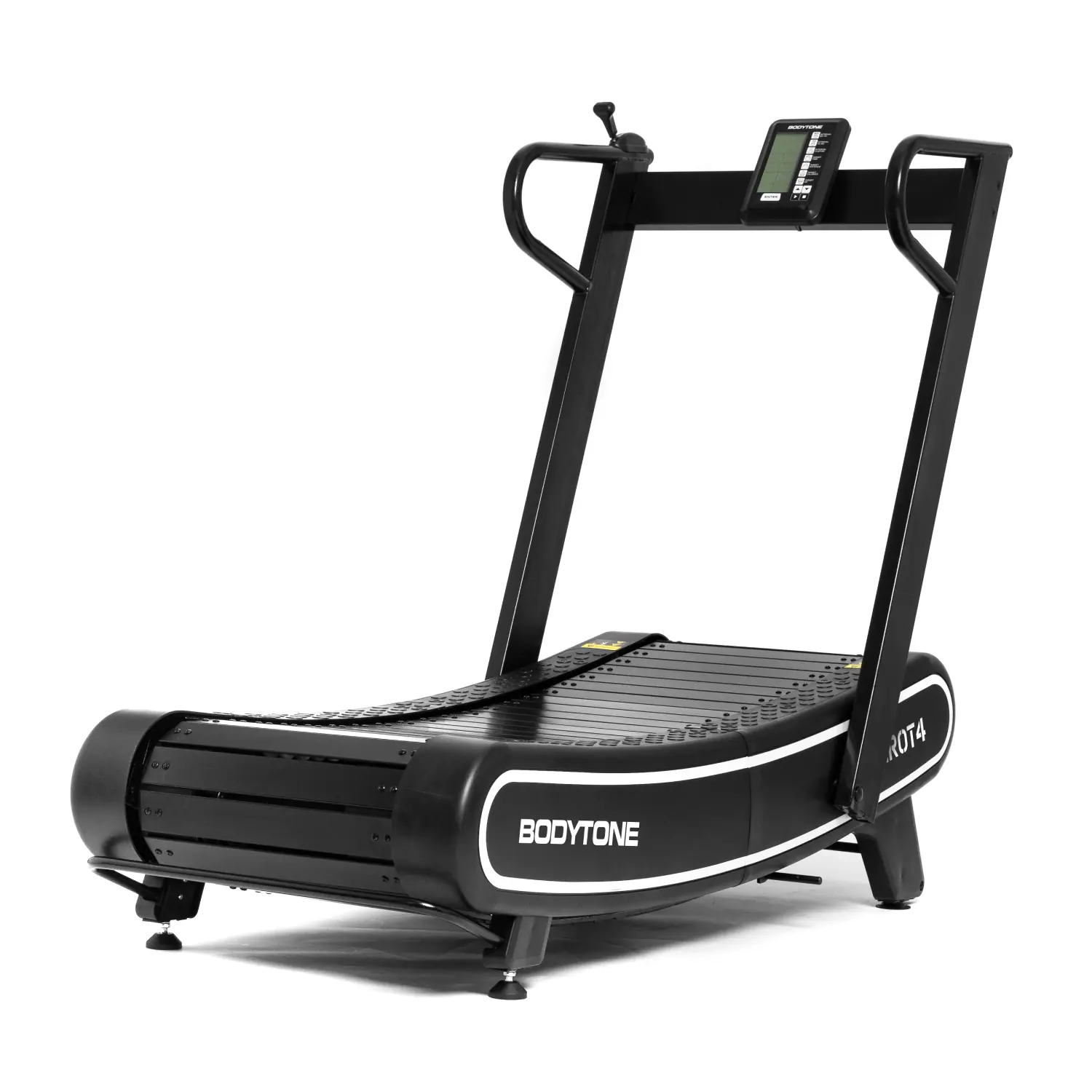
Curved treadmills have become a fixture in commercial gyms, cross-training boxes and performance facilities, and the Bodytone ZROT4 sits squarely in that category. It is worth understanding what a curved treadmill actually is before comparing it with anything else, because it works on a fundamentally different principle from a conventional motorised belt. This article covers how the machine works, what it delivers in training terms, where it fits on a commercial floor, and what to check before you specify one.
How a curved treadmill works
A curved treadmill has no motor. The running surface is a curved slat belt mounted on low-friction bearings, and it is driven entirely by the user. Step towards the front of the curve and the belt accelerates; drop back towards the rear and it slows. Stop running and the belt stops with you. There is no start button, no speed setting and no incline motor, because the curvature of the deck provides the resistance profile instead.
Three consequences follow directly from that design, and they are the reasons operators buy them:
- No power supply required. The machine needs no socket, which frees up placement on the floor and removes a whole category of electrical fault from the maintenance schedule.
- Speed is controlled by the runner. Transitions between walking, running and sprinting are instantaneous, which is exactly what interval and conditioning work needs. On a motorised belt, waiting for the motor to ramp up breaks the interval.
- Fewer parts to fail. No motor and no incline actuator means the two most expensive failure modes on a conventional treadmill simply do not exist.
What it delivers in training
Reduced impact
The slat running surface is designed to limit the impact transmitted to the joints, which matters for members running long sessions and in supervised return-to-activity work.
Genuine versatility
The same machine serves a beginner walking at a steady pace and an experienced athlete running sprint intervals, because the user sets the intensity with their own stride rather than through a console. Varying pace loads the legs and glutes differently, and holding position on the curve demands continuous core engagement.
Quiet operation
With no motor running, a curved treadmill is markedly quieter than a motorised belt. In a small studio, a hotel wellness room or a facility with residential neighbours above, that is a specification point rather than a nicety.
Console readout
The console tracks the metrics a coach or member needs to structure a session: heart rate, calories, distance covered and speed. Exact console configuration varies, so confirm it against the datasheet for the unit you are quoted.
Where it fits on a commercial floor
A curved treadmill is not a replacement for a bank of motorised belts. It is a conditioning tool. Facilities typically place one or two of them in the functional or cross-training zone, where they are used for interval work, warm-ups and testing, while the steady-state cardio demand is served by professional motorised treadmills. If you are equipping a mixed floor, look at the full Bodytone treadmill range and decide how many of each format the membership actually justifies. All of it is built for supervised commercial use to EN ISO 20957-1 class S.
Value for money
A curved treadmill costs more per unit than an entry-level motorised belt, and the comparison is often made badly. The relevant figures are total cost of ownership and utilisation: no electricity consumption, no motor or incline actuator to replace, and a machine that is in constant use in the conditioning zone rather than idle. Against an elliptical trainer or a walking belt, it occupies a different role entirely, so the choice is a programming decision rather than a like-for-like price comparison. We do not publish a public price for this model; ask us for a current quotation.
Frequently asked questions
Does the ZROT4 need an electrical supply?
No. A curved treadmill is self-powered, driven entirely by the user, which is one of its main practical advantages when planning a floor layout.
Can it be set to a fixed speed or incline?
No. Speed is determined moment to moment by where the runner stands on the curve, and the deck curvature replaces an adjustable incline. This is a design characteristic, not a limitation.
Is it suitable for beginners?
Yes, with a proper induction. The self-powered belt feels different for the first few minutes, and members should be shown how to start, control pace and step off safely before using it unsupervised.
How much maintenance does it need?
Considerably less than a motorised treadmill, because there is no motor, no drive belt and no incline mechanism. Routine work centres on keeping the slats and bearings clean and checking the frame fixings.
Getting a price for your facility
Tell us how many units you need, the zone they will sit in and the rest of your cardio specification, and we will come back with a current itemised quotation. See the Bodytone ZROT curved treadmill or request a quote.
À lire aussi sur le même thème
- How to Choose a Professional Spin Bike for Your Studio
- Comment dynamiser vos cours de RPM grâce au vélo de biking magnétique adaptés à tous ?
- Comment augmenter votre cardio avec un tapis de course professionnel adapté à tous les publics ?
- Professional Treadmills: Prices, Specifications and Buying Guide