Bodytone Cardio Equipment: Choosing, Using, Maintaining and Connecting
Introduction
Bodytone is an established name in professional fitness equipment, with a cardio range built for intensive duty cycles while keeping user comfort, modern connectivity and mechanical robustness.
Whether you are fitting out a full gym, a boutique studio, a hotel fitness room or a residential building facility, each Bodytone machine has its own technical and practical specifics. What you need to know is:
- how to choose the right model,
- how to use it correctly,
- how to maintain it so it lasts,
- and how to connect it to digital platforms to keep your members engaged.
This guide covers all four, with an eye on safety, effectiveness and noise.
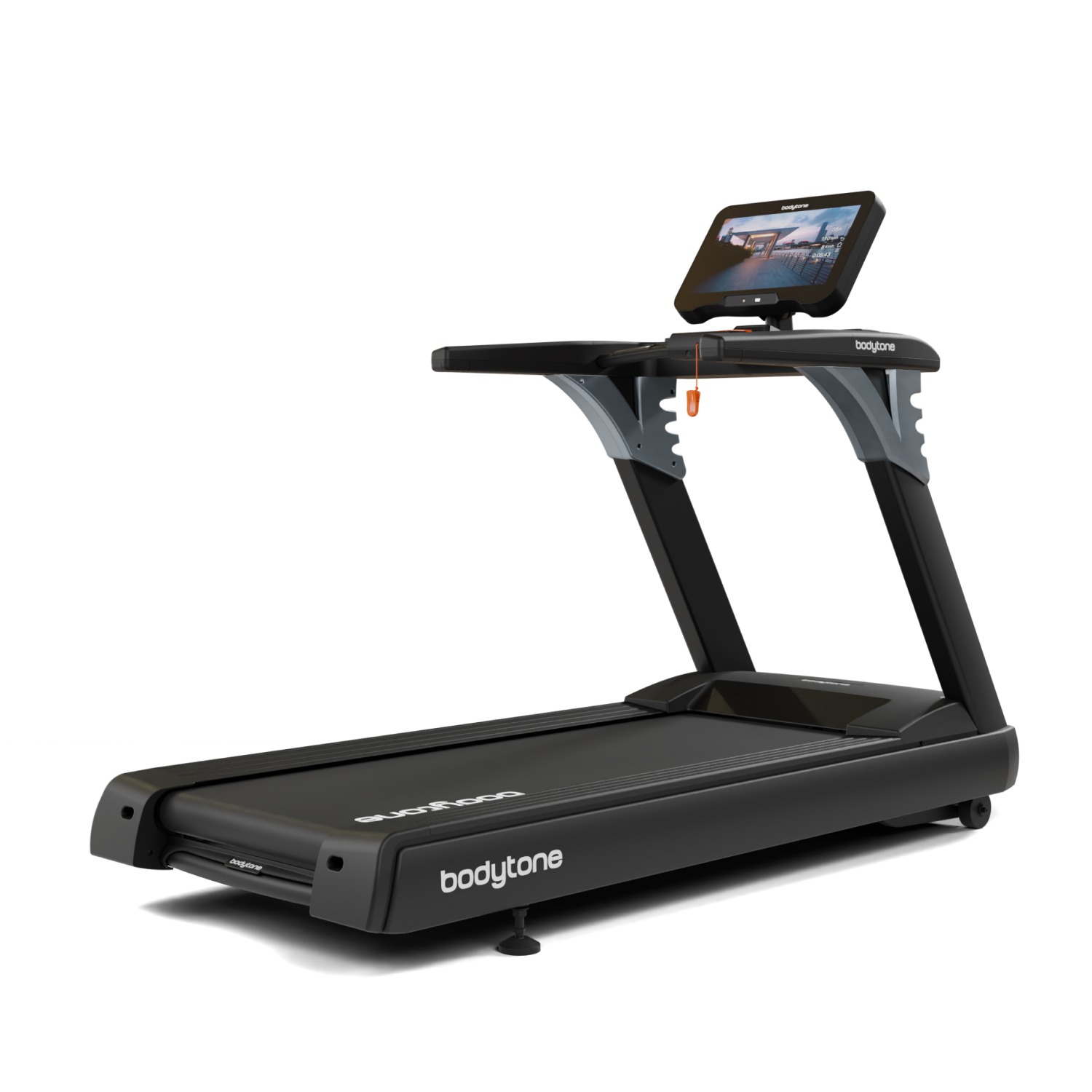
Choosing a Bodytone treadmill for intensive use
The criteria that matter
Continuous motor power. Allow a minimum of 3 HP for intensive professional use. That is what keeps speed and stability under sustained load, hour after hour.
Running surface. Minimum 50 cm wide and 150 cm long, so that tall users can run with a full stride rather than shortening it.
Shock absorption. A suspension system protects joints across long sessions. Bodytone frequently uses a Smart Cushion system.
Speed and incline. Up to 22 km/h for HIIT and interval work, with incline up to 15 percent or more on professional models.
Maximum user weight. At least 150 kg for intensive use.
Bodytone examples
| Bodytone model | Motor power | Running surface | Use |
|---|---|---|---|
| Treadmill DT21 | 4 HP | 55 x 155 cm | Professional |
| Treadmill DT18 | 3 HP | 50 x 150 cm | Professional |
The full Bodytone treadmill range covers the models available for commercial installation.
Using a Bodytone indoor cycling bike
Why the range works in a busy studio
- Heavy flywheel, up to 20 kg, for a smooth pedal stroke
- Rigid frame, so no vibration transmitted to the floor
- Belt drive, and therefore quiet
Session formats
- HIIT: 20 seconds sprint, 40 seconds recovery, 10 rounds.
- Endurance: 45 minutes at 75 to 80 percent of maximum heart rate.
Operating points worth putting on your induction sheet
- Set the saddle at hip height.
- Always engage the emergency brake at the end of the session.
- Wipe down sweat to protect the frame.
A 45 minute session can burn in the region of 600 to 800 kcal depending on intensity and on the weight of the user.
See the full Bodytone bike range for the models suited to your studio format.
Setting resistance on a Bodytone rower
Resistance types
- Magnetic resistance: quiet and smooth.
- Air plus magnetic: more progressive, and closer to the feel of real rowing.
Adjustment
The dial sits under the monitor or on the side rail.
- Levels 1 to 4: warm-up and light cardio.
- Levels 5 to 8: intensive cardio or power work.
Always start light and increase progressively. On hybrid Bodytone rowers, stroke rate is a second variable: adjusting strokes per minute changes the difficulty as much as the damper setting does.
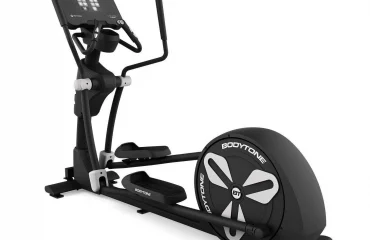
Maintaining a Bodytone cross trainer
Daily
- Wipe down after use.
- Check the pedals and moving arms.
Monthly
- Check the fixing bolts.
- Lubricate the slide rails with Bodytone silicone spray.
Annually
- Inspect the belt condition.
- Check the console and the sensors.
The applicable standard for elliptical trainers is EN ISO 20957-9, read together with the general safety requirements of EN ISO 20957-1 class S for equipment in supervised commercial use. The Bodytone EVOE2 professional cross trainer is the compact reference in the range.
Which model suits a small professional space
Boutique studios, hotel fitness rooms, PT studios and residential building gyms have the same requirement profile: limited footprint, controlled noise, and equipment that still stands up to shared use.
- Compact footprint: choose compact or folding models.
- Moderate weight: easier to reposition when the room doubles as a class space.
- Quiet running: belt drive is the recommendation.
- Digital compatibility: Bluetooth and app support.
| Equipment | Bodytone model | Suited to |
|---|---|---|
| Treadmill | Treadmill DT18 | Professional |
| Indoor cycling bike | SMB1 V3 | Compact studios |
| Cross trainer | EVOE2 | Compact |
| Rower | RAMEO2 | Compact, folding |
Connecting a Bodytone treadmill to a fitness app
Compatibility
Many Bodytone treadmills support Bluetooth and ANT+, and pair with Kinomap, Zwift and Fitshow.
Pairing steps
- Download the chosen app.
- Switch on the treadmill.
- Go to settings and enable Bluetooth.
- Start the scan in the app.
- Pair the treadmill, which appears as BT followed by the serial number.
On Kinomap the treadmill adjusts speed and incline automatically to match the selected route, which is a strong retention argument for a small facility with no class programme.
Replacing a belt on a Bodytone bike
Symptoms of a failing belt
- Cracking or knocking noises
- Slipping under pedal load
- Uneven resistance
Procedure
- Remove the protective cover.
- Identify the belt and check the Bodytone part reference.
- Order the original part.
- Remove the old belt by unscrewing the tensioner pulley.
- Fit the new belt.
- Set the tension according to the Bodytone manual.
Never fit a universal belt that is not specified for the Bodytone flywheel: it voids the warranty.
Using a Bodytone stair climber for glute work
Why it works
The stair climber loads the posterior chain hard: glutes, hamstrings and calves.
How to coach it
- Climb at a controlled pace rather than rushing the cadence.
- Lean the torso very slightly forward.
- Push through the heel, not the toes.
- Avoid leaning heavily on the handrails.
Glute-focused session
30 seconds fast, 30 seconds slow, 10 rounds, at maximum incline where the machine allows it. A 30 minute session can burn in the region of 350 to 500 kcal.
Choosing a quiet Bodytone bike for a noise-sensitive site
Gyms above occupied floors, hotel fitness rooms and residential building facilities all live or die on noise. Four points decide it:
- Belt drive, which is almost silent
- A heavy but well-balanced flywheel, which reduces vibration
- Adjustable anti-vibration feet
- A footprint matched to the room
The Bodytone SMB1 V3 is the reference on this criterion: poly-V belt, 18 kg flywheel, and a sound level at or below 55 dB.
Programming HIIT on a Bodytone machine
Why HIIT
It burns more calories in less time, improves cardiovascular and metabolic capacity, and works on every machine in the range: treadmill, indoor cycling bike, stair climber and rower.
On the console
Select Interval or HIIT mode, then set the work time (for example 30 seconds), the rest time (for example 30 seconds) and the number of cycles.
Treadmill example
- Work speed: 14 km/h
- Recovery speed: 5 km/h
- Work incline: 8 percent
- Recovery incline: 1 percent
Always warm up for 5 to 10 minutes before a HIIT block, machine or not.
Standards and assurances
- Equipment built to EN ISO 20957-1 class S, the professional class for supervised commercial use
- Manufacturers certified to ISO 9001 and ISO 14001
- REACH compliant materials, free of restricted hazardous substances
- Bodytone spare parts available for 10 years on most models
Frequently asked questions
Is Bodytone equipment suitable for beginners?
Yes. Adjustable resistance and pre-set programmes make the machines usable from the first session.
Can a Bodytone treadmill be moved easily?
Most have integrated transport wheels, which matters in rooms that change layout for classes.
Do Bodytone machines need frequent servicing?
No, but a monthly check extends service life considerably and is the cheapest maintenance you will ever do.
Are Bodytone machines noisy?
No. Most use belt drive, which is very quiet.
Can the apps be used without a subscription?
Some basic functions are free, but full interactive use of Kinomap or Zwift usually requires a subscription.
Conclusion
Specifying Bodytone cardio equipment means buying professional-grade build quality: treadmills, bikes, rowers and stair climbers all designed to take intensive use and to stay comfortable under it. Connectivity, low noise and mechanical robustness are what make them work in a commercial room, from HIIT programming to steady general fitness.
Tell us your floor area, your ceiling height, the structure below the room and the number of members, and we will specify the cardio line accordingly. Request a quote for your cardio zone.
Sources et références
- NF EN ISO 20957-1 – équipement d’entraînement fixe, partie 1 : exigences générales de sécurité et méthodes d’essai (AFNOR)
- AFNOR Normalisation – dossier thématique sur les appareils d’entraînement fixes et leurs classes d’usage