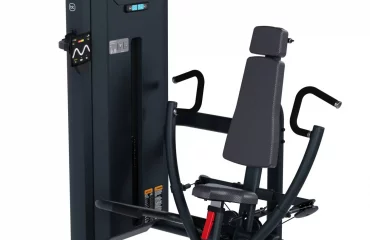
Bench Press: The Complete Guide for Professional Gyms
Le développé couché sollicite les pectoraux, les triceps et le deltoide antérieur, avec une contribution importante de la stabilité scapulaire. La sécurité du mouvement repose sur les barres de sécurité ou la présence d'un pareur, jamais sur la seule technique. La position des omoplates et le trajet de barre conditionnent l'efficacité comme le risque épaule.
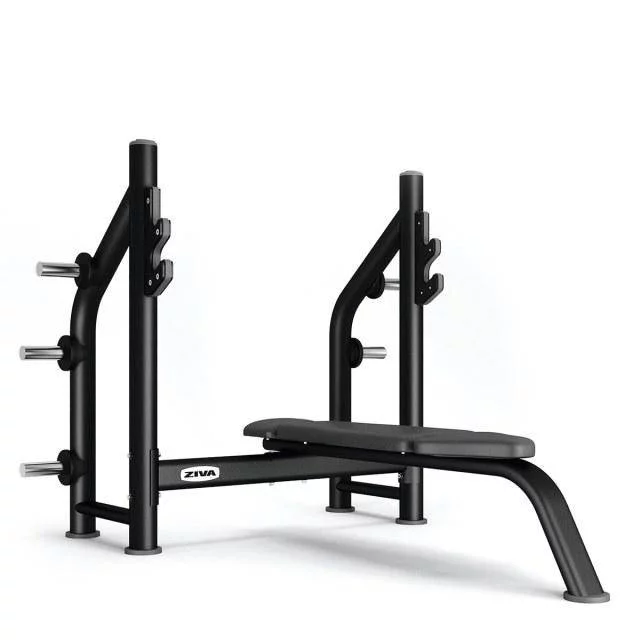
The bench press is the reference horizontal pushing movement in commercial strength training. In a fitness club, a cross-training box, a hotel gym or a rehabilitation centre, it is also one of the most demanding stations to specify: heavy loads, constant traffic and a genuine safety requirement all meet on the same few square metres. This guide covers the muscles involved, correct execution, the main variations and the equipment criteria that matter when you buy for professional use.
Why the bench press is a core station in a professional strength area
The bench press is a horizontal push: the user lies on a bench, lowers a barbell towards the chest, then drives it back up. It earns its floor space in a commercial layout because it:
- recruits several large muscle groups in a single movement;
- allows heavy loading and measurable strength progression;
- breaks down into many variations that target different areas;
- improves functional upper-body power: pushing, stabilising, resisting.
For an operator, that means a station with a very high occupancy rate throughout the day. It has to be built for continuous commercial use, which is what the class S rating of EN ISO 20957-1 covers for indoor equipment.
Anatomy: which muscles work during the bench press
Prime movers
| Muscle | Role |
|---|---|
| Pectoralis major | Drives the bar upwards, main contraction |
| Pectoralis minor | Assists the movement and stabilises the shoulder blade |
| Anterior deltoids | Contribute to the push |
| Triceps | Elbow extension, lockout at the top of the movement |
Secondary and stabilising muscles
- Biceps and forearms: control of the bar.
- Upper back (rhomboids, trapezius): scapular stabilisation.
- Rotator cuff: shoulder stability throughout the movement.
Weak stabilisers mean a higher risk of shoulder injury. A well-built programme therefore also includes rotator cuff and upper back work, which is worth remembering when you plan the accessory zone around the benches.
Equipment: what a commercial bench press station needs
Types of bench
| Type of bench | Use |
|---|---|
| Flat bench | Classic bench press, all-purpose |
| Incline bench | Targets the upper chest and the shoulders |
| Decline bench | Targets the lower chest |
In a club or a training studio, an adjustable bench (flat, incline, decline) covers the widest range of programmes on the smallest footprint. Dedicated fixed benches remain relevant when a station has to absorb a constant flow of users on the same movement. Our range of professional weight benches covers both approaches.
Selection criteria
- Load capacity sized for the user plus the bar and the plates.
- Stability of the frame and width of the backrest.
- Seat height that lets the user anchor the feet properly on the floor.
- Dense, hard-wearing upholstery with an easy-to-clean cover.
- Documented compliance with EN ISO 20957-1 class S for indoor commercial use.
Racks, safeties and accessories
- Rack or power cage with safety bars: essential wherever members train without a spotter. This is the single most important safety item on the station. See the racks and power cages range.
- Wrist wraps: joint support on heavy sets.
- Lifting belt: helps maintain trunk stability on heavy sets.
For a supervised area where the bench press is a permanent station, an integrated solution such as the Bodytone FBC08 olympic bench press combines the bench, the uprights and the safety supports in a single frame.
Bench press technique, step by step
Starting position
- Lie on the bench with the eyes under the bar.
- Feet firmly anchored on the floor, flat or on the heels depending on body proportions.
- Glutes, upper back and head in contact with the bench.
- Keep a slight natural arch in the lower back, never an excessive one.
- Retract the shoulder blades, squeezing them back and down, to stabilise the shoulders.
Grip
- Pronated grip, palms facing forward, slightly wider than shoulder width.
- Wrists aligned with the forearms, not bent backwards.
Executing the movement
- Unrack the bar, arms extended, bar above the shoulder line.
- Breathe in and lower the bar under control towards the lower chest, roughly at nipple level.
- Let the elbows travel at about 45 to 75 degrees from the body, neither pinned to the torso nor flared to 90 degrees.
- Touch the chest lightly, without bouncing.
- Press the bar back up while breathing out, to full arm extension.
- Repeat.
Common mistakes to correct
| Mistake | Consequence |
|---|---|
| Excessive arch or glutes lifting off the bench | Instability, lumbar risk |
| Elbows flared to 90 degrees | Excessive stress on the shoulder |
| Bouncing the bar off the chest | Loss of control, risk of injury |
| Wrists bent backwards | Pain, loss of force transmission |
| Feet moving or lifting off the floor | Loss of stability and power |
| Holding the breath for too long | Risk of dizziness |
These six points are the ones instructors correct most often on the floor. Posting them near the station is a simple way to reduce incidents in a self-service area.
Bench press variations
Varying angles and grips changes the emphasis between muscle groups and keeps programmes from stalling. It also spreads demand across several benches instead of creating a queue on one.
| Variation | Main target | Benefit |
|---|---|---|
| Incline bench press | Upper chest, deltoids | Upper chest and shoulder development |
| Decline bench press | Lower chest | Volume on the lower portion |
| Close grip bench press | Triceps | Lockout strength, arms |
| Wide grip bench press | Chest, shoulders | Chest stretch, range of motion |
| Paused bench press | Explosiveness, starting strength | Removes the bounce, pure strength |
| Spoto press (pause 2 to 3 cm above the chest) | Chest, triceps, control | Continuous tension work |
| Floor press | Triceps, lockout | Reduced range, less shoulder stress |
Benefits beyond the chest
- Upper-body strength: pushing, carrying and resisting, in daily life and in every sport.
- Bone density: mechanical loading stimulates bone remodelling.
- Metabolism: working large muscle groups raises energy expenditure, including after the session.
- Power: better ability to produce force quickly, useful across many sports.
- Cardiorespiratory demand: medium to long sets place a real load on the cardiorespiratory system.
Coaching and safety guidelines for operators
- Require a rack with safety bars, or a spotter, on heavy sets.
- Never let technique be sacrificed for load.
- Rotate angles and grips for balanced development.
- Programme back and rotator cuff work to avoid imbalances.
- Progress in steps: add load only once the current weight is fully controlled.
- Keep circulation space clear around the bench so a bar can always be racked safely.
FAQ
Which grip width should be used?
For most users, a grip slightly wider than shoulder width offers the best compromise between range of motion and shoulder safety.
Should the bar touch the chest on every repetition?
Ideally yes, without bouncing. A full descent ensures the chest works through its whole range.
Barbell bench press or dumbbell press?
The two are complementary. The barbell allows heavier loading; dumbbells offer more range of motion and recruit the stabilisers more.
Can members bench press alone?
Yes, provided they work in a cage fitted with safety bars, or stay on controlled loads without going to complete failure.
How many benches for one barbell station?
That depends on your traffic and your class schedule. Mapping peak-hour occupancy is the reliable way to size the area, and it is one of the points we review with you before quoting.
Equipping your bench press area
A bench press station is a package: a bench rated for commercial use, uprights and safety bars, a barbell and plates, and flooring able to take the load. Light In Fitness supplies gyms, cross-training boxes, hotels, local authorities, clubs and rehabilitation centres with professional strength equipment and helps size the area around real usage rather than a catalogue page.
Request a quote and tell us your surface area, your membership profile and your peak hours: we will come back with a configuration adapted to your project.