Behind-the-Neck Press on a Guided Bar: The Complete Gym Guide
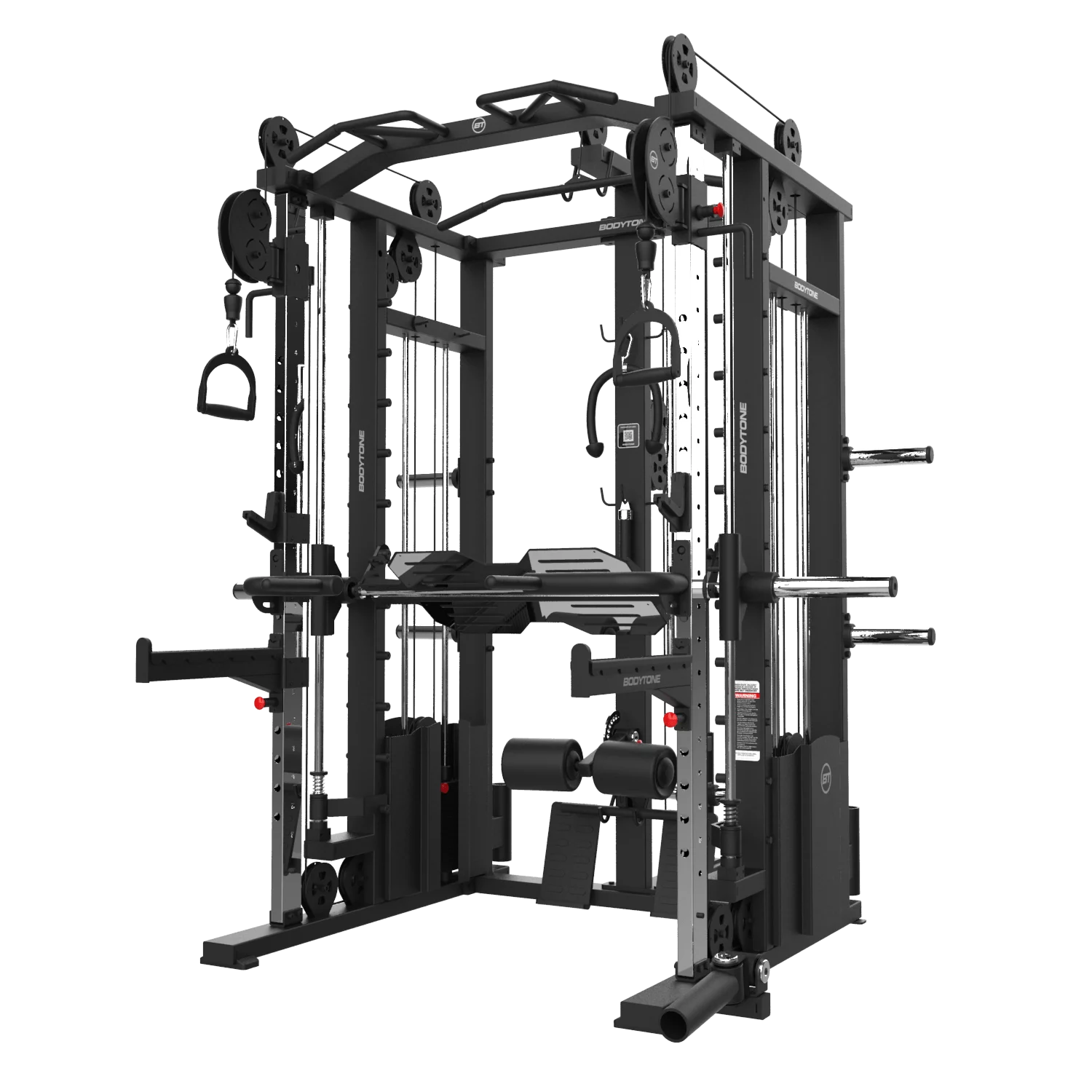
The behind-the-neck press on a guided bar is one of the most talked-about shoulder movements on a commercial gym floor. Performed on a Smith machine or multi-station, it removes most of the balance demand of a free-weight press and lets the lifter concentrate on the working muscles. Done well it builds strong, well-defined shoulders. Done badly, or by someone who lacks the shoulder mobility for it, it is one of the quickest ways to end up with a complaint at reception.
This guide sets out what the movement actually trains, how to execute it correctly, the mistakes instructors see most often, and how to programme it. It is written for gym operators, coaches and serious lifters who want the movement done properly on their floor.
What the guided behind-the-neck press is
The lifter sits under a barbell that runs on fixed vertical rails, with the bar starting at the base of the neck rather than in front of the chest. The bar is pressed overhead and returned under control. Because the rails fix the bar path, the stabilising work normally required to keep a free barbell on line is largely removed, which is exactly why the movement suits a machine-based commercial circuit.
The equipment used matters. A professional Smith machine with smooth rails, a reliable catch system and a genuinely adjustable bench is what makes the exercise repeatable and safe. On a poorly built frame the bar binds under load, which is the point at which a controlled press becomes a jerk.
What the movement actually trains
The behind-the-neck press is an overhead press variation that loads the deltoid, with the bar path placing a large share of the work on the lateral head and on the muscles that abduct and stabilise the arm overhead. That is what gives the shoulder its width when the movement is trained consistently.
It also recruits the upper and middle trapezius. These muscles stabilise the shoulder blade and are involved in almost every upper-body movement, so strengthening them supports posture and takes load off the neck and shoulders in everyday work.
Finally, the triceps at the back of the arm complete the lockout at the top of the press. Programmed alongside other pressing work, the movement contributes to stronger, more developed arms.
One honest caveat belongs in any guide on this exercise: the overhead-and-behind position requires good shoulder external rotation and thoracic mobility. Members who cannot reach that position without arching the lower back or shrugging should be moved to a front press or to a seated shoulder press machine, which delivers the same training effect on a fixed, joint-friendly path.
Correct execution, step by step
Set the seat and the bar rests to your own proportions before loading anything. Your head and neck should stay aligned with the spine throughout the movement, which is what keeps unnecessary tension off the neck and shoulders.
Take the bar with a grip slightly wider than shoulder width. Keep the elbows pointing forward and roughly under the bar throughout. Avoid flexing or extending the wrists excessively during the set, as that is a common source of wrist strain.
Lower the bar towards the back of the head under control, keeping the elbows only slightly out of full extension at the top and driving the movement with the shoulder muscles rather than momentum. Avoid jerks or sudden changes of direction, which is where the risk sits in this exercise.
Stop the descent at the point where you can still hold a neutral neck and an unarched lower back. Depth is not the goal here; a controlled, repeatable range is.
Common mistakes to avoid
The first is loading the bar too heavily from the outset. Start with a moderate weight and add load progressively as strength and technique improve. This prevents injuries and produces better long-term progress than chasing numbers in the first weeks.
The second is letting the shoulders ride up towards the ears during the set. Keep the shoulders down and relaxed to avoid excessive tension through the neck and upper trapezius.
The third is swinging the body or using momentum to move the bar. The behind-the-neck press has to be performed with a slow, controlled movement if it is to load the target muscles rather than the connective tissue around them.
Expert tips to get more from the session
Warm up properly before every session. Raising blood flow to the working muscles reduces injury risk and improves performance from the first working set.
Vary the programme by including other movements for the shoulders, trapezius and triceps. Working those muscles from several angles produces more complete development than repeating a single exercise.
Take the time to recover between sessions. Rest is what allows muscle to rebuild and strengthen, and a balanced, protein-rich diet supports that recovery.
A sample progression
The following weekly structure shows how to progress load across a week while keeping the same movement:
- Day 1: behind-the-neck press on a guided bar, 3 sets of 10 repetitions
- Day 2: rest
- Day 3: behind-the-neck press on a guided bar, 4 sets of 8 repetitions
- Day 4: rest
- Day 5: behind-the-neck press on a guided bar, 5 sets of 6 repetitions
- Days 6 and 7: rest
Treat this as the pressing element of a fuller session rather than as a complete programme, and build the rest of the workout around pulling, legs and core.
Safety and injury prevention
Always use correct technique and never rush the movement. A slow, controlled tempo is what makes the exercise effective and keeps the shoulder joint out of trouble.
Ask a qualified strength coach or personal trainer to check your execution. They can show you the correct position and correct you where needed, which is worth far more than any written guide on a first attempt.
Listen to your body and stop immediately if you feel pain or discomfort during the set. Do not push beyond your limits, and see a healthcare professional if symptoms persist.
Progression and adjustments
Master the technique with a moderate load before increasing the weight. Letting the muscles adapt gradually reduces injury risk and builds a base you can keep adding to.
Vary the programme regularly by changing the number of sets, the repetitions or the variation used. This keeps stimulating the muscle and avoids the plateau that comes from repeating the same session indefinitely.
Set realistic, measurable goals. Being able to track progress is what keeps members on a programme long enough to see results.
Recovery and nutrition
Rest between training sessions so that muscle can rebuild and strengthen. That recovery window is where adaptation actually happens.
Keep the diet balanced and rich in protein. Protein supports muscular recovery and the growth of muscle tissue after training.
Stay hydrated throughout the session. Dehydration reduces performance and increases injury risk.
Frequently asked questions
Is the behind-the-neck press suitable for beginners?
Only with supervision and a light load, and only for members who can hold the overhead position comfortably. A front press or a seated press machine is the better starting point for most beginners.
Guided bar or free barbell?
The guided bar fixes the path and removes most of the balance requirement, which makes it the safer option in an unsupervised commercial gym. A free barbell demands more stabilising work and more coaching.
What equipment does a gym need to offer this movement safely?
A commercial-grade Smith machine or a multi-station gym built to EN ISO 20957-1 class S, with an adjustable bench, functioning catches and enough clearance around the frame for a spotter to work.
Equipping your shoulder training area
The behind-the-neck press is an effective way to strengthen the upper body when the technique is right, the mistakes are avoided and the programming is sensible. It is also only as safe as the frame it is performed on. Light In Fitness supplies the guided bars, shoulder press machines and multi-stations that make this kind of training work on a commercial floor. Request a quote for your project.