Arm Training in a Commercial Gym: Equipment and Programming Guide
Le bras se compose principalement du biceps brachial, du brachial antérieur et du triceps, ce dernier représentant environ deux tiers du volume total. Un programme équilibré accorde donc au moins autant de volume au triceps qu'au biceps. La progression suit la surcharge progressive et un apport protéique suffisant.

Arm training is one of the most requested outcomes on any gym floor, and one of the easiest to programme badly. For a club operator, the question is rarely how to curl a dumbbell: it is which stations members will queue for, how much floor space to allocate to pulling and pressing, and how to brief coaches so that a popular training goal does not turn into a stream of elbow and shoulder complaints. This guide covers the anatomy, the programming logic and the equipment that a commercial facility needs to serve members who want stronger, better-defined arms.
Understanding the arm musculature
The arm is built around a small number of muscles with very different roles. The biceps brachii and the underlying brachialis flex the forearm at the elbow; the triceps brachii extends it; the brachioradialis assists flexion in a neutral grip; and the anconeus supports extension. The single most useful fact for a coaching team is one of proportion: the triceps accounts for roughly two thirds of total upper-arm volume. A programme that gives the triceps at least as much volume as the biceps will produce a visibly better result than one built around curls alone.
That distinction matters for equipment selection too. Elbow flexion is served by free weights and by low-pulley work; elbow extension is served by high-pulley work, dip stations and pressing patterns. A gym that owns plenty of benches and dumbbells but only one cable column will systematically underserve the triceps side of the equation.
Programming arm work in a club setting
Members do not need to live in the gym to see progress. Two to three arm sessions per week is a realistic starting frequency, increased over time as tolerance builds. Basic movements are enough at the start: elbow flexion variations and elbow extension variations, loaded appropriately. Variety can be added later, but it should not replace consistency.
Set and repetition structure follows the goal. Strength-biased work uses lower repetitions with heavier loads; endurance and conditioning work uses higher repetitions with lighter loads. Both belong in a well-run facility, which is why a mix of plate-loaded stations, selectorised machines and adjustable free weights serves a broader membership than any single family of equipment.
Related muscle groups should not be neglected. Shoulder and back training changes how the arms look and how they perform, and it distributes load away from the elbow. Coaches should also enforce rest intervals and periodic variation to avoid plateaus and overuse.
The equipment a commercial gym needs
Arm training is equipment-hungry in one specific way: it creates congestion. Several members can share a rack, but a single cable column becomes a bottleneck at peak hours. Planning the arm zone means planning throughput.
- Cable and pulley stations — the most versatile answer for both flexion and extension, with continuous tension and fast load changes. See the cable stations range.
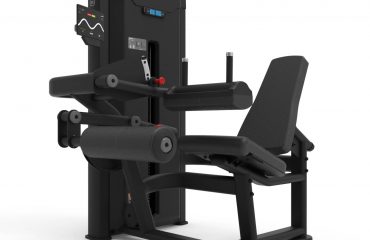
- Selectorised machines — the safest entry point for beginners and the fastest to reset between users, which matters at peak hours. Browse selectorised strength machines.
- Dumbbells and adjustable benches — irreplaceable for unilateral work and for correcting side-to-side imbalances. See professional dumbbells.
- Bodyweight stations — dip and pull-up positions give high training value per square metre and relieve pressure on machines.
All indoor equipment specified for a facility open to the public should be certified to EN ISO 20957-1 class S. Class S covers professional use in supervised commercial environments; equipment sold for private use does not carry the fatigue and safety testing that continuous commercial duty requires.
What to tell members about nutrition
Nutrition carries as much weight as training, and members will ask. Protein supports muscle repair and growth, and quality matters as much as quantity: lean sources such as poultry, fish and lentils should form the backbone of the diet. Carbohydrates supply training energy; vegetables and fruit supply the vitamins and minerals that support recovery.
On quantity, the figure most often quoted for hypertrophy is one gram of protein per pound of bodyweight, which is approximately 2.2 grams per kilogram. Nuts and seeds contribute healthy fats, and eggs supply both protein and fat. Hydration during training should not be treated as optional. Where a facility offers nutrition guidance as a paid service, it should be delivered by appropriately qualified staff rather than by floor coaches.
Injury prevention and floor layout
The common arm-training injuries are strains, muscle tears, sprains and tendinitis. Nearly all of them trace back to the same three causes: inadequate warm-up, excessive load relative to technique, and doing too much too quickly. Prevention is a coaching problem before it is an equipment problem, but layout helps: adequate spacing between stations, unobstructed sightlines for staff and correctly specified flooring all reduce incident rates.
When an injury does occur, the response is to stop the session and rest the affected muscle. Persistent pain warrants medical assessment. A club that documents its incident procedure and trains staff on it protects both its members and itself.
Coaching points that make the difference
Sleep is not a soft factor: recovery and muscle rebuilding happen during it, and members who train hard on four hours of sleep will stall. Recovery work such as stretching and heat therapy reduces soreness and muscular tension. Training partners improve adherence, which is the metric that actually drives retention. Helping members find their own motivation, whatever it is, is part of the service a well-run club provides.
Frequently asked questions
Will members get bulky by training their arms?
No. Visible size gains require sustained high training volume and a calorie surplus over long periods. This is the most common objection your coaching team will hear, particularly from women, and it is not supported by how muscle actually develops.
How much space should an arm training zone occupy?
There is no universal figure: it depends on membership size, peak-hour attendance and the equipment mix chosen. Our technical team sizes zones from your actual floor plan rather than from a rule of thumb.
Do members need machines or free weights?
Both. Machines lower the technical barrier and reduce supervision load; free weights allow unilateral correction and progression. A commercial floor that offers only one of the two limits who it can serve.
Does arm training alone produce definition?
No. Definition depends on body composition, which is driven by overall training volume, cardiovascular work and diet. Arm work builds the muscle; the rest of the programme reveals it.
Specifying your arm training zone
Strong arms are a training outcome. A gym floor that delivers them consistently is a specification decision: the right balance of cable stations, selectorised machines and free weights, sized for your peak-hour attendance and certified for professional use. Tell us your surface area, your membership profile and your budget, and our team will return a full layout proposal. Request a quote.