Running an aquabike programme: class protocols, timetable and pricing
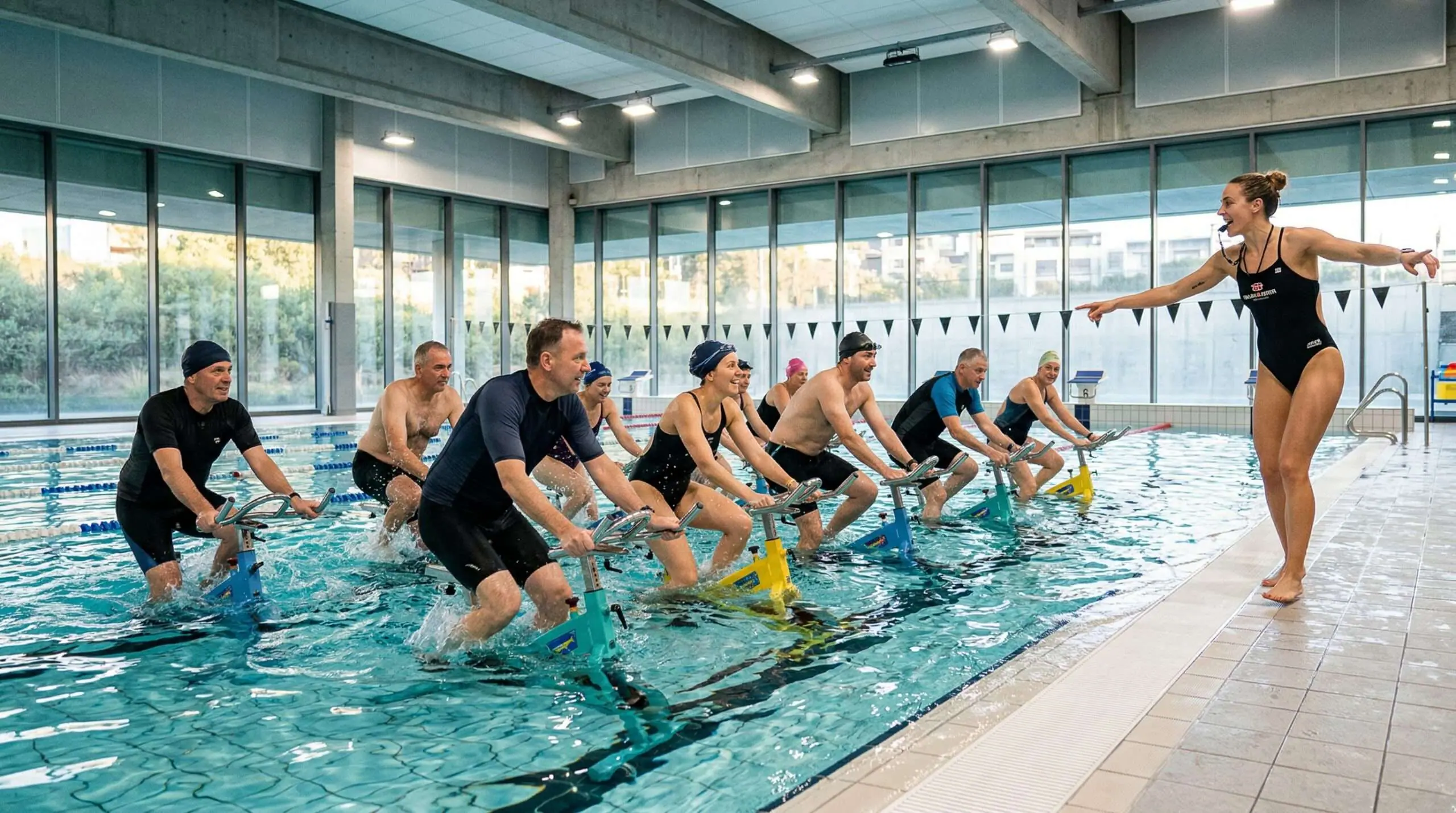
A successful aquabike programme runs on four structured class formats — endurance, aquatic HIIT, muscular conditioning and seniors/rehabilitation — scheduled across a week so that every audience finds its slot and every bike earns its keep. Equipment choice and pool-side specification are covered in our commercial aquabike equipment guide, and the investment mathematics in the aquabike programme ROI model; this article is the operating manual in between — class protocols, timetabling, instructor requirements, pricing structure and the retention mechanics that keep fill rates above the profitability line.
The four class families
| Format | Duration | Structure | Audience and slot |
|---|---|---|---|
| Fundamental endurance | 45 – 60 min | Steady cadence blocks at moderate resistance, long warm-up and cool-down, music-paced | General fitness and weight-management clientele; daytime and early-evening slots |
| Aquatic HIIT | 30 – 45 min | Short maximal intervals (20 – 45 s) against high water resistance, active recovery spins; capped intensity progression across the cycle | Younger, sportier clientele; lunchtime and 18:00 – 20:00 peak |
| Aquatic conditioning | 45 – 50 min | Cadence work combined with out-of-saddle positions, upper-body work against water, core sequences using the bike as support | Mixed levels; complements rather than duplicates HIIT slots |
| Seniors / rehabilitation | 45 min | Low-impact continuous work, joint-friendly cadences, emphasis on circulation and mobility; instructor in-water or pool-side coaching throughout | Seniors, post-injury, medically referred users; late-morning and early-afternoon slots that would otherwise sit empty |
The seniors format deserves emphasis: it monetises off-peak water time, addresses a clientele with high loyalty and low churn, and positions the facility with local health professionals — the cheapest acquisition channel an aquatic centre has.
A weekly timetable that fills bikes
- 15 – 25 classes per week is the working range for a dedicated 10 – 12 bike zone; below 12 classes the asset is idle, above 25 instructor cost and pool scheduling strain.
- Anchor the peaks: HIIT and endurance at 12:15 and 18:00 – 20:00 on weekdays, endurance and conditioning on Saturday morning.
- Fill the troughs deliberately: seniors and rehabilitation formats at 10:30 and 14:00; one mixed “discovery” class per week feeding new entrants into the programme.
- Protect setup time: 15 minutes between classes for bike checks, height adjustments and user changeover — timetables without buffers degrade both safety and punctuality.
Instructors: qualifications and coverage
Aquatic group exercise sits at the intersection of two competence sets: group fitness instruction and aquatic safety. In most European countries that means a nationally recognised aquatic fitness or swimming-instruction qualification for the class leader, plus compliance with local pool supervision and lifeguard rules — verify the applicable national requirements before publishing a timetable. Beyond the legal minimum, the operational bar is simple: the instructor makes or breaks fill rates. Invest in coaches who programme varied cycles, learn names and progress regulars; their classes waitlist while identical slots with weaker coaches run half-empty.
Cover and continuity planning belongs in the same conversation: holidays, illness and turnover will test the timetable within the first year. A shared class-plan library per format, a second qualified instructor per site and a cancellation protocol that offers the next equivalent slot (rather than a refund by default) keep single absences from becoming attendance dents.
Pricing structure: memberships beat single tickets
| Offer | Indicative price | Role in the mix |
|---|---|---|
| Single class | 12 – 18 EUR | Entry point and price anchor; deliberately the worst per-class value |
| 10-class pass | 100 – 150 EUR | The volume seller; expiry dates keep attendance regular |
| Monthly unlimited / subscription | 45 – 80 EUR / month | Revenue stability and the highest-retention segment; cap sales to protect peak-slot availability |
| Off-peak / senior rate | −20 to −30% | Fills trough slots without discounting the peaks |
Prices are illustrative market ranges — calibrate against local competition and your cost base using the ROI model linked above. The structural rule holds everywhere: recurring formats (passes and subscriptions) should carry at least 70 percent of attendances, because regularity is what sustains both revenue and results.
Waitlist data is the most under-used asset in aquatic programming: it tells you, slot by slot, exactly where to add capacity before you spend anything on marketing. Review it monthly alongside fill rates.
Retention mechanics
- Track fill rate per slot, not per week. A 70 percent average can hide dead slots subsidised by waitlisted peaks; fix or move the dead slots monthly.
- Progress visibly. Cycle programming in 6 – 8 week blocks with a stated theme; participants who feel progression rebook, participants who feel repetition lapse.
- Onboard deliberately. First-timers get bike setup help and a follow-up message with the recommended next class — the second visit, not the first, predicts retention.
- Maintain the fleet invisibly. Rinse-down after classes, weekly corrosion checks, monthly resistance and fastener inspection; one seized bike in a ten-bike class is a 10 percent capacity cut and a visible quality failure.
Quality control: keeping classes consistent between coaches
Programmes outgrow their founding instructor quickly, and the operational risk is drift: the Tuesday HIIT that bears no resemblance to the Thursday one, participants shopping between coaches rather than formats. The fix is a light programming template per format — warm-up length, work-to-recovery structure, intensity ceiling, cool-down — inside which each instructor keeps their personality. Add a monthly fifteen-minute review of fill rates and participant feedback per slot, and a twice-yearly session where instructors ride each other’s classes. None of this is bureaucracy; it is what lets you advertise a format rather than a person, which is the difference between a programme that survives an instructor’s departure and one that leaves with them.
Frequently asked questions
How many bikes should an aquatic centre start with?
Ten to twelve supports a viable timetable with meaningful class revenue; smaller pilot fleets of six to eight suit hotel spas and small pools, as discussed in the equipment guide linked above.
What fill rate does the programme need to be profitable?
Most cost structures break even between 50 and 65 percent average fill; run your own figures through the ROI model. The retention levers above are what hold mature programmes at 70 – 85 percent.
Can one instructor run all four formats?
Technically yes with appropriate qualifications, but programme quality and holiday cover argue for at least two trained instructors per site, with a shared programming template so classes stay consistent between coaches.
Do we need to close lanes to run aquabike?
Not necessarily: many centres run classes in a sectioned shallow area or a dedicated small pool. What matters is a stable depth of roughly 1.20 – 1.50 m, non-slip access and storage close to the pool edge.
How do we relaunch a programme whose attendance has faded?
Diagnose before discounting: pull six months of fill data per slot and per instructor. Faded programmes almost always show the same pattern — a timetable never adjusted since launch and formats that stopped progressing. Relaunch with a rebuilt schedule around the proven slots, one new format as a headline, a six-week themed cycle with a stated goal, and personal win-back messages to lapsed pass holders. Price cuts come last: they recover volume for a month, while programming quality recovers it for years.
Launch or upgrade your aquabike programme
Light In Fitness supplies chlorine-resistant professional aquabikes and complete aquatic fitness fit-outs, with layout and storage planning included. Request a quotation and we will size the fleet and timetable for your pool.
Sources et références
- Code du sport, articles R322-4 à R322-43 – garanties d’hygiène et de sécurité applicables aux établissements d’activités physiques et sportives (Légifrance)