The Complete Guide to Abdominal Machines: Choice, Use and Results
Another fitness guide claiming to be the last one you will ever need. Except this one skips the jargon and the miracle claims and sticks to what the equipment actually does, how to pick it, how to use it and how to keep it working. Whether you are a member wanting a stronger midsection or an operator deciding what belongs in the core corner, everything is below.
Worth saying up front, because a lot of the internet gets this wrong: a strong trunk is not a cosmetic accessory. It is what holds posture together, what transfers force between the lower and upper body, and what protects the lower back when a load gets heavy. Visible abdominal definition, on the other hand, is a matter of overall body composition, not of how many crunches were performed. No machine reduces fat in the place it is used, and any claim of local fat reduction should be treated as marketing.
Understanding abdominal machines
The category covers several very different things: abdominal benches, guided crunch machines with a selectorised or plate-loaded stack, back extension and combined crunch stations, ab wheels and roman chairs. They earn their place for three concrete reasons. They make the movement easier to execute correctly, they help the user feel the muscle working rather than pulling on the neck, and they support the spine through the range instead of leaving it to improvise. On a commercial floor they are also solid and durable, which is more than can be said for most abdominal gadgets.
What they are not is compulsory. Abdominal work existed long before machines did, and floor work, hanging leg raises and loaded carries all build a strong trunk. The machine is there to make the work measurable, progressive and safe for someone with no coach beside them. That is the argument, and it is a good enough one.
Choosing the right machine
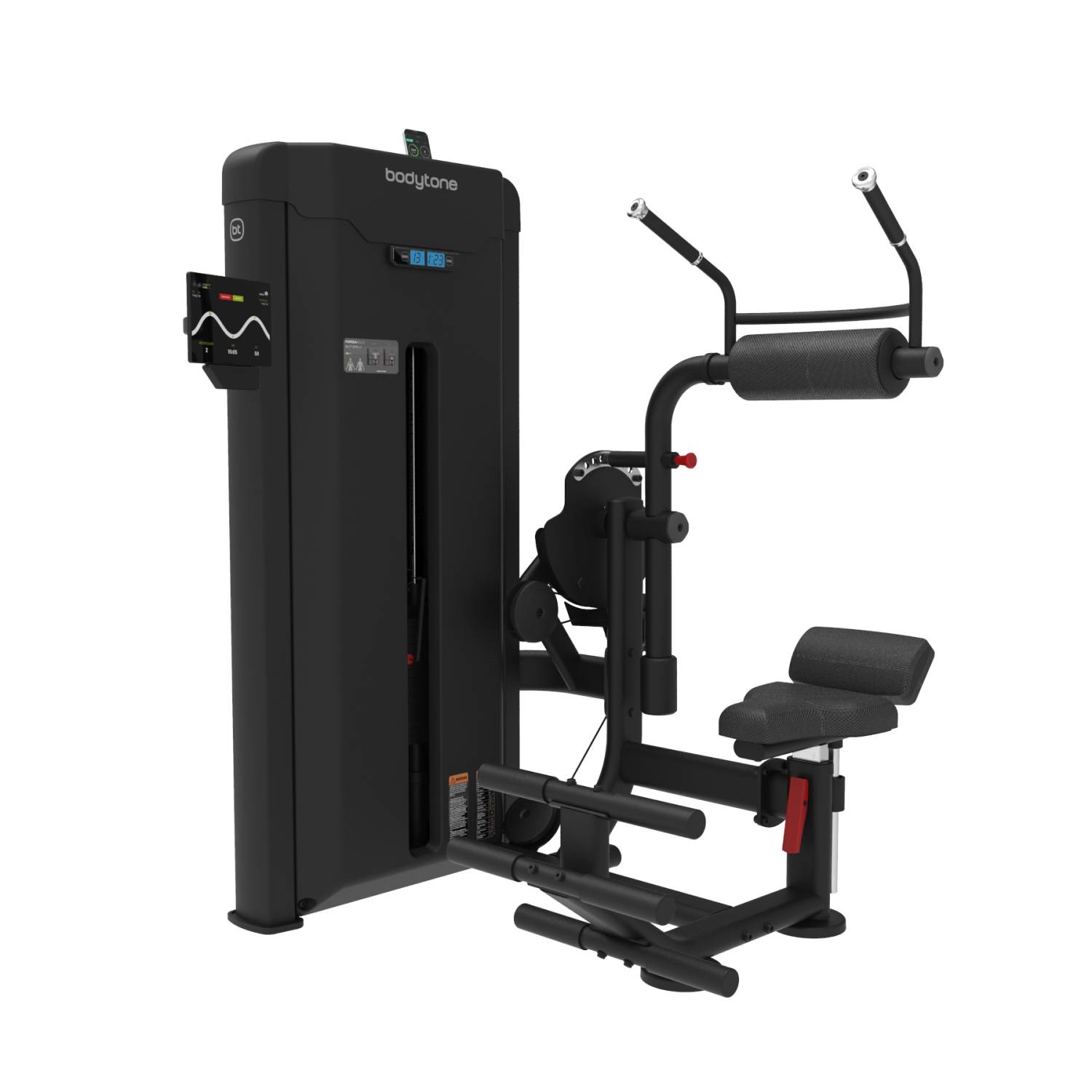
Start with what you want it to do. Straight-line crunch loading, oblique and rotational work, and back extension are three different jobs, and a single station rarely does all three well. A combined crunch and back extension machine is the efficient answer where floor space is tight, because it trains the trunk on both sides of the body from one footprint. The Bodytone FH40 abdominal crunch and back extension machine is a good example of that arrangement.
Then judge the build. A good abdominal machine has to be as solid as the muscles you want to develop: a welded steel frame, upholstery that survives sweat, adjustment that does not slip under load and a load increment small enough that a beginner can progress. Cheap plastic has no place here. Look at the whole range of professional strength training machines and compare the frames, not the photographs.
Finally, consider the low-cost complements. An ab wheel costs a fraction of a machine, takes no floor space and is one of the most demanding trunk exercises there is. It belongs in the accessory rack of almost every facility, alongside the machines rather than instead of them.
Using an abdominal machine properly
Warm up first. Explosive or heavily loaded trunk work on cold tissue is how a session ends early. A few minutes of light cardio and some mobility for the hips and spine is enough.
Then set the machine up before the first repetition: seat height, pad position, range stop and load. Take the time to learn how the station adjusts rather than working around a setting that does not fit you.
Avoid the common errors. Fast, uncontrolled swinging produces more soreness than progress. Pulling on the head or neck handles shifts the work away from the muscle you are trying to train. Rushing the load up is not wisdom. Keep the technique clean and the breathing regular, exhaling as the trunk flexes.
And be patient. Trunk strength builds over weeks and months, not over one enthusiastic session.
Results, and how to measure them
What should you expect from consistent work? Improved trunk strength and endurance, better posture, and better transfer of force in every other lift on the floor. Whether the abdominals become visible depends on overall body composition, which is decided by total energy balance and not by the number of crunches.
Measure what is measurable. Count the repetitions completed at a given load with clean technique and watch that number rise. Record the load itself, week by week. Time a plank or a hollow hold. A photograph comparison over months is fine as a motivational tool, but the numbers are what tell you whether the programme is working.
Keeping the equipment in good condition
Regular maintenance is unglamorous and cheap, and skipping it is neither. A damp sponge and a soft cloth to remove sweat and dust after use is the bulk of it. Sweat is the main enemy of upholstery and of the chrome on guide rods, and it works fast.
Respect the machine’s limits. Do not overload beyond the rated capacity and use the station as designed. If something stops working, check the manual first, then contact after-sales support. And while you wait, floor work still exists.
For an operator, put abdominal machines on the same inspection schedule as the rest of the circuit: cables and pins, upholstery seams, adjustment pins, and the bolts that hold the frame square.
Frequently asked questions
How often should the trunk be trained?
Two to three sessions a week is enough for most people, alongside the compound lifts that already load the trunk heavily.
Do abdominal machines flatten the stomach?
They strengthen the muscles underneath. What is visible on top of them is decided by body composition. Anyone selling local fat reduction is selling something else.
Machine or floor work?
Both. Machines allow measurable progressive loading, floor and hanging work develop control and stability. A well built core corner has room for both.
Specifying your core area
A core corner is one of the cheapest ways to add training capacity to a room, and one of the easiest to get wrong by buying the wrong station. Tell us the space you have, the membership profile and whether you also need back extension, and we will specify the machines and the accessories together. Request a quote for a costed proposal.