How to Maximise Training: A Guide to the 3 Types of Muscle Contraction

Every athlete, from the first-time member to the experienced competitor, knows that behind every movement, every effort and every improvement there is a complex world of science, commitment and, above all, knowledge of the body. Muscles are the architects of physical performance, the guardians of strength and of health. To get the most out of each session, though, it is not enough to know how muscles work: you also have to understand how they react and adapt to the different stimuli you give them.
At the centre of that dynamic are the three types of muscle contraction: concentric, eccentric and isometric. Each of them plays a distinct role in training, influencing not only performance but also the way muscles grow, repair themselves and get stronger. This article looks at the anatomy and the physiology behind each contraction, and then at how to turn that knowledge into better programming – and, for anyone responsible for a facility, into better equipment decisions.
Muscle anatomy and function
Muscles are the engine of the body and the driving force behind every movement, from a sprint to the simple act of standing up from a chair. What makes them so effective at turning chemical energy into force and motion?
Muscle structure
Muscles are made of muscle fibres, which are themselves made of actin and myosin filaments, the true contractile units. These filaments slide over one another during contraction, a process fuelled by ATP (adenosine triphosphate), the main energy source of the cell.
But the strength of a muscle does not come only from the sum of its parts. The real work happens through innervation: each muscle fibre is controlled by a motor neuron that carries the contraction signal along the nerve impulse. It is the precision of that communication between nerve and muscle that determines the force, the speed and the efficiency of a movement.
What muscles actually do
Muscles serve three main functions in the body:
- Movement – the most obvious function, allowing us to move, react and interact with the world around us.
- Stability – less visible but just as important, muscle contraction stabilises the joints, protects them from injury and allows posture to be maintained.
- Thermoregulation – muscles produce heat as a by-product of contraction, which helps keep body temperature constant.
Each type of contraction – concentric, eccentric and isometric – contributes to these functions in its own way, influencing not only training but general health and wellbeing.
Why anatomy matters when you programme training
Understanding muscle anatomy and function is essential to any training programme. Sound knowledge makes it possible to select specific exercises for specific muscle groups, to avoid injuries and to optimise recovery. It also helps in interpreting what users feel during a session, and in distinguishing normal training discomfort from the kind of pain that signals a problem.
The three types of muscle contraction
Muscles can contract and generate force in different ways, depending on the movement or the resistance they meet. Understanding these mechanisms is decisive both for the effectiveness of a programme and for injury prevention.
Concentric contraction
A concentric contraction happens when the muscle shortens while producing force, overcoming the resistance opposing it. This is what most people picture when they think about exercise: lifting the weight upwards in a biceps curl is the classic example.
- Mechanism – during a concentric contraction the actin and myosin filaments in the muscle fibres attach and pull towards each other, shortening the muscle.
- Training applications – concentric contractions are central to developing strength and muscle mass. Exercises that emphasise this type of contraction generally require weights or another form of external resistance.
Eccentric contraction
An eccentric contraction happens when the muscle lengthens under tension while trying to control or slow down an external force. Lowering the weight in a biceps curl is a good example: the biceps lengthens while keeping the load under control.
- Mechanism – the actin and myosin filaments are involved again, but the muscle lengthens instead of shortening. This type of contraction can generate more force than a concentric one and is often associated with a greater stimulus for muscle growth and increased strength.
- Training applications – including exercises that emphasise the eccentric phase can improve muscular endurance, flexibility and the speed of recovery. It is also effective in injury prevention, because it improves the ability of the muscle to absorb impact and tension.
Isometric contraction
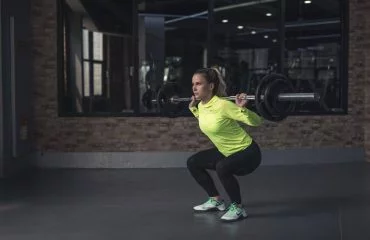
An isometric contraction happens when the muscle generates force without any visible change in length. Holding a fixed position, as in a plank or during a pause in a squat, is a typical example.
- Mechanism – here, despite the activity of the actin and myosin filaments, the muscle neither shortens nor lengthens: it keeps the same length despite the tension.
- Training applications – isometric contractions are particularly useful for improving stability and strength at specific joint angles. They are also widely used in rehabilitation and to increase muscular endurance.
Turning contraction types into better training
Understanding and applying the different types of contraction is a powerful tool for optimising every aspect of training, from strength to endurance to injury prevention. Here is how that works in practice.
Variety and balance
The key to effective training is variety. Alternating exercises that stimulate the muscles through concentric, eccentric and isometric contractions produces complete training, which not only improves overall performance but also builds greater resistance to injury. That diversity of stimulus encourages a more balanced adaptation and prevents imbalances between muscle groups.
Muscle growth and recovery
The eccentric contraction in particular is known for its role in promoting muscle growth and recovery. Because it can generate more force, it produces micro-tears in the muscle tissue which, once repaired, lead to hypertrophy. Building in exercises that emphasise the eccentric phase can accelerate growth and also improve the ability of the muscle to recover and to adapt to heavier workloads.
Strength and stability
Isometric contractions play a decisive role in building strength at specific joint angles and in stabilising the joints. Exercises that include isometric work are useful for athletes at every level: they contribute to greater overall strength and to better injury prevention, particularly at the joints under the most stress.
Individualising the programme
Understanding the specific benefits of each type of contraction makes it possible to tailor training to individual goals. Whether the objective is to increase muscle mass, to improve endurance or to recover from an injury, the targeted inclusion of exercises based on specific contraction types can make the difference in reaching the intended result.
What this means for the equipment in your facility
For a gym operator, a coach or a club committee, the three contraction types are not only a physiological curiosity: they are a checklist for the equipment mix. A floor that only allows concentric work will always be an incomplete offer.
- Controlled eccentric work needs equipment where the load can be lowered slowly and safely, which is where guided and converging machines earn their place. Our strength training machines cover that requirement across the main muscle groups.
- Heavy eccentric and tempo work is generally programmed on plate-loaded machines, where the feel of the load is closer to free weights and the loading can be adjusted plate by plate.
- Isometric holds and stability work mostly need floor space and a small stock of well-chosen functional training accessories rather than more machines, which is often the least expensive way to widen what a facility can offer.
All indoor equipment installed in a facility open to third parties must meet EN ISO 20957-1 class S, the professional class. That is the baseline for any club, hotel, corporate or municipal gym, whatever the training method being programmed on it.
Frequently asked questions
Which contraction type builds the most muscle?
The eccentric phase is the one most associated with a strong growth stimulus, because the muscle can produce more force while lengthening. That does not make the other two optional: a programme built only on eccentric work is hard to recover from and neglects the stability that isometric work develops.
Are isometric exercises useful for beginners?
Yes. They require no load management and no complex movement pattern, which makes them a safe entry point for deconditioned users, and they are widely used in rehabilitation for exactly that reason.
Do you need special machines for eccentric training?
No. Any machine or free weight allows eccentric work, since the lowering phase is eccentric by nature. What matters is that the equipment lets the user control that phase safely, which means smooth guidance, a comfortable starting position and load increments fine enough to keep the tempo under control.
How should the three types be combined in a session?
There is no single formula, because it depends on the level of the user, the objective and the recovery available. The usual approach is to keep concentric work as the backbone of the session, to add controlled eccentric tempo on selected exercises, and to place isometric holds where stability is the limiting factor.
Conclusion
Deliberately integrating concentric, eccentric and isometric contractions into training is not only a strategy for maximising physical results; it is also an invitation to experiment and to listen to the body, adapting exercises to answer its particular needs. Training then becomes a continuous dialogue with the organism rather than the mechanical execution of movements.
The aim of this article was to bring out the potential hidden behind each contraction and to give you the tools to explore new dimensions of your training. Whether you are an experienced athlete or a newcomer to fitness, optimal performance rests on knowing these principles and applying them intelligently.
If you are equipping or re-equipping a facility and want a floor that supports all three types of work, send us your plan and your user profile: we will put together an equipment list and a layout for your project. Request a quote.
Réalisations documentées
- Cage street workout ultime, Carcassonne – armée française
- Cage street workout ultime, Tahiti – armée française, Polynésie
- Cage SP Max, centre EPIDE de Combrée – établissement public d’insertion
- Cage SP Max, lycée Saint-Bénigne de Dijon – établissement scolaire
À lire aussi sur le même thème
- Les avantages de la marche nordique au printemps dans le Puy-de-Dôme : Pourquoi s’y mettre maintenant ?
- Terrain de sport extérieur : définir les activités et les zones
- Maîtriser les Contractions Concentriques et Excentriques: Le Secret pour Optimiser vos Performances Sportives
- Comprendre les Types de Fibres Musculaires : Le Secret pour Optimiser vos Performances Sportives