Which Muscles Does the Arm Curl Machine Work?
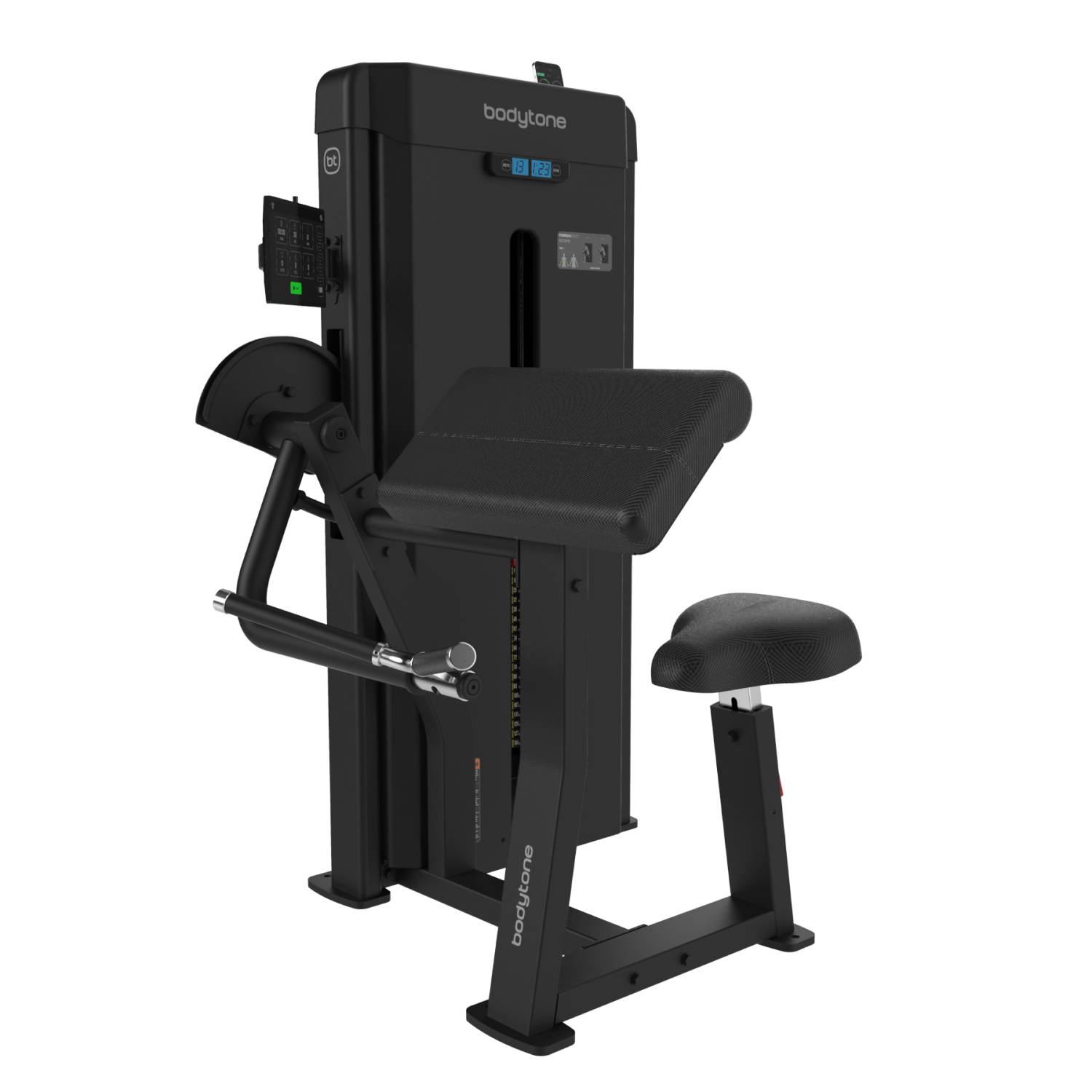
The arm curl machine, also called a biceps curl machine or preacher curl machine, is one of the most used stations on any strength floor. It looks simple, and that is exactly why it is worth understanding what it actually trains: the answer determines where it belongs in a circuit and what a facility should buy.
The short answer
The arm curl machine trains the elbow flexors. Three muscles do that work, in this order of contribution:
- Biceps brachii, on the front of the upper arm. It has two heads, a long head and a short head, and besides flexing the elbow it supinates the forearm, meaning it turns the palm upwards.
- Brachialis, a separate muscle lying underneath the biceps. It is a pure elbow flexor and it is often the strongest contributor, particularly when the grip is neutral or pronated.
- Brachioradialis, running along the thumb side of the forearm, which takes over a larger share when the palms face inwards.
The forearm flexors and extensors work statically to hold the grip and keep the wrist neutral, and the anterior deltoid stabilises the shoulder. Neither is being trained in any meaningful sense; they are simply doing their job.
Why the machine isolates so well
On a preacher pad the upper arm rests on an inclined surface, the shoulder is fixed and the trunk cannot swing. That removes the compensation patterns that free-weight curls invite, which has two consequences on a commercial floor. First, a beginner can load the movement correctly on their first session without supervision. Second, the loading is repeatable, so progression can be measured rather than guessed.
The trade-off is that isolation is exactly that: the arm curl machine does not train the chest, the back or the posterior chain, and no amount of volume on it will substitute for a pulling exercise. It belongs in a programme, not at the centre of one.
Guided load or plate-loaded?
Both formats exist and they answer different needs.
Selectorised arm curl stations use a weight stack and a pin. They are the fastest to adjust, the safest for an untrained member and the easiest to supervise, which is why they dominate club circuits. The full family is grouped under selectorised strength machines.
Plate-loaded arm curl machines are loaded with Olympic discs on the movement arm. They give a different resistance feel, tolerate very heavy use and are mechanically simpler to maintain, which suits strength-oriented and cross-training facilities. See the plate-loaded range.
A typical example of the second family is the SRX30 biceps curl machine, with an inclined pad and independent arms.
Technique points that change what is trained
Three details shift the emphasis noticeably. A supinated grip, palms up, favours the biceps brachii. A neutral or pronated grip shifts work towards the brachialis and brachioradialis. Stopping short of full extension keeps constant tension on the muscle but reduces the range in which the elbow flexors are strongest, so most programmes use the full available range with a controlled tempo. Finally, the seat and pad height must place the elbow at the pivot axis of the machine: if it does not, the resistance curve no longer matches the joint, and the member feels it in the elbow rather than in the arm.
What this means when equipping a facility
An arm curl station is a comfort purchase rather than a foundation purchase. It earns its floor space in clubs with a bodybuilding-oriented membership, in hotel and corporate rooms where members expect a complete upper-body circuit, and in rehabilitation settings where a fixed, guided elbow flexion is genuinely useful. In a small facility, a cable station covers the same movement with more variety for the same footprint.
Whichever format you choose, indoor equipment for shared professional use should be built to EN ISO 20957-1 class S: it is the class written for supervised commercial use, and it covers the load cycles and stability requirements that a shared floor imposes.
Frequently asked questions
Is the arm curl machine better than dumbbell curls?
It is more controlled and easier to supervise; dumbbells recruit more stabilisers and allow more grip variation. Most complete floors offer both, because they answer different member profiles.
Does the arm curl machine train the triceps?
No. The triceps extend the elbow, which is the opposite movement. A balanced arm programme needs a separate pushing exercise.
Why do members feel it in the forearm?
Usually grip, not anatomy: too heavy a load makes the forearm flexors work at their limit before the elbow flexors are fatigued. Reducing the load or using a thicker bar generally resolves it.
How much space does an arm curl station need?
Less than most strength stations, since the user is seated and the movement is contained, but circulation space behind the seat still has to be planned. Exact footprints are given on each product sheet.
Specifying the right station
If you are building or renewing a strength floor and want to know whether an arm curl station is worth its square metres in your case, send us your floor area, your member profile and your budget frame: request a quote.
À lire aussi sur le même thème
- Réinventez Votre Entraînement avec RVL13: Parcs de Fitness et d’Entraînement de Pointe
- Explorez Lexco: La Révolution du Fitness et de la Technologie en Corée
- Lexco LPS-103 Chest Press: What It Adds to a Commercial Gym
- Combat Sports and Martial Arts: Disciplines, Differences and What Each One Needs From Your Facility