How to Choose Strength Machines That Fit Every Body Size
The phrase you hear on a gym floor is that a machine has to suit your body type. For an operator the useful version of that sentence is more precise: a machine has to fit the range of body dimensions that walk through your door. Height, limb length, hip width, body mass and reach are what determine whether a user can adopt a correct position, and they vary enormously within any membership. A strength line specified around an average user quietly excludes everybody at the ends of the distribution, and those are exactly the members most likely to give up.
Fit is dimensional, not typological
Popular training writing still sorts people into body types and prescribes equipment accordingly. That is not how machine fit works and it is not a useful basis for a purchasing decision. What actually determines whether a user can train correctly on a given station is measurable: standing height, femur and tibia length, arm length, torso length, shoulder width, body mass. Two members of identical build can need very different seat positions, and the same person needs a different setting on a chest press than on a leg extension.
So the question to ask a supplier is never which body type a machine suits. It is: what is the adjustment range, and which user stature does it accommodate from smallest to largest?
The adjustment specification
Read the datasheet for these numbers, and ask for them when they are missing.
Seat height and travel. The range in centimetres and the number of positions. On a pressing station, seat height sets the shoulder angle; on a pulling station, it sets whether the user can reach the handles at full stretch.
Back pad and thigh pad travel. Fore-and-aft travel determines whether a shorter or a longer torso can sit correctly against the pad.
Range-of-motion adjustment. A start-position adjuster lets a user with limited shoulder or hip mobility begin the movement in a safe range instead of an extreme one. On a mixed-population floor this feature is worth more than any amount of extra stack weight.
Axis alignment. On any single-joint station, the machine pivot has to line up with the user joint. Look for a marked pivot point and enough seat travel to achieve alignment for both a 1.55 m and a 1.95 m user.
Handle and lever options. Multiple grip positions and adjustable levers extend the useful range of the same machine across arm lengths and shoulder widths.
Maximum user weight and class. Indoor professional equipment should be declared to EN ISO 20957-1 class S, with the maximum user mass stated for that class of service.
Building a line that serves everyone
Adjustment covers most of the population, but not all of it. Three practical additions widen the door.
Wide, low-entry seats. Entry and exit is the first barrier for heavier and older members, and it is a design feature, not an afterthought.
Small load increments. A stack that jumps in large steps is unusable for a deconditioned beginner. Add-on plates of a few kilograms solve this cheaply.
Free-weight and bodyweight alternatives. Benches, racks and cable stations adapt to the user rather than the reverse, and they cover the cases no fixed machine geometry reaches. Our weight benches and selectorised machines ranges are usually specified together for exactly this reason.
Matching stations to training goals
Once fit is settled, the station mix follows the training your members actually do.
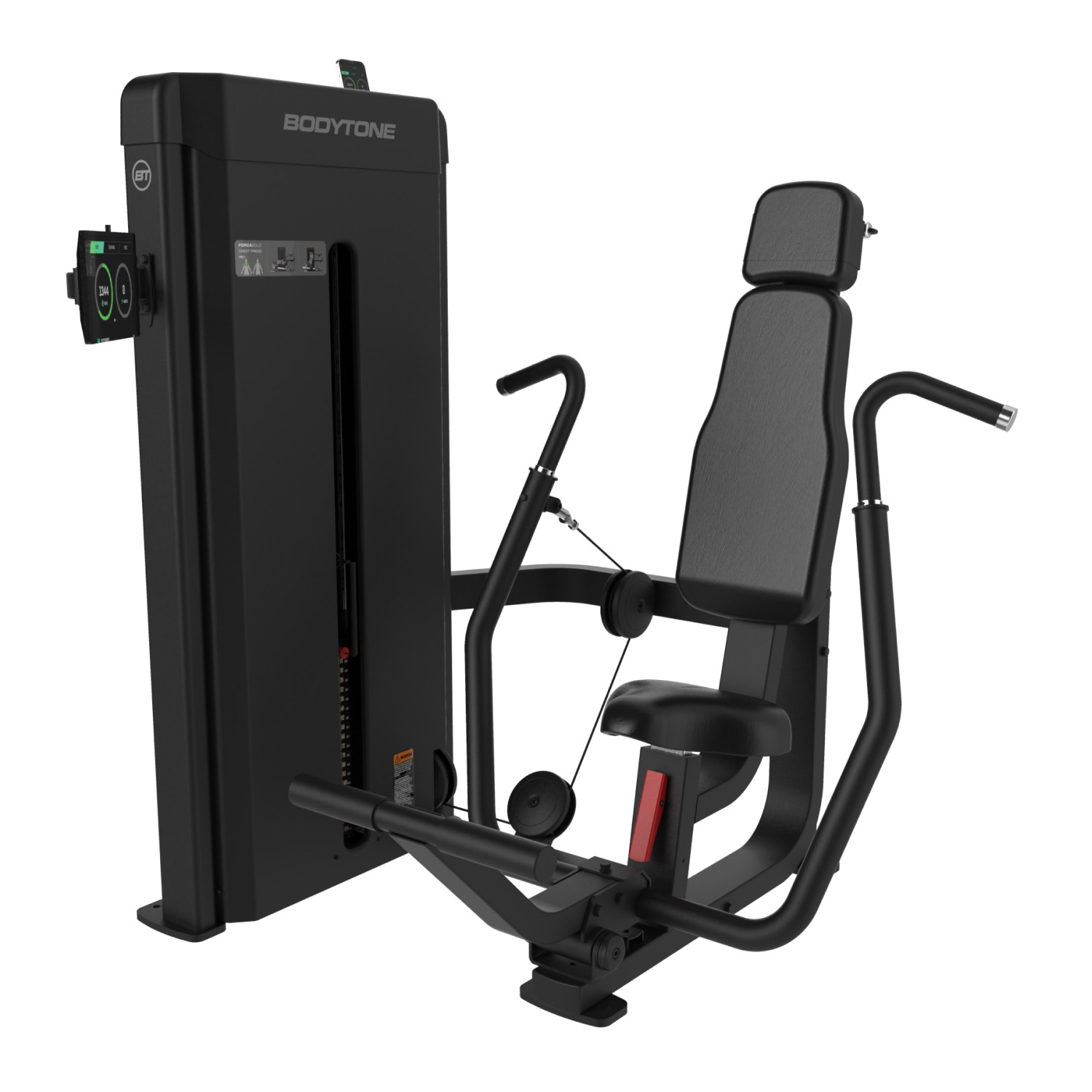
Upper body. Chest press and incline stations, shoulder press, lat pulldown and row cover the main pressing and pulling patterns for chest, shoulders, back and arms.
Lower body. Leg press, leg extension, leg curl and hip stations build the quadriceps, hamstrings and glutes, and they pair with squat and lunge patterns in the free-weight zone.
Trunk. Abdominal and back extension stations, plus mat space for bracing work with bands. Worth stating plainly to members: no abdominal station reduces fat over the abdomen, and training the trunk is done for strength and stability, not for spot reduction.
Instruction, warm-up and supervision
Equipment fit is only half the story. Clear station instructions, an accessible warm-up area and, where the format allows it, an induction with a coach are what turn a well-specified line into one that is used correctly. For a facility this is a straightforward operational choice: a member who has been shown how to set a machine for their own dimensions uses it more, uses it better and stays longer.
Frequently asked questions
What is the single most important fit specification?
Adjustment range, expressed as the smallest and largest user stature the machine accommodates. Everything else follows from it.
How do I know whether a machine suits my members?
Ask the supplier for the accommodation range and compare it against your membership profile. If your population skews older, heavier or shorter than average, say so before the order, not after.
Are machines or free weights better for a mixed membership?
Both, in the right proportion. Machines give a guided path and a low barrier to entry; free weights adapt to any body dimension. Most well-used floors carry both.
Does a bigger stack matter?
Less than the increment does. Very few members ever reach the top of a commercial stack, but a great many are stopped by a first plate that is too heavy.
Specifying a line that fits your members
Light In Fitness supplies professional strength training machines to clubs, hotels, public facilities and rehabilitation centres. Tell us your membership profile and your floor area, and we will propose a line sized for the people who actually use it. Request a quote to start from your own numbers.