Smith Machine Training: Uses, Safety and Exercises
La Smith machine permet de travailler en charge sans pareur grâce à ses crans de sécurité présents sur toute la course. Squat, développé, fentes, tirages et hip thrust s'y pratiquent avec une trajectoire imposée. Cette trajectoire fixe décharge les stabilisateurs, ce qui limite le transfert vers la barre libre.

The Smith machine, or guided barbell, is a fixture of any serious strength floor. Used by athletes at every level, it allows a wide range of exercises to be performed safely and, crucially for an operator, without a spotter. What makes it different from a free barbell, and how should it be used in a professional facility? Here is the full picture.
How the Smith machine works, and why it is used
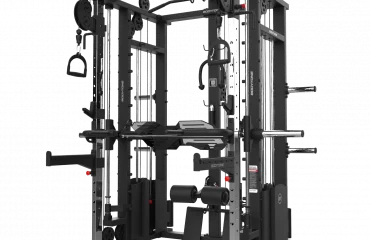
The Smith machine is built around a barbell fixed between two vertical rails. That mechanism delivers stability and safety: unlike a free bar, the load is guided throughout the movement, which minimises the risk of losing balance or dropping the bar.
For anyone training alone, this is the decisive argument. Members can work several muscle groups without external assistance, running squats, bench presses and other movements independently thanks to the guided bar. In a commercial gym, that means the strength area stays usable at quiet hours when no coach is on the floor.
Safety first
The design incorporates integrated safety devices. Catches can be engaged along the full bar path to hold the bar if the athlete fatigues or fails a repetition, which lets a member push closer to their limit without risking a serious injury. Graduated markings on the uprights make it easy to set the bar at the right height for each user.
Adding and removing plates is simple, so resistance is adjusted quickly between users. That ease of use is what makes the machine flexible enough to serve a whole membership rather than one training style.
Popular exercises on the Smith machine
Its versatility is why the machine is one of the most used stations in the room. Common movements include the following.
- Squat: works the quadriceps, glutes and hamstrings.
- Bench press: develops the pectorals, triceps and anterior deltoids.
- Upright row: strengthens the back, particularly the trapezius and rhomboids.
- Lunges: target the legs and glutes while improving balance and coordination.
- Deadlift: recruits the lower body, including glutes and hamstrings.
- Hip thrust: a natural fit for the guided bar path.
Each of these can be scaled to the user, which is why the machine suits beginners and experienced lifters in the same room.
A built-in spotter
In practice the guided load acts as an automatic assistant: even without a coach present, the trajectory helps a member keep a correct position. Counterbalanced models also let users test a movement without risking accidental overload. The machine therefore helps refine technique and progress in load safely.
Targeted work and rehabilitation
Isolating the intended muscles
Because the bar path is fixed, it is easy to focus effort on specific muscles. During a squat, for example, the guided bar makes it possible to emphasise the quadriceps by limiting the contribution of the stabilising muscles. The same applies to more complex work such as the military press or calf raises, where controlling range and direction is exactly what produces the intended result.
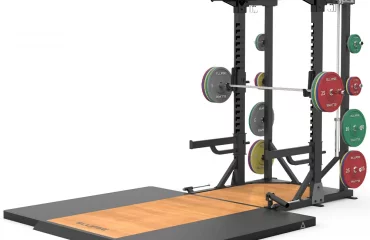
The counterpart is worth stating plainly: because the fixed trajectory unloads the stabilisers, transfer to free-barbell work is limited. A well-built strength area therefore keeps both, and our squat racks and power racks sit alongside the guided machines rather than instead of them.
Rehabilitation and injury prevention
For members returning from injury or working to avoid one, the Smith machine has a clear role. Reducing the need for stabilisation lowers joint stress during heavier movements, so strengthening can continue with less risk. That balance between performance and caution is what earns it a place in a well-planned programme.
Specifying one for a commercial floor
Equipment used by members rather than by a single owner is professional equipment and should be specified to EN ISO 20957-1 class S, the professional class for indoor use. Beyond the standard, look at the rail system and its bearings, the number and spacing of the catch positions, the footprint including the loading area, and the bench compatibility, since most facilities pair the machine with adjustable weight benches. Our professional Smith machines range covers the usual configurations.
Frequently asked questions
What is the difference between a Smith machine and a squat rack?
The bar. A Smith machine uses a barbell fixed between two rails, giving a guided and stable vertical path. A squat rack uses a free bar, which allows far more freedom of movement but requires more control to avoid losing balance. The Smith machine is the better answer where users train with little supervision.
Which muscles does it work?
Quadriceps through squats and lunges, pectorals mainly through the bench press, lats and trapezius through upright rows, hamstrings and glutes through deadlifts, and deltoids through military presses.
Is it suitable for beginners?
Yes, and it is one of the best stations for them. The guided structure reduces the risks associated with poor positioning and loss of balance, so new members can learn the basics with more protection.
Choosing the right machine for your gym
A Smith machine earns its floor space when your membership includes people who train alone, when supervision is not constant, or when you need targeted strength work alongside free weights. Send us your floor plan and your membership profile and we will tell you which configuration fits and what it costs. Request a quote and we will work it through with you.