Rubber Safety Tiles: How to Specify and Buy Them
Choosing the right floor is no longer a refinement, it is a requirement. Whether the surface is a children’s play area, a gym, a terrace or an industrial zone, a rubber safety tile protects the people using it and the substrate underneath it. The question for a buyer is where to find tiles at a sensible price without giving up the certifications that make the installation legal.
This guide covers what a rubber safety tile is, what it does, how to specify one for your surface, what the certifications actually mean, and what it costs.
What a rubber safety tile is
Composition
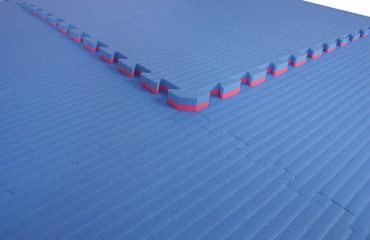
A rubber safety tile is a floor covering made from recycled rubber granulate bound with high-strength polyurethane resin. The material is flexible but dense, designed to absorb impact, limit injury in a fall, and protect the surface beneath it.
The high-density structure protects joints, reduces noise transmission and prevents premature wear of the substrate. Tiles are made in several thicknesses according to need, from 20 mm for strength training areas up to 50 mm for play areas and high-risk zones.
Standards and certifications
Rubber safety tiles should meet several European references, and it is worth understanding what each one actually covers.
- EN 1177: the standard for impact-attenuating playground surfacing, which defines the critical fall height determined by HIC testing. This is the certification that matters if children will use the surface.
- Bfl-s1: the reaction-to-fire classification, including the s1 smoke index. This is the class typically required for floors in premises open to the public. Fire requirements for such premises are set by national building regulations in each country, so confirm the class your local rules demand before you order.
- REACH: assurance that the material contains no restricted substances.
- ISO 9001: certification of the manufacturer’s quality management process. It says something useful about how the factory operates, but it is not a product safety certification.
Together these cover user safety and regulatory compliance for schools, nurseries, sports facilities and other buildings open to the public.
Where they can be laid
- Indoors: fitness rooms, cross-training boxes, garages, multi-sport halls.
- Outdoors: play areas, terraces, patios, fitness trails, accessible ramps.
Compatible substrates include concrete, asphalt, stabilised base, lean screed, and, on some models, compacted earth with a geotextile membrane.
What rubber safety tiles deliver
Technical performance
- Impact absorption: up to 80 per cent of the impact is absorbed, which materially reduces injury risk.
- Acoustic reduction: up to 25 dB in gym environments.
- Anti-slip surface: good grip, including in wet conditions.
- Weather resistance: unaffected by UV, frost, damp or high heat.
- Permanent elasticity: the tile keeps its shape and its flexibility over time.
Indoors and outdoors
Rubber tiles hold up in extreme conditions. They do not deform under UV, they drain naturally through the channelling moulded into the underside, and they protect against slips outdoors even in rain. Their thermal insulation improves comfort indoors and on terraces alike.
Installation and maintenance
- Fast to lay: interlocking puzzle format, loose-laid or bonded.
- Easy to cut: with a heavy-duty knife or a jigsaw.
- Simple upkeep: washing with clean water, no corrosive products.
Specifying by thickness
| Thickness | Recommended use | What governs the choice |
|---|---|---|
| 20 mm | Light commercial strength areas, residential facility gyms | Load protection and noise, no fall-height requirement |
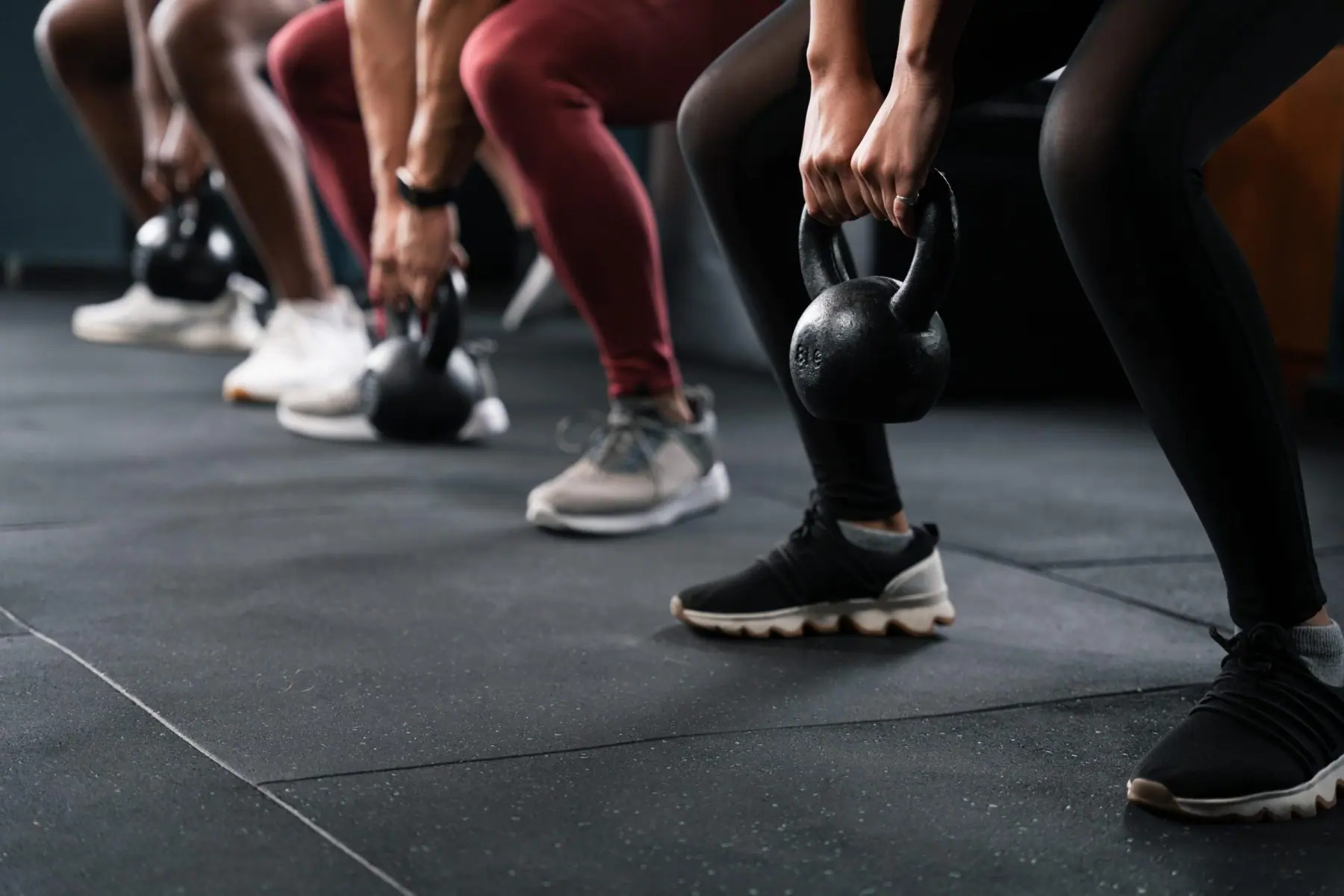
| 25 mm | Professional gyms, CrossFit boxes | Dropped-weight protection and substrate preservation |
| 40 mm | Play areas, nurseries | Certified critical fall height under EN 1177 |
| 50 mm | High-risk zones, public-access surfacing | Higher critical fall height and fire class |
Price per square metre varies with granulate size, tile density and fire classification, so a thickness alone does not determine a price. As a verified reference point, our 25 mm tile in 100 x 100 cm format, a high-density product at 1000 kg per cubic metre, is listed at 32.00 EUR excluding VAT. Ask for a quotation against your actual surface area, because volume pricing applies and the applicable discount depends on the quantity ordered.
Formats and options
- Standard format: 100 x 100 cm.
- Puzzle format: ideal for areas that may be reconfigured.
- Colours: black, red, green, blue, speckled.
- Finishes: smooth, textured, reinforced anti-slip.
How to choose
Start from the use
Three questions settle most specifications. Does the floor have to survive dropped weights? Is the environment wet or dry? Is the space open to the public? A 25 mm tile suits a strength training room. For outdoor use, a 40 mm draining tile is the usual answer.
Load and wear resistance
Professional-quality tiles carry loads up to 1200 kg per square metre. They are built to resist crushing, abrasion and repeated impact without losing density, which is what separates them from decorative rubber flooring.
Certifications to require
- EN 1177: mandatory for play areas, with the certified critical fall height stated for the exact tile you are buying.
- Bfl-s1: reaction-to-fire class including the smoke index, for premises open to the public.
- REACH: health and environmental safety.
- Slip resistance R10 to R13: selected according to how wet the surface will be.
Specifying with Light In Fitness
Light In Fitness works as a technical partner rather than a catalogue, supporting local authorities, businesses, sports clubs, nurseries and schools with more than three hundred flooring references.
The tiles are manufactured in Europe from high-quality recycled rubber. They are odourless, free of solvents and carcinogenic substances, and meet current REACH requirements, with manufacturing under ISO 14001 environmental management certification.
Support covers a project study for your surface, laying recommendations and technical support, and samples on request.
Projects
Municipal sports hall
Surface: 300 square metres. Product: 25 mm tiles in alternating red and black. Result: a shock-absorbing, clean, durable floor that stays anti-slip in damp conditions, approved by the sports department.
Outdoor nursery
Surface: 150 square metres. Product: 40 mm tiles with a certified critical fall height of 1.30 m, in natural green. Benefit: compliance with EN 1177 and optimal fall attenuation for the age group.
Private garage
Surface: 50 square metres. Product: 20 mm anti-slip tile in speckled black. Benefit: hydrocarbon resistance, easy maintenance, fast installation.
Our rubber flooring ranges
Our rubber gym flooring tiles cover the indoor thicknesses and formats above. Where a fire class is required by the building rules, the fire-rated rubber tiles carry the declared reaction-to-fire classification, and for children’s areas the playground surfacing range is specified against EN 1177 critical fall height rather than against thickness alone.
Frequently asked questions
Are rubber safety tiles compatible with underfloor heating?
Some ranges are. Specify it when you request a quotation so the right range is proposed.
Can rubber tiles be laid directly on earth?
Not advisable. Provide a stabilised base, either concrete or compacted aggregate with a geotextile membrane.
How are outdoor rubber tiles maintained?
Hose, stiff brush and mild soap. No abrasive products are needed.
Can a rubber tile be cut to fit?
Yes, with a heavy-duty knife or a suitable jigsaw.
How long do they last?
Between eight and fifteen years depending on use, exposure and maintenance.
Which thickness do I need for a play area?
That is determined by the free-fall height of the equipment above it, not by a rule of thumb. Take the equipment’s free-fall height, then specify a tile whose certified critical fall height under EN 1177 equals or exceeds it.
Get a costed specification
Specifying a rubber safety tile means matching thickness to the actual risk, fire class to the building rules that apply where you are, and slip rating to how wet the surface gets. Get those three right and the floor will outlast the equipment standing on it.
Send us your surface area, the intended use and the equipment going on top, and we will put together a costed specification. Request a quote and our team will work through it with you.
Réalisations documentées
- Dalles et sols sportifs : livraisons documentées – plusieurs chantiers
- Sol sportif extérieur, square Georges-Vallerey – Taverny (95)
Sources et références
- Décret n° 96-1136 du 18 décembre 1996 – prescriptions de sécurité relatives aux aires collectives de jeux (Légifrance)
- NF EN 1176-1 – Équipements et sols d’aires de jeux, partie 1 : exigences de sécurité et méthodes d’essai générales (AFNOR)
- NF EN 1177 – revêtements de surface amortissants : détermination de la hauteur de chute critique (AFNOR)
À lire aussi sur le même thème
- Comment choisir son vélo de fitness ergomètre robuste et de qualité professionnelle ?
- Quelles sont les caractéristiques essentielles à vérifier avant d acheter une plaque anti-vibration en caoutchouc ?
- How to Choose a Weight Bench That Matches Your Objectives
- How to Choose Exercise Mats for Strength Training