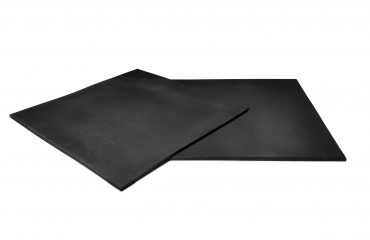
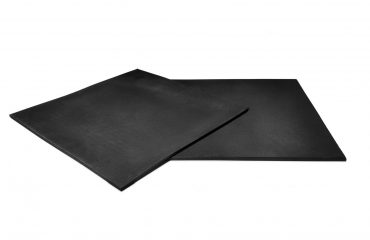
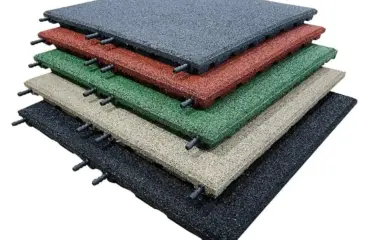
Rubber Floor Tiles for Workshops, Garages, Warehouses and Storage Buildings
Une dalle caoutchouc d'atelier ou de garage protège la dalle béton des chutes d'outils, absorbe les vibrations et résiste aux huiles. Les dalles industrielles présentent une dureté de l'ordre de 70 Shore A et supportent des charges statiques élevées. La pose modulaire permet le remplacement d'une dalle isolée sans reprendre la surface.

Rubber floor tiles are one of the most practical ways to make a workshop, garage, warehouse, storage shed or stable box safer and easier to work in. Built for intensive use, they protect against moisture, impact and wear, they go down quickly and they need very little maintenance, which makes them as relevant to a maintenance contractor as to a facilities manager. They also come in a range of colours and textures, so a working space can be laid out and zoned visually while its ergonomics improve. This guide covers what rubber tiles do well, how to choose them and how to install and maintain them.
Why rubber tiles work in a working environment
Comfort and safety
Rubber floor tiles stand out for the comfort they give users, particularly in working environments such as workshops and garages. Their flexible, elastic surface absorbs impact, which matters for anyone who spends long hours standing. Staff working on rubber surfaces commonly report less fatigue and less leg pain than those standing on bare concrete all day.
On the safety side, the tiles are designed to reduce the risk of slipping, including in damp conditions, thanks to their non-slip texture. That makes them a sound choice for workshops where liquids are handled and where a spill would otherwise turn a concrete floor into a hazard.
Durability and resistance
Service life is another major advantage. Made from robust materials, rubber tiles cope with demanding conditions, whether that means temperature swings, moisture or heavy loads. In spaces such as garages, where heavy vehicles are a daily reality, the tiles do not deform and keep their physical integrity for years. Some rubber tile ranges carry warranties of up to 20 years, which says a good deal about how they are expected to perform. They are also unaffected by oil and other chemicals, which suits workplaces where corrosive substances are present, and they protect the substrate underneath.
Easy to fit, easy to maintain
Installation and upkeep are straightforward. Because the tiles are light and modular, they can be laid quickly without specialist tools, which saves both time and labour and suits sites that cannot afford a long shutdown. Once down, they need very little attention: cleaning with soapy water is usually enough to keep them in good condition. That matters in warehouses and stable boxes, where cleanliness is often central to how the operation runs.
How to choose rubber floor tiles
Durability first
When choosing tiles for a workshop, a garage or a warehouse, durability is the first criterion. Rubber tiles are known for exceptional wear resistance, which makes them suitable where foot traffic and heavy machinery movement are constant. A mechanical workshop may take in several vehicles a day, and the floor covering has to carry those loads without degrading. Properly maintained, rubber tiles can last up to 20 years or more. That is a long-term investment which translates into real savings on replacement and maintenance.
Comfort and safety
Comfort and safety come next. Rubber is naturally shock-absorbing and feels noticeably better underfoot after a long shift, which reduces fatigue and physical discomfort for staff who stand all day.
The tiles also have non-slip properties that reduce the risk of slipping, which is critical wherever liquids can be spilled. Investing in rubber floor tiles is therefore not only a question of appearance or function, it is a proactive measure for staff wellbeing and one that a health and safety assessment will recognise.
Installation and cleaning
Finally, ease of installation and cleaning should not be overlooked. These tiles are generally designed to be laid without adhesives or fixings, which makes installation fast and efficient. Their surface is easy to clean, and a broom or a mop is usually all that is needed to remove dust and debris. In a garage, where oil and other fluids accumulate, the resistance of rubber to those chemicals is a decisive advantage: spills wipe off instead of soaking in.
Installing and maintaining rubber floor tiles
Preparing the subfloor
Before laying rubber tiles, the surface has to be prepared carefully. An uneven floor compromises both the durability and the performance of the tiles. Start by cleaning the floor and removing all dirt, dust and debris: a smooth, clean surface gives a better bond between the tiles and the substrate. In a garage where oils or fluids have been spilled, a deep clean with suitable detergents is often necessary.
Next, check the condition of the floor. Imperfections such as cracks or holes should be repaired with an appropriate filler. A sound base lets the rubber tiles resist impact and wear better, which extends their service life.
The installation process
Laying rubber floor tiles can look daunting, but with the right method it is manageable. Some tiles are designed to interlock, while others are bonded with adhesive. Start from a corner of the room and make sure the first tile is properly aligned, because it acts as the reference for everything that follows.
Installers usually work in rows, checking alignment regularly to avoid drift. It is also wise to leave a small expansion gap around the edges so the rubber can expand and contract with temperature changes. This stage looks simple, but it deserves close attention if the result is to be both durable and tidy.
Cleaning and upkeep
Once the tiles are down, maintenance keeps them looking and performing as they should. Regular cleaning, ideally weekly, removes dust and debris: sweeping followed by a wipe with a mild cleaning solution is normally enough. Avoid aggressive chemicals, which can damage the rubber. Stubborn stains from oils or fluids are a familiar problem in workshops.
In those cases, clean immediately, because the longer a stain sits the harder it is to remove. For even wear, it is also worth repositioning tiles every few months in high-traffic areas. Followed properly, this routine lets rubber floor tiles give years of service.
How rubber compares with other floor coverings
Rubber tiles against concrete
Rubber tiles differ sharply from the bare concrete used in most workshops and garages. Concrete is durable and strong, but its rigidity tires the people working on it, and long periods on hard surfaces are associated with joint and muscle pain. Rubber tiles have a degree of elasticity that reduces that physical fatigue. Rubber tiles are also easier to install and maintain than concrete, which needs regular repair and cracks over time.
Rubber tiles against vinyl
Vinyl coverings are often chosen for their low cost and easy upkeep. Vinyl gives a clean, water-resistant surface, but it lacks the toughness and service life of rubber. Where heavy tools and machinery are in use, vinyl scratches or tears easily and has to be replaced often. Rubber tiles are designed to take impact, chemicals and temperature variation. On safety, rubber also grips better, which reduces slips and falls in workplaces that are frequently cluttered.
Rubber tiles against carpet
Carpet can feel warm and comfortable, but it is a poor fit for a workshop or a garage. It traps dust, grease and other contaminants, which makes it impractical where regular cleaning is essential. It also fails against moisture and chemicals and deteriorates quickly. Rubber tiles are easy to clean and far more resistant to both. Choosing rubber for a working space means choosing durability and practicality, and a safer, more pleasant place to work.
Where rubber floor tiles are used
Repair and DIY workshops
Workshops gain a great deal from rubber floor tiles, which make the space safer and more comfortable. Dropped tools and parts are part of workshop life, and rubber tiles absorb that impact, reducing the risk of injury and damage. Their non-slip surface also prevents slips in damp conditions. Falls are among the leading causes of workshop injury, and a floor that grips is a direct answer to that. The tiles are also easy to clean, which counts where oil and dust build up fast.
Garages and parking areas
In garages, professional or private, rubber floor tiles stand out for their durability and toughness. They take the weight of vehicles without deforming or cracking, where the pressure of a vehicle would easily damage other coverings. They are also generally treated to resist chemicals such as oil and fuel that run onto the floor.
That extends the life of the covering and makes cleaning easier. Because the tiles come in a variety of colours and patterns, a garage can be made functional and presentable at the same time, and an ordinary bay becomes a workspace people are happy to be in.
Warehouses and storage buildings
Warehouses and storage buildings are demanding environments where heavy goods and heavy equipment move constantly. Rubber floor tiles absorb impact and help reduce fatigue among staff who stand for long shifts.
In a warehouse where pallets are moved regularly, the tiles protect the substrate and give a surface that resists scuffing and marking. Choosing the right material makes a measurable difference in a demanding workplace, both for the fabric of the building and for the people in it.
Frequently asked questions
What thickness of rubber tile does a garage need?
Thickness follows the load. Vehicle bays and heavy storage need a substantially thicker tile than a walkway or a light assembly area. Tell us the loads involved and we will specify accordingly rather than guessing.
Do rubber tiles need to be glued down?
Not always. Many are designed to interlock or to sit loose-laid, which makes installation fast; adhesive is used where the surface must not move at all. Leave an expansion gap at the perimeter in both cases.
How long do rubber floor tiles last?
With proper maintenance, up to 20 years or more, which is what makes them a long-term investment rather than a consumable.
Specifying your floor
Our range covers rubber floor tiles in several thicknesses, along with rubber flooring rolls for continuous surfaces. For heavy-duty protection in a workshop or garage bay, the 25 mm rubber tile is a solid starting point. Light In Fitness has supplied professional flooring and equipment since 2013. Send us your surface area, the loads involved and the substrate you are working on, and we will specify the right tile. Request a quote for a costed proposal.
Réalisations documentées
- Dalles et sols sportifs : livraisons documentées – plusieurs chantiers
- Sol sportif extérieur, square Georges-Vallerey – Taverny (95)