Professional Recumbent and Seated Exercise Bikes
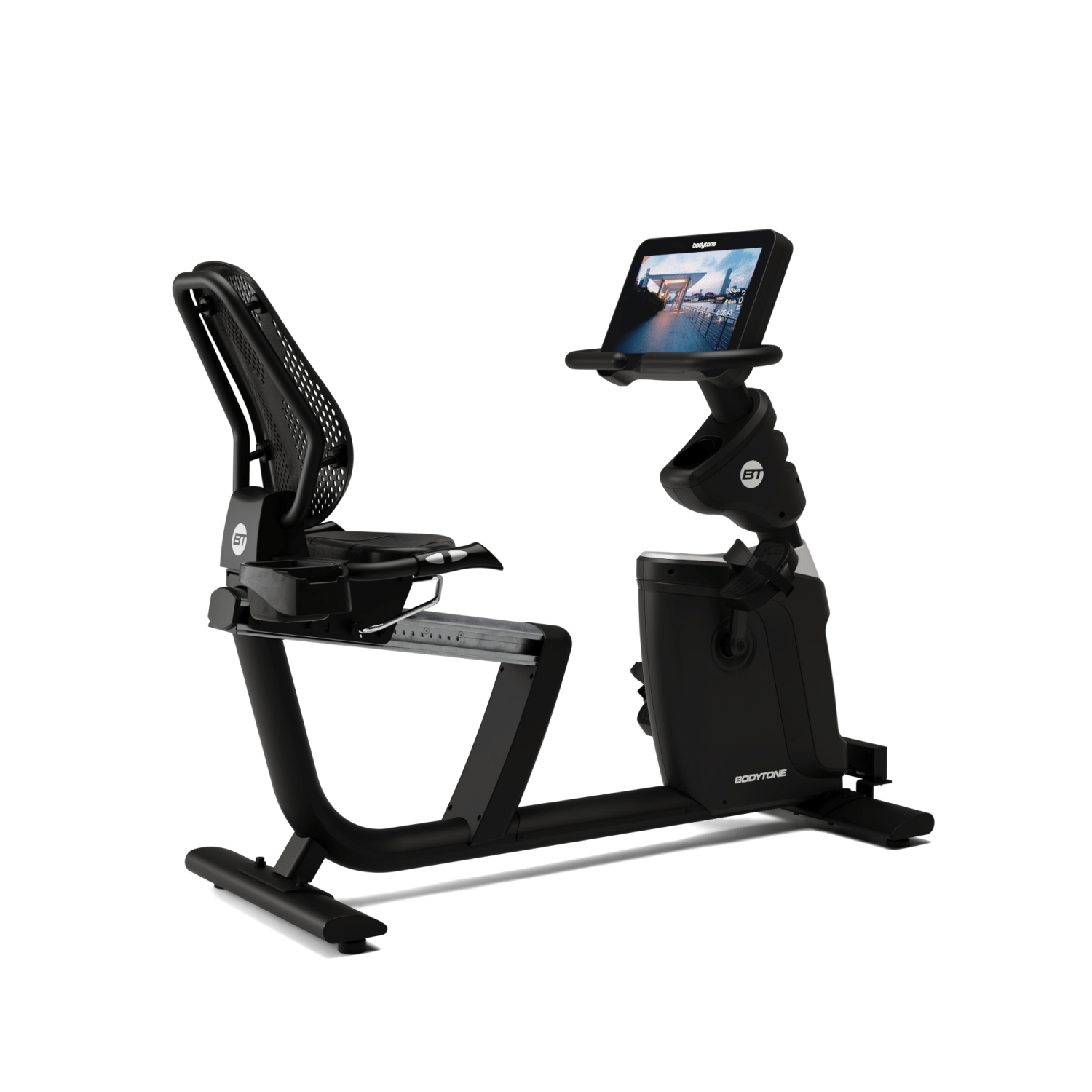
The seated and recumbent exercise bike is the cardio station that opens a facility to the members other machines exclude. The back-supported, semi-reclined position spreads body weight across the seat and backrest instead of loading the wrists, lower back and knees, which is why it is standard equipment in rehabilitation centres, senior programmes, hotel gyms, corporate facilities and any club serving a broad range of ages and abilities.
What a recumbent bike actually is
An upright bike puts the rider over the pedals in a cycling posture. A recumbent bike moves the seat back and adds a backrest, so the pedals sit in front of the body rather than beneath it. The result is a pedalling movement with the trunk fully supported. Seated bikes sit between the two: an upright-style frame with a proper backrest and a wider, padded seat.
That geometry changes who can use the machine. A member who cannot hold an upright cycling posture for twenty minutes – because of back pain, limited mobility, balance issues or simple deconditioning – can complete the same session on a recumbent bike. For a facility, that is not a comfort feature; it is an addressable-market feature.
Where it earns its floor space
- Rehabilitation and physiotherapy: the supported position and the fine resistance control make it the default cardio station for supervised return-to-activity work.
- Senior and low-impact programmes: step-through frames and swivel seats matter more than console technology for this group; specify them explicitly.
- Hotels and serviced residences: guests use equipment unsupervised and across every fitness level, so the safest station is the one that is hardest to use badly.
- Corporate facilities: members arrive in short windows and at mixed fitness levels; the recumbent bike is the station that requires no coaching to use correctly.
- General fitness floors: a recumbent alongside uprights keeps the cardio zone usable during recovery sessions and for members training around an injury.
What to specify
Seat adjustment and access
The seat rail travel decides whether one machine serves your whole membership. Look for tool-free adjustment the member can operate from the seated position, and for a step-through or low-entry frame where mobility is a constraint. A swivel seat is worth specifying in rehabilitation and senior settings, where getting on and off the machine is the harder part of the session.
Resistance control
Fine, calibrated resistance increments matter more here than a high maximum load. Supervised programmes progress in small steps, and a machine whose lowest setting is already too hard is unusable for exactly the population the station exists to serve. Check the bottom of the range, not the top.
Comfort and contact points
Padded seat and backrest, ergonomic handles and adjustable footplates with secure straps. Contact points are also the wear points: ask what the replacement upholstery costs and how long it takes to arrive before you commit to a fleet.
Stability and rated user weight
Check the rated user weight against your actual membership rather than an average. For indoor commercial use, specify equipment built to EN ISO 20957-1 class S; this is the class rated for the duty cycle of a staffed facility.
Console and tracking
Time, distance, calories and heart rate are the baseline. Heart-rate monitoring is more useful on this station than on most, because supervised and cardiac-rehabilitation programmes are prescribed against it. App connectivity is a retention tool and should be weighed as such.
Frequently asked questions
What is the difference between a recumbent and an upright bike?
The rider position. An upright bike holds a cycling posture over the pedals; a recumbent bike supports the back and places the pedals in front of the body, which removes load from the lower back, wrists and knees.
Which muscles does it work?
Quadriceps, hamstrings, glutes and calves, as on any bike. Adjusting resistance and cadence shifts the emphasis between endurance and strength-endurance work.
Is it suitable for rehabilitation?
It is one of the standard stations for supervised return-to-activity programmes, precisely because of the supported posture and the low joint load. Programming remains the responsibility of the clinician following the patient.
How many recumbent bikes should a cardio floor plan for?
It depends on the membership profile rather than headcount. A general fitness floor commonly runs one recumbent for every three or four uprights; a rehabilitation or senior-focused facility inverts that ratio entirely.
Browse the professional recumbent bikes and the Lexco seated bikes, or request a quote for your cardio floor.