Professional Pull-Up Bars and Pull-Up Stations for Gyms and Outdoor Sites
Of every training position in a commercial gym, the pull-up bar is the one that costs least and breaks least. There is no motor, no cable run, no console to replace. What there is instead is a steel bar carrying the full body weight of a user nobody is supervising, which is exactly why a professional bar has almost nothing in common with the telescopic fitting sold for a doorway at home.
This guide is written for the people who sign the order: club and box owners, hotel and campsite operators, school and university facilities managers, municipal sports departments and armed forces training units. It covers the families of professional pull-up bar, the standards that apply indoors and outdoors, and the mounting checks that decide whether an installation lasts a decade or a season.
What pull-up work actually trains
The load on a pull-up bar is the user’s own body weight, so a facility never has to manage plates, stacks or adjustment around it. Which muscles are recruited depends almost entirely on grip.
- Supinated grip, palms facing the user: the biceps take a large share of the work and the movement shapes the arms.
- Wide pronated grip: the latissimus dorsi leads and the emphasis moves to the width of the upper back.
- Neutral and parallel grips: shoulder-friendly variants that keep members with limited shoulder mobility training rather than dropping out.
- Hanging leg and knee raises: the same bar becomes a core station without occupying another square metre.
Bodyweight loading does not make the movement risk-free, and it should never be presented that way to members. A bar in an unstaffed room needs a clear fall zone underneath, an approach height that does not force a member to jump at it, and flooring appropriate to the drop.
The families of professional pull-up bar
Commercial pull-up bars divide into four types, and the right one is decided by the building before it is decided by the training programme.
Wall-mounted bars
A wall-mounted bar is the standard answer where floor area is scarce and the wall is sound. Professional versions offer several grip spacings and grip angles on one frame, so a single fixing point supports narrow, wide and neutral work. They sit flat against the wall between sessions, which is why they suit hotel gyms, residential facilities and school halls where the room does other jobs. The limiting factor is never the bar: it is the wall. Hollow block, plasterboard partitions and thermally insulated facades all need to be assessed before a fixing schedule is issued.
Ceiling-mounted bars
Ceiling mounting frees the wall completely and gives a full, unobstructed swing under the bar, which matters for kipping work and for hanging core exercises. It demands more precision at installation, since the fixings work in direct tension and the slab has to be confirmed as structural rather than suspended. Many professional bars are supplied with a drilling pattern that allows either wall or ceiling installation, which is useful when the site survey changes the plan.
Freestanding pull-up and dip stations
A freestanding station needs no fixing into the building at all, which makes it the only option in leased premises, listed buildings and temporary or seasonal facilities. It can be repositioned as the floor plan evolves. Professional stations usually combine the bar with parallel dip handles and push-up grips, so one footprint covers pulling, pushing and core work. The trade-off is base area: a station that resists a user swinging on it needs a wide, weighted footprint.
Bars integrated into a rig or cage
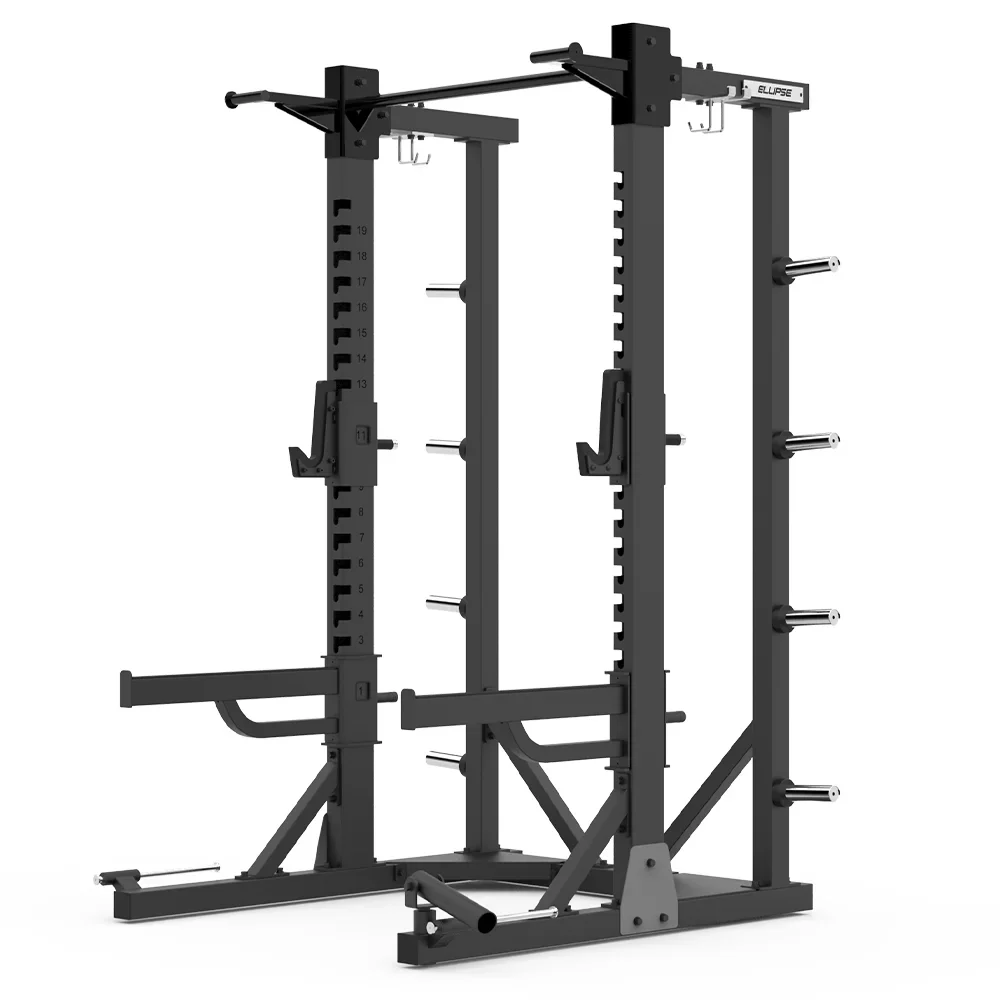
In a club free-weight area the pull-up bar rarely exists on its own. It is a crossmember of the rig, which also carries the squat spotters, the storage horns and the attachment points for bands and rings. This is the most efficient arrangement per square metre, because the same structure serves several athletes at once. Our full range of racks and cages includes wall-mounted, freestanding and double configurations with pull-up crossmembers as standard.
Outdoor pull-up bars and calisthenics parks
Outdoor bars follow a completely different rulebook. Adult outdoor fitness and calisthenics equipment is covered by EN 16630, which addresses the loads, the entrapment risks and the free space around permanently installed outdoor training equipment. If the bar sits within a children’s play area rather than an adult training area, the applicable standards are EN 1176-1 for the equipment and EN 1177 for the impact-attenuating surfacing underneath. The two families are never interchangeable, and EN 16630 never applies to a children’s unit.
For municipalities, campsites, hotels and schools the practical unit is not a single bar but a structure: a set of bars at several heights, dip bars, wall bars and monkey elements on one frame, so a group can train at once and users of different abilities all find a usable height. Light In Fitness manufactures these structures in galvanised steel and stainless steel. See the calisthenics and street workout cages range, and the outdoor wall bars that pair with them along a training trail.
Indoor standards: what class S means
Indoor equipment for commercial use falls under EN ISO 20957-1 class S. Class S is the studio and club level: it defines the stability, endurance and safety requirements for equipment used by people who have never read a manual and were never shown how the station works. Class I is also a professional class, but it exists to make training accessible to users with reduced mobility. It is not a level above class S in intensity, and the two are often confused in supplier literature.
Anything specified outside these classes belongs in a private home, not in a facility open to members, guests, pupils or the public. For a bar this is not a paperwork detail: the difference shows up in wall thickness, weld quality, the grade of the fixings supplied and the diameter and knurl of the grip itself.
Mounting: what to check before ordering
- The substrate. Solid concrete, solid masonry, hollow block, timber stud or steel frame each require a different anchor. Ask what fixings are supplied and whether they suit your wall, because a bar is only ever as strong as what it is bolted to.
- Height and headroom. Leave enough clearance above the bar for the head at the top of the movement and enough below for a hanging user to remain clear of the floor.
- Fall zone. Keep the area under and behind the bar free of benches, racking and glazing.
- Flooring. Rubber tiles or rolls under a pull-up station absorb the drop and protect the slab.
- Grip diameter. A thicker bar builds grip strength but excludes smaller hands; mixed-membership sites usually want a standard diameter with a knurled section.
- Corrosion. Indoors, powder coating is sufficient. Outdoors and in pool or coastal environments, specify stainless steel or hot-dip galvanised steel.
Frequently asked questions
Can a pull-up bar be installed in any room?
Almost. The constraint is never the size of the room but the load path: you need a wall or slab that can take the fixings, and clear space in front of and below the bar. A freestanding station removes the fixing question entirely where the structure cannot be drilled.
Do we need a separate bar for beginners?
Not a separate bar, but a way of assisting the movement. Bands anchored to the bar, a step to reduce the range and a low bar for horizontal rows all let a beginner train the same pattern. On outdoor structures, several bar heights on the same frame do the same job.
Wall, ceiling or freestanding?
Wall mounting is the default when the wall is structural. Ceiling mounting gives the most freedom of movement under the bar. Freestanding is the answer for leased sites, temporary rooms and anywhere drilling is not permitted.
Does an outdoor bar need special surfacing?
An adult outdoor training area under EN 16630 requires free space appropriate to the equipment. Where the installation sits in a children’s play area, impact-attenuating surfacing under EN 1177 is required and must be specified with the equipment, not added afterwards.
Specifying your installation
A pull-up bar is a small line on a quotation and a large share of the training volume it makes possible. The decisions that matter are structural: what it is fixed to, what stands under it, and whether it is a single station or a crossmember on a structure that will serve twenty people. Send us the room, the wall build-up or the site plan and the number of simultaneous users you need to accommodate, and we will specify the bar, the fixings and the flooring together. Request a quote and we will come back with a costed proposal.
Réalisations documentées
- Cage street workout ultime, Carcassonne – armée française
- Cage street workout ultime, Tahiti – armée française, Polynésie
- Cage SP Max, centre EPIDE de Combrée – établissement public d’insertion
- Cage SP Max, lycée Saint-Bénigne de Dijon – établissement scolaire