Professional dumbbells and barbells for commercial gyms
Barbells and dumbbells are the most basic equipment in any gym, and they are also the pieces that decide whether a free-weight area feels professional or improvised. Dumbbell work stabilises and activates individual muscle groups, supports hypertrophy and builds endurance, and it can be performed without a training partner, which is not the case for heavy barbell work. For an operator, that combination means high throughput per square metre and very low supervision cost. This page sets out what to look for when you specify dumbbells and bars for a commercial installation.
What dumbbell training brings to your floor
A complete free-weight area lets your members build strength and muscle mass evenly, without waiting for a machine to free up during peak hours. Dumbbells allow unilateral work, which corrects strength imbalances that guided machines tend to hide, and they cover the full range of movement patterns your instructors need to programme: pressing, pulling, hinging and carrying.
Because they are self-limiting, dumbbells also suit mixed populations. The same rack serves a first-time member working with light loads and an experienced lifter, which is exactly what a hotel gym, a corporate facility or a residents club needs from a compact area.
Specifying dumbbells for commercial use
Three points decide the lifetime of a dumbbell set in a shared environment.
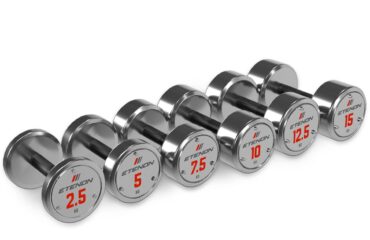
- Load range. A range running from 2.5 kg to 50 kg per dumbbell covers beginners and advanced users from a single rack, and it removes the need for a second set later.
- Coating. Rubber and urethane coatings mean that a dropped dumbbell does not damage the floor. That single property protects your slab, your flooring investment and your noise levels in a mixed-use building.
- Head geometry. Hexagonal heads do not roll, which matters in a busy area where a round head that escapes a rack becomes a hazard.
Compare the finishes and load ranges in the professional dumbbell range, or look at a complete graduated set such as the ZIVA XP Urethane dumbbell set when you are equipping a full free-weight zone in one order.
Barbells: Olympic bars and curl bars
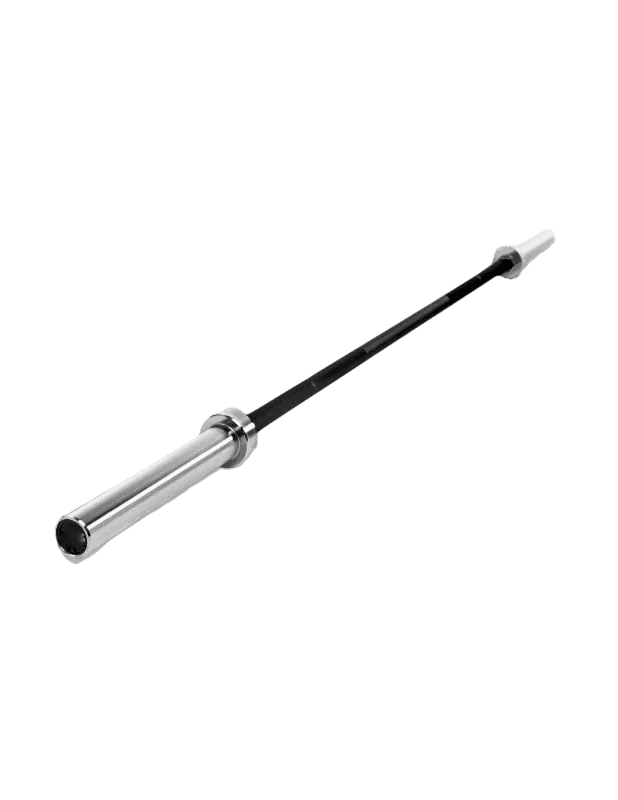
Alongside dumbbells, bars are what make bench pressing, squatting and deadlifting possible, and they are the backbone of any cross-training or strength area. Our bars suit beginners and experienced athletes alike and are built for repeated daily loading rather than occasional use.
A curl bar with non-slip knurling is the accessory most often forgotten at the specification stage and the most often requested once a facility opens: it gives strength-focused members a wrist-friendly option for arm work and takes pressure off the straight bars at peak times. Browse the Olympic barbell range to compare shaft diameters, knurling patterns and load ratings.
Racks, benches and flooring: the rest of the area
A dumbbell set is only as good as the area around it. Plan the rack footprint together with the working space in front of it, so users can press and row without collision. Add adjustable benches in proportion to the number of pressing stations, and protect the floor with rubber tiles or rolls rated for the loads that will be dropped on them.
Indoor equipment for collective use must meet EN ISO 20957-1 class S, the professional classification covering stability, load capacity and the absence of trap points in supervised and commercial environments. Class I is the professional classification for inclusive access, not a level above class S, so specify the two together when you are planning an accessible area.
Frequently asked questions
How many dumbbell pairs does a facility need?
It depends on your peak occupancy and your programming rather than on your total floor area. A graduated set covering the full range in small increments is generally more useful than duplicated pairs at a few popular weights, because it lets members progress without a gap.
Are rubber and urethane coatings interchangeable?
Both protect the floor. Urethane is more resistant to marking and colour transfer over years of intensive use, which makes it the usual choice for high-traffic commercial areas, while rubber remains an efficient solution for moderate use.
Do we need a dedicated lifting platform?
If your programming includes Olympic lifts or heavy deadlifts, yes. A platform concentrates the impact where the floor build-up is designed for it and keeps structure-borne noise away from adjacent rooms.
Building your free-weight area
Whether you are opening a new site or replacing a worn set, the fastest way to a workable specification is to start from your floor plan and your member profile. Our team can propose a dumbbell range, a bar selection, rack layout and flooring build-up that work together, and confirm the standards applicable to your building. Send us your dimensions and request a quote, and we will come back with a costed proposal.