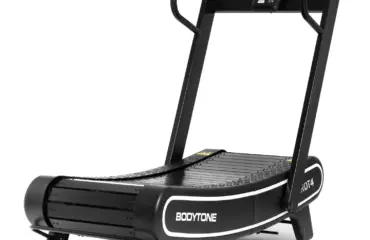
Professional Connected Cross Trainer: What It Brings to a Gym
Un elliptique connecté enregistre les paramètres de séance et les restitue via une application ou un écran intégré. L'intérêt porte sur le suivi de progression et l'animation de l'offre en salle. La partie mécanique, foulée et inertie, reste le critère déterminant du choix.

Connectivity has reached every corner of the fitness floor, and the cross trainer is no exception. For a gym operator, a hotel or a public facility, a professional connected cross trainer is not a gadget: it is a cardio station that records what members actually do and gives the operator something to act on. This guide looks at what the connected generation adds, what it does not change, and how to specify a machine that will still be running smoothly after several seasons of continuous use.
What a professional cross trainer is for
The cross trainer places the user in a standing position with feet on moving pedals and hands on moving handles. The stride is continuous and the feet never leave the footplates, which is why the machine delivers cardiovascular work with far less joint loading than running. On a commercial floor that makes it the natural companion to the treadmill: it absorbs the members who cannot or will not run, and it opens the cardio area to older users, rehabilitation programmes and beginners.
Nothing about connectivity changes that mechanical role. Stride length, flywheel inertia, resistance smoothness and frame stability remain the criteria that decide whether a machine feels good at 6 a.m. and still feels good after four years. Specify the mechanics first, then the console.
The technical specification that matters
A professional cross trainer is built around a rigid frame, sealed bearings and a resistance system designed for continuous duty rather than occasional use. The points to compare across suppliers are consistent:
- Frame and stability: the machine has to stay planted under a heavy user working at pace, with no lateral movement and no walking across the floor.
- Stride and geometry: the stride path determines who is comfortable on the machine. A commercial site serving mixed profiles needs a geometry that suits both a short and a tall member.
- Resistance: the range and the granularity of adjustment decide whether the same machine can serve a rehabilitation session and an interval workout.
- Console: an LED console is enough for unsupervised self-service; a touchscreen adds programmes, connectivity and entertainment, now expected in premium clubs and hotels.
- Serviceability: ask which parts are wear parts, how they are accessed and how quickly they can be supplied. On a commercial floor, downtime costs more than the part.
Low-impact cardio and the users it opens up
The cross trainer engages the legs and, through the moving handles, the upper body and trunk, in a single continuous movement. Two operational consequences follow. First, the machine suits members who need cardiovascular work without impact, which covers a large part of the senior, post-injury and beginner population. Second, the whole-body pattern makes the station attractive to members who want an efficient session in limited time.
For an operator, that breadth is the commercial argument. A treadmill serves runners; a cross trainer serves almost everyone, which is why it is rarely the machine standing idle.
What connectivity actually adds
A connected cross trainer records session parameters and returns them through an integrated screen or an application. Used properly, this gives an operator three things.
| Function | What it delivers on a commercial floor |
|---|---|
| Session tracking | Members see progression over weeks rather than a single session, which supports retention |
| Guided programmes | Structured sessions for unsupervised members, and a consistent offer outside staffed hours |
| Device synchronisation | Session data carried to the member’s own watch or phone, so training continues off site |
Connectivity is also an animation tool: challenges, programme cycles and progress reporting give a club something to build a schedule around. What it does not do is compensate for a mediocre stride or a noisy resistance system, and it should never be the reason to accept a lighter frame.
Cross trainer, treadmill, bike or rower
Each cardio station answers a different need, and a balanced floor carries several. The treadmill is the reference for running and delivers the highest impact load. The upright bike is the most accessible seated station and the easiest for a fragile user. The rower recruits a large muscle mass but demands technique, which limits it in unsupervised use. The cross trainer sits between them: standing, whole-body, low impact and easy to use correctly without coaching. That combination is why it usually earns more than one position in the cardio line-up.
Choosing and installing
Start from the room. Measure the footprint including the clearance a user needs behind the machine, check ceiling height, since the standing stride raises the user by the height of the footplate, and confirm the floor build-up. Then match the specification to your members: mixed public in a hotel or residence, intensive use in a club, accessibility and simple controls in a rehabilitation or senior context.
Finally, plan the machine as part of a cardio zone rather than as a single purchase. Spacing, circulation, sightlines and power access determine how the area is used, and they are far cheaper to get right on a plan than after installation.
Frequently asked questions
Is a cross trainer suitable for unsupervised use?
Yes. The movement is guided by the machine, which makes serious technical error unlikely, and that is one of the main reasons hotels and residential gyms choose it as a first cardio station.
Does a connected model need a network connection?
It depends on the console and the functions you want. Confirm with your supplier what works offline, what needs a network and what the machine does if the connection drops, before you plan the installation.
Cross trainer or treadmill for a hotel gym?
Most hotel gyms carry both, but if the room only takes one standing cardio station, the cross trainer serves a wider range of guests and generates less noise and vibration in a building with rooms nearby.
How much space should be planned per machine?
Work from the manufacturer’s stated footprint plus a clear working perimeter for access and circulation. Ask for the dimensioned drawing at the quotation stage rather than estimating from a catalogue photograph.
Specifying your cross trainers
The right machine is the one that matches your members, your opening hours and your room. Compare the mechanics first and the console second, and ask every supplier for the same specification sheet. Browse the professional cross trainers and the wider cardio equipment range, see how the station fits into a full cardio training area layout, or request a quote with your room dimensions and member profile.