Opening a reformer Pilates studio: premises, machines and budget
Opening a reformer Pilates studio comes down to four decisions taken in order: the format, the premises, the machine park and the financing structure, and the machine park is the largest single line in the budget. Unlike a gym, Pilates is not a regulated activity in France under the sports code and no state diploma is required to open a studio, which lowers the barrier to entry and raises the competitive pressure. That makes the equipment and the room the differentiators. This guide covers the three formats, the space and acoustic requirements, verified machine prices and the capacity arithmetic that tells you whether the studio works.
Step one: the format decides the budget
Three formats structure the market and each imposes its own machine park.
| Format | Machine park | Commercial model | Exposure |
|---|---|---|---|
| Mat studio | Mats and small equipment | Group classes at low unit price | Direct competition from general gyms and online classes |
| Micro reformer studio | 2 to 3 reformers | Private and duet sessions at premium rates | Revenue capped by teacher hours |
| Group reformer studio | 4 to 8 stations | Small group classes, tight scheduling | Highest entry cost, strongest growth model |
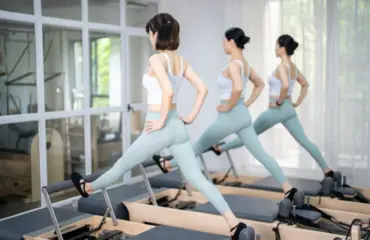
The group reformer studio is what is driving the current growth of the discipline: small groups, dense timetables and a premium clientele retained by the experience as much as by the method. It is also the format where the room itself contributes to perceived value, which is not a decorative detail when a session is priced at 50 EUR or more.
Step two: the premises, counted in stations rather than square metres
Count the room in working stations, not gross floor area. A reformer occupies roughly 2.4 m by 0.7 m, but the usable requirement is the machine plus the practitioner’s working space plus a circulation route wide enough for the teacher to correct every student without stepping over a machine. Allow five to seven square metres per station as a planning figure, then add reception, changing rooms and small equipment storage.
Two issues cause openings to fail. The first is acoustics. A studio on an upper floor or at the base of a residential building transmits impact and rolling noise, and the carriage of a reformer rolling on its rails is exactly the frequency that travels through a slab. Treat it at floor specification stage, not after the first complaint. The second is regulatory status: a studio receiving the public is a public building, with the safety, accessibility and record keeping obligations that follow. Both belong before the lease is signed, not after.
Step three: the machine park
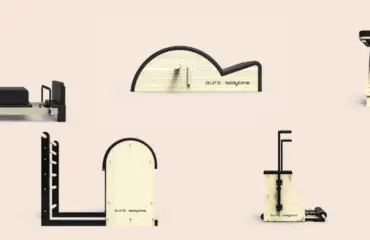
A balanced studio is not a row of reformers. The reference configuration combines reformers sized to the timetable, a Cadillac or trapeze table for deeper work and rehabilitation, one or two chairs, a barrel and small equipment. All prices below are excluding VAT from our current catalogue.
| Machine | Role | Price excluding VAT |
|---|---|---|
| Aero Pilates reformer, anodised aluminium | Entry level studio reformer | 2,150 EUR |
| Essential Pilates reformer with tower, maple | Reformer plus tower in one footprint | 2,950 EUR |
| Track Pilates reformer with folding tower | Space efficient studio station | 2,950 EUR |
| Heritage Pilates reformer, solid walnut | Premium finish for boutique studios | 2,950 EUR |
| Bodytone wood alloy professional reformer | Professional reformer, heavy duty use | 3,411 EUR |
| Tower accessory for wood alloy reformer | Adds tower work to the station | 1,665 EUR |
| Bodytone Wunda chair | Chair repertoire, small footprint | 1,314 EUR |
| Bodytone ladder barrel | Extension and mobility work | 1,872 EUR |
| Bodytone spine corrector | Small equipment, high utility | 472.50 EUR |
Three costed configurations
| Configuration | Contents | Machine budget excluding VAT |
|---|---|---|
| Micro studio, 3 stations | 3 reformers with tower, 1 Wunda chair, 1 spine corrector | Around 10,600 EUR |
| Boutique studio, 6 stations | 6 reformers with tower, 1 Wunda chair, 1 ladder barrel, 1 spine corrector | Around 21,400 EUR |
| Premium studio, 8 stations | 8 professional wood alloy reformers, 1 tower accessory, 1 chair, 1 barrel | Around 32,100 EUR |
To these add flooring, mirrors, sound, storage and reception. Flooring deserves particular attention in a Pilates studio because it carries both the acoustic function and a large part of the visual identity of the room, and it is far cheaper to specify correctly than to replace.
The capacity arithmetic
A six station studio running five classes a day, six days a week, offers 180 places a week. At 70 per cent occupancy that is 126 places sold. The revenue that produces depends entirely on your local pricing, so build the table with your own numbers rather than borrowing anyone else’s: places offered, realistic occupancy, price per place, weeks of operation per year. Then subtract teacher cost per class, rent, and a maintenance allowance for the machines. What this arithmetic usually shows is that studio viability is decided by timetable density and teacher availability, not by the number of machines. Buying an eighth reformer that sits idle at 11:00 changes the cost base and not the revenue.
Maintenance and machine life
Reformers are mechanical equipment in daily commercial use. Rails, wheels, springs, straps and upholstery all wear on a predictable cycle, and a studio that does not maintain them loses its premium positioning quickly, because a noisy carriage is immediately obvious to a paying client. Establish a weekly check on straps and spring attachments, a monthly check on wheels and rail cleanliness, and confirm before purchase that springs, straps and wheels are available as stocked spare parts with published references.
Frequently asked questions
Do we need a qualification to open a Pilates studio?
In France, Pilates is not covered by the sports code and no state diploma is required to open a studio. That says nothing about teaching quality, and in a market where clients compare studios on the instructor rather than the equipment, recognised teacher training remains the practical entry requirement for anyone teaching.
How many reformers to start with?
Three for a micro studio built on private and duet sessions. Six is the smallest number that supports a group class model with a viable revenue per hour. Going straight to eight is justified only where the timetable is already proven or where a second teacher is available from day one.
Reformer with tower or reformer alone?
A tower widens the repertoire substantially within the same footprint, which matters in a small room. Where budget forces a choice, equip most stations as plain reformers and one or two with towers, then add tower accessories later where the machine range allows it.
What flooring should a studio use?
Something that absorbs rolling and impact noise, is comfortable underfoot for barefoot practice and is easy to clean. If there is occupied space below, add an acoustic underlay and treat the specification as an acoustic decision first and an aesthetic one second.
Buy or lease the machines?
Leasing spreads the largest line in the budget across the term and preserves cash for fit out and marketing, which is often where a new studio is short. It does not change maintenance or replacement costs. Compare total cost over the full term rather than the monthly figure.
Get your studio configuration costed
Light In Fitness has equipped more than 2,500 customers since 2013 from Tours, France. Tell us the number of stations you are planning and the room dimensions, and you will receive a balanced configuration, a layout drawing and a total budget including studio flooring within 24 working hours. Stock items ship in 5 to 10 working days to France, Belgium, Switzerland and Luxembourg, with export quoted per project. See Pilates reformers and Pilates studio accessories, or request a quote.
Sources et références
- Code du sport, articles R322-4 à R322-43 – garanties d’hygiène et de sécurité applicables aux établissements d’activités physiques et sportives (Légifrance)