Multi-Station Gyms: How to Choose the Right Machine for Your Facility
Un appareil de musculation complet, ou multiposte, regroupe plusieurs stations à charge guidée sur un châssis unique. Il économise de la surface au prix d'un nombre d'utilisateurs simultanés limité. C'est une solution adaptée aux petites salles, résidences et espaces d'entreprise, moins aux plateaux à forte fréquentation.
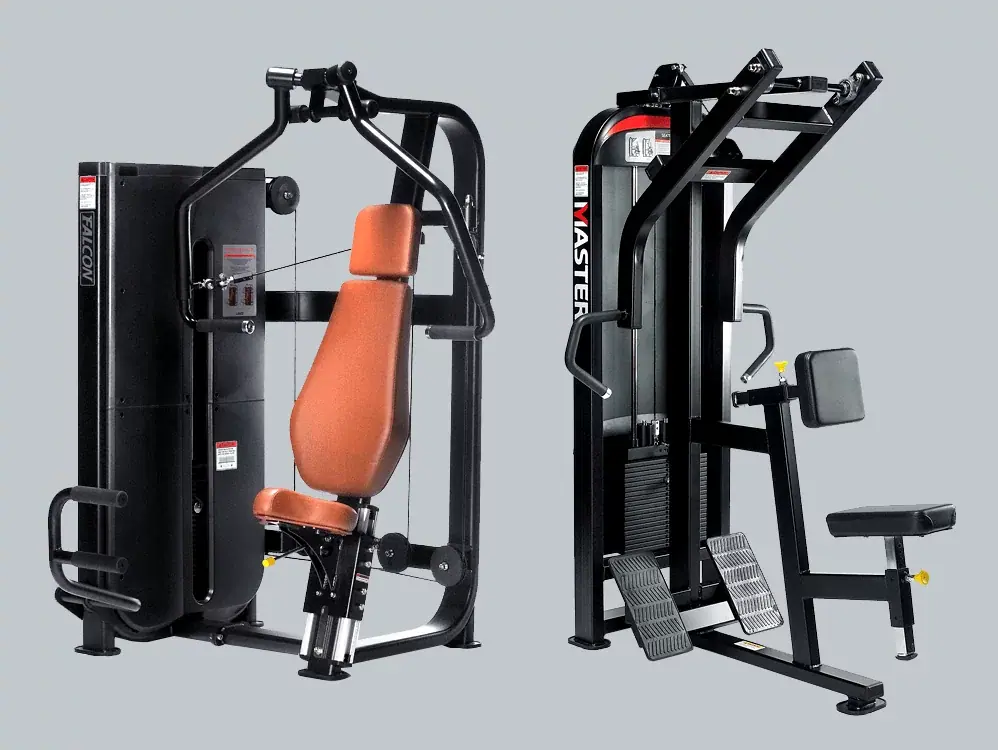
A multi-station gym gathers several selectorised stations on a single frame. For an operator it is a way of buying a full strength offer within a very small footprint, and of keeping unsupervised users on guided movements. It is also a machine that limits how many people can train at once, so it suits some rooms far better than others. This guide covers what a multi-station actually delivers, how to specify one, the brands worth considering, how to get the most from it in service, and the mistakes that cost the most money.
What a multi-station gym really is
A multi-station, sometimes called a multi-gym, combines two, four, six or more workstations around one central structure and one or more weight stacks. A typical configuration will offer a lat pulldown, a seated row, a chest press, a leg extension and curl, a cable column and a pec deck, all sharing the same chassis and the same footprint.
The design principle is simple: instead of buying six separate machines, each with its own base, its own stack and its own circulation space, you buy one structure that hosts the same movements. Explore the range of multi-station gyms to see the configurations available.
The real advantages for an operator
Floor area
This is the decisive argument. A multi-station replaces a series of single machines and their individual clearances with one compact block. In a hotel fitness room, a residential gym, a corporate wellness space or a small municipal facility, that difference often decides whether a strength offer exists at all.
Safety in unsupervised hours
Guided movements with an enclosed weight stack remove the two main risks of free weights without supervision: a dropped bar and a load that cannot be released. A multi-station lets a facility open a strength area without permanent staff on the floor.
Simple induction
Pictograms, fixed movement paths and pin-selected loads make a multi-station one of the fastest pieces of equipment to explain to a new user. That matters where the average user is a beginner rather than an experienced lifter.
One maintenance point
One frame, one set of cables and pulleys, one service visit. Spare parts and consumables are concentrated rather than spread across six suppliers.
Where a multi-station is the wrong answer
The trade-off is throughput. A four-station unit can only be used by four people at once, and in practice fewer, because adjacent stations interfere with each other. On a busy commercial floor at peak hours, separate machines will always serve more members per square metre of usable capacity.
A multi-station also has a ceiling on load. If the membership includes serious lifters, it complements a rack and free-weight area rather than replacing it. See the range of selectorised machines for higher-throughput alternatives.
How to specify the right multi-station
Start from the users, not the catalogue
Define who trains, when, and in what numbers. A residential gym with fifteen simultaneous users in the early evening has nothing in common with a rehabilitation centre working one-to-one. The number of stations follows from that count, not from a price bracket.
Measure the real footprint
The machine footprint is not the space required. Add the circulation and the working envelope of each station: a user pulling a lat bar needs clearance behind, a user on a leg extension needs clearance in front. Ceiling height also constrains lat pulldown and cable column positions. Take these figures from the technical drawing of the specific model, never from an estimate.
Check the stations against the programme
Count the movements you actually want to offer, then check that the unit covers them without contortion. A station that exists on the spec sheet but is uncomfortable to use will be ignored within a month.
Weight stacks and increments
Look at the maximum load per station and, just as important, at the size of the increments. Wide increments make progression impossible for lighter users, which is a real problem in mixed-ability facilities.
Build quality and standard
For any indoor installation open to the public, the reference is EN ISO 20957-1 class S, the professional class for equipment in commercial facilities. Frame section, weld quality, cable specification, bearing quality and upholstery density are what separate a unit that survives ten years of continuous use from one that does not.
Comparison at a glance
| Criterion | Multi-station gym | Separate machines |
|---|---|---|
| Floor area | Compact, one block | Higher, each unit needs its own clearance |
| Simultaneous users | Limited by the number of stations | One per machine, no interference |
| Unsupervised use | Well suited | Well suited |
| Maintenance | Concentrated on one frame | Spread across several units |
| Best fit | Hotels, residences, corporate rooms, small facilities | Commercial gyms and clubs at volume |
Brands worth shortlisting
| Brand | Positioning |
|---|---|
| Lexco | Durable selectorised equipment for full-service clubs, cardio and strength |
| Bodytone | Complete catalogue, strong value for money |
| Ziva | Wide choice of exercise options and accessories |
| Light In Fitness | Strength equipment, racks, cages and sports flooring |
None of these is universally the right answer. The choice depends on budget, on the number of stations required and on whether the room is dominated by beginners or by experienced users.
Getting the most out of the machine in service
- Install it properly. Level the frame, check the floor loading and leave the manufacturer clearances. A multi-station installed too close to a wall loses a station in practice.
- Run a proper induction. Seat height, pad position and load selection should be explained once to every new user. It takes five minutes and prevents most of the misuse.
- Vary the programming. The unit covers the whole body; publish two or three suggested circuits on the wall so the same three stations are not the only ones used.
- Schedule maintenance. Cables, pulleys, guide rods and upholstery are wear items. A quarterly inspection and an annual service keep a multi-station safe and quiet.
- Pair it with benches and free weights where the room allows. A multi-station plus two professional weight benches covers far more programming than the multi-station alone.
Common mistakes when buying
- Not defining the use first. The number of stations must follow from peak occupancy, not from a target price.
- Ignoring circulation. Measuring only the machine footprint is the single most frequent planning error.
- Buying stations that will not be used. Extra stations that do not match the programme add cost, footprint and maintenance for nothing.
- Buying on price alone. On a commercial floor, an underspecified frame fails in a way that costs far more than the initial saving.
- Skipping the standard. Equipment that is not built to the professional class has no place in a facility open to the public.
Frequently asked questions
How many stations does a small facility need?
The honest answer is that it depends on peak simultaneous occupancy, which only the operator can measure. Count the users present at the busiest hour and specify from there rather than from a generic recommendation.
Can a multi-station replace a full strength floor?
In a hotel, residence or corporate room, usually yes. In a commercial gym with a strength-focused membership, no: it complements racks and free weights rather than replacing them.
Does a multi-station include cardio functions?
No. A multi-station is a guided strength machine. Cardio work needs dedicated equipment, and any configuration presented as combining both should be examined closely before it is specified.
What maintenance does it need?
Regular inspection of cables, pulleys and guide rods, cleaning of the upholstery and an annual service. The exact intervals are set by the manufacturer for each model.
Specifying your machine
Every room imposes its own constraints: floor area, ceiling height, floor loading, user profile and opening hours. The most efficient route is to share the plan and the intended use, then work back to a configuration that fits. Request a quote and receive a costed proposal built around your room and the way it is actually used.
Réalisations documentées
- Functional Rig inox – installations sur trois continents
- iGreenMill, tapis de course extérieur – installations sur trois continents