How to Choose Professional Strength Training Machines
Le choix d'un appareil professionnel part des besoins de l'établissement : public accueilli, fréquentation attendue et surface disponible. Ces paramètres déterminent le ratio entre charges guidées et charges libres, puis le nombre de postes. La classe d'usage EN ISO 20957 et la disponibilité des pièces closent la sélection.
Choosing strength equipment for a commercial gym is not a shopping exercise, it is a capacity decision. The right selection starts with who walks through your door, how often, and how many square metres you have to work with. Get that order wrong and you end up with an impressive-looking floor where three machines are permanently queued and six are never touched. This guide sets out the sequence a professional buyer should follow.
Start with the members, not the catalogue
Before comparing brands, describe your users honestly. A boutique studio serving young members who want hypertrophy work needs a very different floor from a hotel gym, a corporate facility, a rehabilitation centre or a club with a large over-sixties membership.
Three questions settle most of the specification:
- Which movement patterns will actually be trained? Push, pull, hinge, squat and carry cover almost everything. Every pattern should have at least one station that a beginner can use unaided.
- What is the expected footfall at peak hour? That number, not the total membership, dictates how many duplicate stations you need.
- How much instruction will be available? A floor with no coaching present needs a higher proportion of guided-resistance machines, because the movement path is constrained and the risk of a bad repetition is far lower.
A gym that answers these three questions can size its equipment list before ever opening a price list.
Build quality: what professional actually means
The word professional is used loosely in this market. In practice it comes down to a standard and a supply chain.
Indoor training equipment is covered by EN ISO 20957-1, and the relevant use category for a staffed commercial facility is class S. Anything sold for private or unsupervised household use falls outside what a gym operator should be installing, whatever the marketing says. Ask for the declaration, in writing, for every reference on the quotation.
Beyond the certificate, look at the parts that wear:
- Frame section and weld quality, since deflection under load is what eventually kills a machine.
- Bearings and guide rods on selectorised stations, and the pulley diameter, which determines how smooth the cable feels after two years.
- Upholstery density and the ease of replacing a pad without taking the machine out of service.
- Availability of spare parts and the lead time on them. A cheap machine with no parts pipeline is a machine you will scrap.
Ergonomics belong in the same paragraph as durability. Adjustable seats and back pads with a wide range, clear pictograms and a start position a novice can reach without help are what keep a station in use.
Space: guided load, plate loaded and free weights
Selectorised machines take the most floor area per exercise, because each station generally trains one movement. In exchange, they are the fastest to use, the easiest to supervise and by far the most approachable for a beginner. Our selectorised machines cover the full range of patterns.
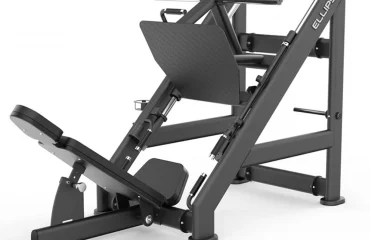
Plate-loaded machines sit in the middle. They keep a guided movement path but give a stronger training stimulus and cost less per station than an equivalent selectorised unit, at the price of loading and unloading time. See the plate-loaded range for the usual configurations.
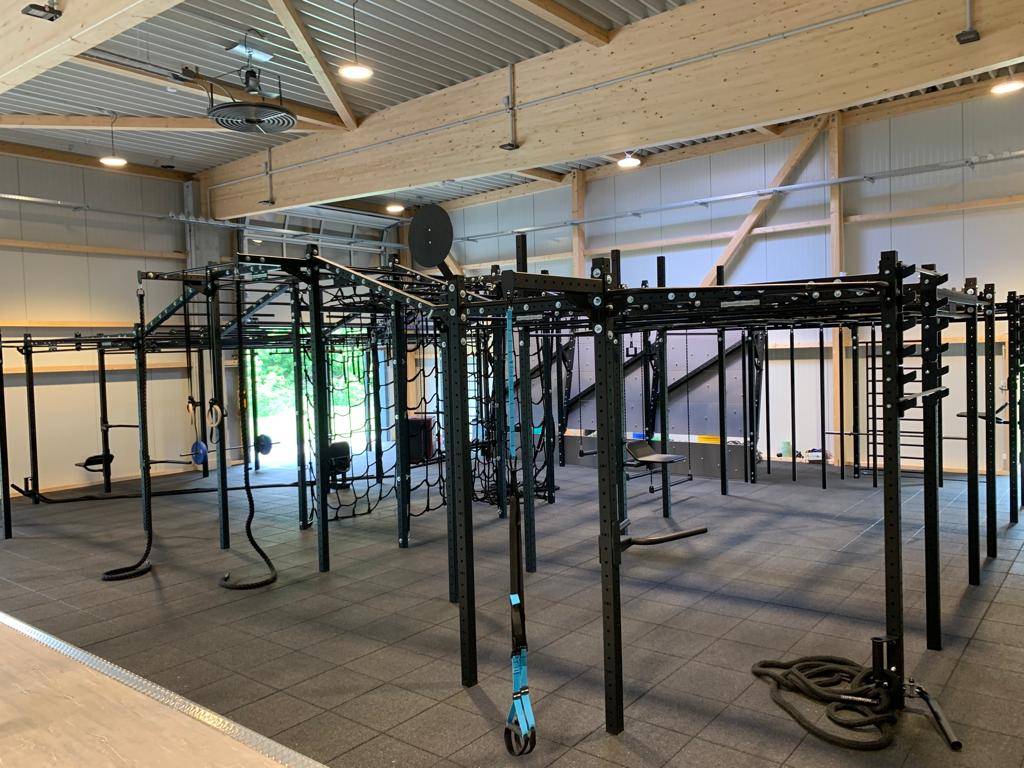
Free weights are the most space-efficient way to buy training capacity: a rack, a bench and a set of dumbbells covers dozens of exercises in a few square metres. The trade-off is supervision, flooring and storage. Free-weight areas need a rubber floor rated for dropped loads and a storage discipline that keeps the walkways clear.
| Solution | Strength | Constraint |
|---|---|---|
| Selectorised stations | Approachable, fast, safe without coaching | Highest floor area per movement |
| Plate-loaded stations | Strong stimulus, lower cost per station | Loading time, plate storage |
| Racks, benches and free weights | Most exercises per square metre | Needs supervision, flooring and storage |
A workable starting ratio for a general commercial gym is roughly half guided stations, a quarter plate-loaded and a quarter free weights, then adjusted according to the answers in the first section.
Fitting the users you actually have
Body size is the most commonly overlooked criterion. A machine with a narrow seat-height range excludes the shortest and tallest members of your community, and those are precisely the people most likely to give up. Check the stated user height range and the minimum starting load. A first weight increment that is too heavy makes a machine useless to a deconditioned beginner and to anyone in a rehabilitation programme.
Accessibility of the controls matters too. Pin-loaded selection is intuitive; a machine that needs a manual to adjust will be used incorrectly or avoided entirely.
Whenever you can, try before you buy. Ten minutes on a machine tells you more than a specification sheet, and a supplier who cannot arrange a trial or a showroom visit is telling you something.
Frequently asked questions
Which standard should commercial strength equipment meet?
EN ISO 20957-1, use category class S, for equipment installed in a supervised commercial facility. Ask for the declaration for each reference, not a generic brand statement.
How many stations do I need?
Size the floor on peak-hour attendance rather than total membership, and count duplicates for the three or four most popular movements. Chest press, leg press, lat pulldown and a cable station are almost always the bottlenecks.
Are free weights cheaper than machines?
Per exercise, generally yes, and they use less floor area. The saving is partly offset by the flooring, the storage and the supervision that a free-weight area requires.
What flooring does a strength area need?
Rubber tiles or rolls specified for the loads involved, with a heavier grade under lifting platforms and drop zones. The floor is part of the equipment budget, not an afterthought.
How long should professional machines last?
With correct servicing, a decade or more of commercial use is normal for a well-built frame. What limits life in practice is upholstery, cables and the availability of spare parts.
Build your equipment list with us
Light In Fitness has equipped more than five hundred sites since 2013, from single-room club gyms to multi-storey commercial facilities. Send us the floor plan, the opening hours and the profile of your members, and we will return a station-by-station layout with the circulation drawn in. Browse the full strength training machines range, then request a quote and we will build the list with you.
À lire aussi sur le même thème
- Professional Strength Training Machines: A Buyer Guide
- Banc de Développé Décliné Olympique Bodytone FC06 : L’outil idéal pour s’entraîner
- Banc de Développé Couché Olympique FBC08 Bodytone: L’Accessoire Indispensable pour une Entraînement de Force Exceptionnel
- Bodytone FBC07 Olympic Incline Press: Specification, Use and Limits for Commercial Gyms