Professional Strength Training Machines: A Buyer Guide

In short: three things decide how long a professional strength machine lasts: the quality of the frame and its welds, the quality of the guides and bearings, and the regularity of maintenance. A monthly check of fixings, cables and upholstery prevents most of the failures seen in heavy duty use.
Professional strength training machines are built for a different job than the equipment sold for private use. They are specified for gyms and fitness clubs, hotel and residence facilities, hospitals and physical rehabilitation centres, university and military facilities. They have to deliver controlled, repeatable resistance to users of very different body sizes and fitness levels, hour after hour, with a safety margin that does not depend on the user knowing what they are doing.
This guide covers what actually separates a professional machine from a consumer one, the main families of equipment, what to check before you buy, and the maintenance routine that keeps a floor of machines in service.
What makes a machine professional
The dividing line is not the badge on the frame, it is the specification behind it. Indoor equipment installed in a facility open to a public should meet EN ISO 20957-1 class S, the professional class. Class S covers equipment intended for use in supervised, commercially operated environments with high daily throughput. It is the reference to ask for in a tender, and the reason a class S machine costs more than a similar looking one is that the steel section, the welds, the bearing quality and the fatigue testing behind them are not the same.
Beyond the class, three components determine service life:
- The frame and its welds. Section thickness and weld quality decide whether a machine stays square after several years of loaded cycles. A frame that flexes puts every other component out of alignment.
- Guides and bearings. Linear guides, bushings and pulley bearings carry the movement. Cheap bearings feel acceptable on delivery and rough within a year of shared use.
- Maintenance. The best frame in the world fails early if cables are never inspected and fixings are never retorqued.
The main families of equipment
Different machine families answer different needs, and most commercial floors mix them.
Selectorised machines use a weight stack and a pin. Resistance is set in seconds, the movement path is guided, and the risk of a bad rep is low. They suit beginners, group circuits, rehabilitation and any setting with limited supervision. Our selectorised strength machines cover the standard muscle groups with adjustable seats and backrests.
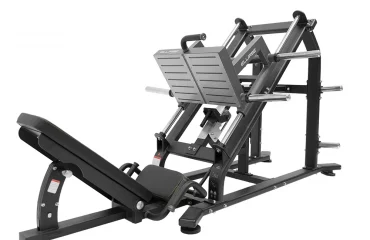
Plate loaded machines take olympic discs rather than a stack. The load feel is closer to free weights, the maximum load is higher, and the purchase price per station is generally lower because there is no stack to pay for. They suit strength focused clubs and performance settings. See the plate loaded range.
Multi-station units combine several exercises around a shared frame and shared stacks. They are the classic answer for a small floor area, a hotel gym or a residence, where a full circuit of individual stations would not fit. Our multi-station gyms are built for that brief.
Benches, racks and cable stations complete the floor. Free weight work through a full range of motion remains the basis of most programmes, and machines complement it rather than replace it.
What professional machines change for your members
Guided resistance lets a user load a specific muscle group without having to master a complex technique first. That produces measurable gains in muscular strength and endurance, and it lets a coach progress a beginner safely from the first session. For an operator, that translates into members who see results and renew.
Well designed machines also work through generous ranges of motion, which supports mobility rather than restricting it. Leg extension, leg curl and chest press stations with correctly positioned pivots let a user move through the full amplitude the joint allows, and the seat and backrest adjustments are what make that possible across different body heights.
The safety argument is the one that matters most on a busy floor. A machine provides more support and stability than a free barbell, which reduces the consequences of poor technique for an unsupervised member. Grips and handles hold posture. Stack pins and load limits cap what an inexperienced user can attempt. None of this removes the need for supervision, but it lowers the floor of what can go wrong.
Features worth checking in a specification
Adjustable resistance in usable increments. A weight stack that steps in large jumps is unusable for a beginner or a rehabilitation patient. Ask for the increment, not just the total.
Adjustable seat and backrest. Comfort is the visible part, joint alignment is the real one. A pivot that does not line up with the user knee or shoulder loads the joint rather than the muscle.
Exercise coverage. Check that the range you buy covers chest, back, shoulders, arms and legs without leaving a gap that members will complain about. Some stations offer articulated arms and bars that widen the exercise list on the same footprint.
Ergonomics and finish. Upholstery quality, grip material and edge protection are what members judge in the first ten seconds, and they are also consumables you will replace over the life of the machine.
Consoles. Some machines carry displays that log repetitions and load. Useful for member engagement, but never the reason to choose one frame over another.
Maintenance and safety
Cleaning and lubrication are the whole of preventive maintenance on a strength floor. Equipment should be wiped after each use to remove sweat, which is what corrodes chrome and degrades upholstery. Providing gym wipes at each zone is the cheapest maintenance measure available to an operator.
Lubrication of moving parts reduces friction and slows wear. Guide rods, pivots, bars and machine linkages need a protective lubricant on the schedule the manufacturer specifies, no more and no less. Over-lubrication collects dust and does its own damage.
Regular inspection catches what cleaning does not: loosened bolts, damaged cables, frayed crimps, cracked upholstery, worn adjustment pins. A weekly visual check of cables and fixings, backed by a fuller monthly check, covers most of the risk. Record it. In a commercial facility the inspection log is what demonstrates that you exercised your duty of care.
Correct use matters as much as correct maintenance. Manufacturer instructions define the intended movement of each station, and a multi-station unit in particular allows a wide range of exercises that only stay safe when each is performed as designed. Posture and form matter: excessive momentum, arching and swinging are what turn a controlled rep into an injury, and some movements need adapting for some users.
Finally, layout is a safety measure. Sufficient clearance between machines prevents collisions and gives users room to enter and exit a station. Leave circulation space in the plan rather than filling every square metre with equipment.
Budget, space and supplier
Budget. The cost of a professional strength station varies widely by type, brand and build quality. As an order of magnitude, plan on 1,000 to 5,000 EUR excluding VAT per machine. Machines built for commercial use are engineered for continuous duty, and that engineering is most of the price difference against equipment intended for private use.
Floor space. Take the footprint of the machine and add the space needed to use it. A multi-station unit can require up to 19.64 m2 once the working area around it is counted. Check that the room can accommodate the machine and still allow safe, efficient use.
Brand and after sales. Choose a supplier whose equipment is built for commercial use, and weigh warranty terms, customer service and above all the availability of spare parts. Cables, upholstery, pulleys and adjustment pins are consumables. A machine whose spares cannot be sourced in five years is not a saving. Reviews and recommendations from other operators are worth collecting before you commit.
Investing in high quality professional strength equipment is not only a safety decision. Equipment quality is visible, members judge a club by it, and it is one of the things that turns a trial into a membership.
Frequently asked questions about strength machine maintenance
How often should a professional strength machine be serviced?
A weekly visual check of cables and fixings, backed by a fuller monthly check of upholstery, bearings and tightening points, covers most of the risk. Increase the frequency with the number of daily users.
What wears out first on a machine?
Cables and their crimps, pulleys, seat upholstery and adjustment pins. These are consumables: replacing them is part of running a gym, not a defect in the equipment.
Do machines need to be anchored to the floor?
It depends on the type. Tall structures, racks and cages need anchoring. Selectorised machines are generally stable through their own mass, but the manufacturer instructions are the authority and the operator carries the responsibility.
Specifying your strength floor
Choosing the right professional strength equipment decides how your floor performs for the next ten years. Weigh the available space, the class of the equipment, build quality, spare part availability and the experience of other operators. Send us the room dimensions, the member profile and the budget envelope, and we will come back with a layout and a costed proposal. Browse the full professional strength training machine range or request a quote.
À lire aussi sur le même thème
- Banc de Développé Décliné Olympique Bodytone FC06 : L’outil idéal pour s’entraîner
- Banc de Développé Couché Olympique FBC08 Bodytone: L’Accessoire Indispensable pour une Entraînement de Force Exceptionnel
- Bodytone FBC07 Olympic Incline Press: Specification, Use and Limits for Commercial Gyms
- Professional Strength Training Equipment Manufacturer