Hip Thrust Machine: Which Muscles Does It Work?
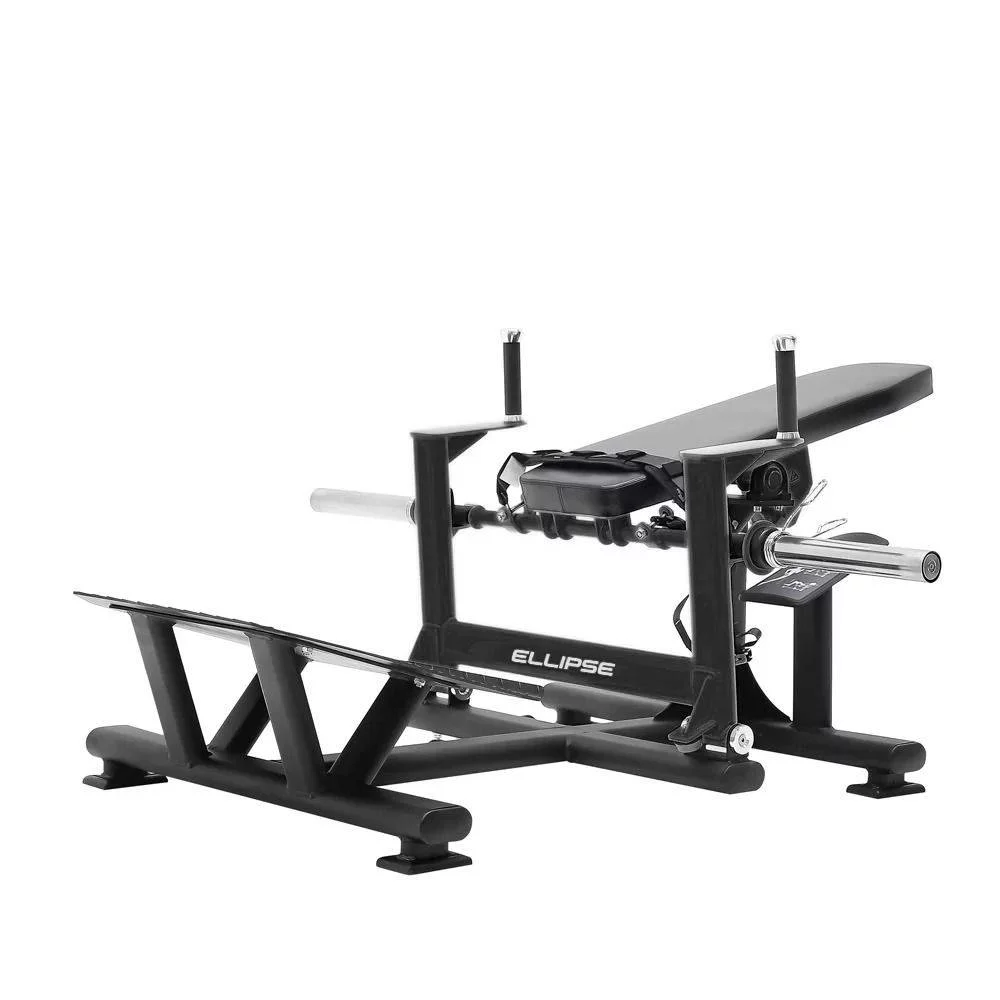
Hip thrust stations have moved from a niche accessory to a structural part of the lower-body zone in commercial gyms, cross-training boxes, hotel fitness suites and rehabilitation centres. Before allocating floor space and budget to one, it pays to be precise about what the movement actually recruits, and about where a dedicated machine earns its place against a bench and a loaded barbell.
The gluteal complex: the primary target
The hip thrust is a horizontal hip extension. At lockout the load vector is roughly perpendicular to the femur, so tension on the gluteal group peaks exactly where squat and deadlift patterns tend to lose it. Three muscles are involved:
- Gluteus maximus – the prime mover. It drives the pelvis upward and holds the locked-out position against the load.
- Gluteus medius – stabilises the pelvis in the frontal plane and prevents the knees from collapsing inward under heavier loads.
- Gluteus minimus – works alongside the medius on abduction and internal rotation of the hip.
A resistance band placed around the thighs, a common coaching cue on this machine, raises the abduction demand and brings the medius and minimus further into the pattern.
The supporting muscles
The hip thrust is not an isolation exercise in the strict sense. Around the gluteal group, several chains contribute:
- Hamstrings – biceps femoris, semitendinosus and semimembranosus assist hip extension, with their share rising as the feet are placed further from the hips.
- Quadriceps – they hold the knee angle and take a larger share when the feet are placed closer to the bench.
- Adductors – they contribute to hip extension and to frontal-plane control.
- Trunk – rectus abdominis, transversus abdominis and the lumbar erectors work isometrically to keep the pelvis and rib cage aligned. This is the part users most often neglect.
| Muscle group | Role in the movement | Level of recruitment |
|---|---|---|
| Gluteus maximus | Hip extension, lockout | Primary |
| Gluteus medius and minimus | Pelvic stabilisation, abduction | Strong secondary |
| Hamstrings | Assist hip extension | Secondary, varies with foot placement |
| Quadriceps | Maintain knee angle | Secondary, varies with foot placement |
| Trunk and lumbar erectors | Isometric stabilisation | Support |
Why a dedicated machine rather than a bench and a barbell
In a supervised facility with a handful of experienced lifters, a bench and an Olympic bar are enough. In a club running back-to-back sessions, three arguments usually decide the purchase:
- Throughput. Loading and unloading a barbell across a member’s hips is slow and needs a spotter. A machine with a guided carriage and a padded restraint cuts set-up to seconds, which matters when the same station has to serve a full class.
- Accessibility. Members who cannot get under a bar on the floor – older users, deconditioned beginners, rehabilitation patients – can use a machine safely. That widens the addressable audience of the zone.
- Consistency of the movement path. A guided path limits lumbar hyperextension at lockout, the most common technical fault on the free-weight version.
Specifying a hip thrust station for a professional facility
Whatever the brand, apply the same checklist:
- Loading system. Plate-loaded stations suit strength-oriented rooms and give a familiar feel to experienced users. Selectorised stations suit high-traffic clubs, circuits and rehabilitation, where fast weight changes matter more than absolute load.
- Certification. For indoor equipment, ask for compliance with EN ISO 20957-1 class S, the class intended for supervised professional use. Anything positioned below that class does not belong in a commercial room.
- Frame and upholstery. Check the steel section, the weld quality and the density of the hip pad, which takes the whole load and is the first part to wear.
- Footprint and flooring. Plan the free space in front of the station for foot placement and coaching, and specify a floor able to take dropped plates in the loading area.
Our range covers both approaches, from the plate-loaded Gold Line hip thrust machine to the heavier Lexco LPS-124 hip thrust machine. When the brief is a complete lower-body area rather than a single station, the Booty Area configuration groups the stations that make the zone coherent.
Frequently asked questions
Does the hip thrust machine work the abdominals?
Indirectly. The trunk works isometrically to hold the pelvis and rib cage in line. It is a stabilisation demand, not an abdominal training exercise.
Can the exercise be programmed for beginners?
Yes, and this is one of the machine’s strengths. Body weight or a light load is enough to learn the pattern before any progression. A guided station makes that first stage much easier to supervise.
Does foot placement change the muscles worked?
It changes the balance. Feet further forward shift work toward the hamstrings; feet closer to the bench increase the quadriceps share. The gluteal group remains the prime mover in both cases.
Which other stations complete a lower-body zone?
Typically a glute extension or kickback machine, an abductor and adductor pair, and a leg press or pendulum squat. Grouping them keeps the circuit readable for members and easier to supervise for staff.
Equipping your lower-body zone
Choosing a hip thrust station is a floor-plan decision as much as a muscular one: loading system, footprint, expected traffic and the profile of your members all weigh on the specification. Send us your floor plan and your usage brief and we will come back with a configured proposal – request a quote.