Functional training in a commercial gym: equipment, layout and programming

Functional training in a commercial gym: equipment, layout and programming
Functional training organises effort around movement patterns rather than around isolated muscles: push, pull, hinge, squat, rotate, carry and brace. For a gym operator, a hotel fitness manager or a local authority running a sports hall, it is one of the few investments that serves a deconditioned newcomer, a coached small group and a competitive athlete with the same footprint of equipment. This guide covers what the method actually involves, what it changes for members, and how to specify and lay out a functional area that stays safe, busy and profitable.
The fundamentals: movement patterns, balance and muscular chains
The starting point of functional training is the everyday movement inventory. Members push, pull, lift, twist, carry an unbalanced load and catch themselves when they lose their footing. A functional session reproduces those patterns under load and under control, instead of isolating a single joint on a fixed path. That is the whole difference between training a muscle and training a movement.
Balance and stability sit at the centre of the method. Every unilateral exercise, every unstable load and every change of direction forces the nervous system to manage the body as a whole. The more varied the movement, the more efficiently the body learns to organise itself, which is exactly what a member notices first: they move better before they look different.
The third pillar is the muscular chain. Muscles do not work in isolation in real tasks; they work in sequences that transfer force from the ground to the hands. Training those chains rather than their individual links is what produces carry-over into sport, into work and into daily life. For an operator, this is also what makes a functional area so versatile: one rig, one set of accessories, and an almost unlimited number of session formats.
What functional training does for athletic performance
Because the exercises recruit several muscle groups at once, they develop coordination, usable strength and agility together rather than in separate blocks. Members who split their week between machines and a functional area typically progress faster on both, simply because the transfer works in both directions.
The exercise library is deliberately simple. Single-leg squats, lateral lunges and push-ups with rotation cover a large part of the pattern list on their own, and they scale from bodyweight to loaded variants without any change of station. That scalability is what allows a coach to run a mixed-ability group without splitting it, and it is the reason functional zones tend to hold their occupancy rate far better than single-purpose equipment.
Suitable for every level: a commercial argument, not a slogan
Functional training genuinely adapts across fitness levels, and that matters commercially. The same station serves a member coming back from a long sedentary period and one training for competition, because the variable is the load, the range and the tempo, not the machine. Nothing needs to be bought twice.
For the non-athlete majority of your membership, the selling point is not performance at all. It is carrying shopping without a stiff neck, changing a light bulb without hesitating on the step, and walking down stairs comfortably after a training session. Members who feel that difference in their week renew. That is a retention argument, and it is the one worth putting on your membership pages.
Injury prevention and duty of care
Functional work is also a prevention tool, because it improves coordination, strength and suppleness across the muscular chains at the same time. A dynamic side plank strengthens the trunk and the obliques and makes movement cleaner under fatigue. A single-leg squat improves balance while loading the legs, glutes and trunk together, which is precisely the combination that protects against sprains and muscle tears.
None of this replaces supervision. A functional area is only as safe as its layout: clear fall zones, unobstructed circulation, accessories returned to storage, and a floor specified for impact. In practice, most incidents in functional zones come from congestion and from equipment left on the floor, not from the exercises themselves.
Specifying the area: what to buy first
Functional training needs less hardware than most operators expect, but every item has to withstand collective use. Choose ranges built for continuous professional use, with spare parts and after-sales support available, and resist the temptation to fill the space before you know how it will be programmed.
| Zone | Purpose | Catalogue |
|---|---|---|
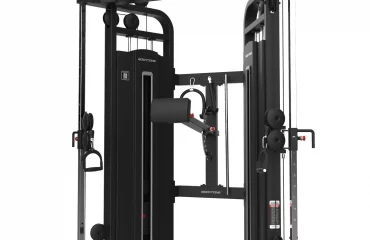
| Rig or functional station | Pull-ups, suspension work, band anchors, integrated storage | Functional training rigs |
| Accessories | Kettlebells, medicine balls, dumbbells, sandbags, steps | Fitness accessories |
| Floor | Impact absorption, grip, noise and vibration control | Rubber gym flooring |
| Conditioning block | Rowing, air bike, ski and running formats for interval work | Cardio equipment |
Storage deserves more attention than it usually gets. An accessory that has no home ends up on the floor, and a floor covered in accessories is a fall zone that no longer exists. Plan the storage at the same time as the equipment, not afterwards.
Building the programme
Equipment does not create a programme. Define the session formats you intend to sell first, then buy against them. Open access, coached small groups and rehabilitation-oriented slots do not need the same accessory count or the same circulation, and the difference shows up in the floor plan long before it shows up in the invoice.
For members with no training history, or returning after injury or a long inactive period, progression should be set with a qualified coach or a health professional. Volume comes after technique. That sequence protects your members and protects you.
Frequently asked questions
Does a functional area require a lot of floor space?
It requires usable space more than large space. Circulation, fall zones and access to storage matter more than the number of stations, and a smaller area that is easy to move through will out-perform a crowded one.
Can functional training coexist with machine-based strength training?
Yes, and the two support each other. Machines give controlled, isolated loading; functional work gives coordination and transfer. Most balanced facilities run both and route members between them.
What is the most common specification mistake?
Buying accessories before deciding on the floor. Impact absorption, grip and noise control determine what can safely be dropped, dragged or carried in the area, and retrofitting a floor around installed equipment is always more expensive than doing it first.
Is functional equipment suitable for hotels, schools and municipal facilities?
It is often the best fit, precisely because it is compact, scalable and does not require one machine per exercise. The constraint is supervision: unsupervised sites should favour simple, robust stations over technical loaded work.
Equipping your functional area
Functional training is not a trend to bolt on to an existing floor plan; it is a way of getting more programming out of less hardware. Define your formats, specify the floor, choose professional-grade stations and accessories, and plan the storage from day one. Send us your surface area, your ceiling height and the formats you want to run, and we will come back with a coherent equipment list and a layout proposal: request a quote.
À lire aussi sur le même thème
- Entraînement Ultime Pour Les Jambes : Les Meilleurs Exercices Et Routine Complète
- Le Meilleur Programme d’Entraînement en Salle Pour Gagner Du Muscle | PureGym
- Essential CrossFit Equipment: A Complete Guide for Box Operators
- Entraînement fort des cuisses – les meilleurs exercices pour les parties inférieures, exemple de plan d’entraînement