Full Body Training Programme: The Most Efficient Way to Build Strength
Le programme full-body sollicite l'ensemble des groupes musculaires à chaque séance, ce qui convient aux fréquences de deux à trois séances par semaine. La fréquence de stimulation par groupe musculaire y est plus élevée que dans un programme divisé à volume égal. Il demande peu de postes simultanés, ce qui limite l'encombrement en salle.

The full body programme is the most underrated training format in the gym. While most lifters grind through complex splits that hit one muscle group per session, the research shows that full body training — working the whole body every session — produces superior results for the majority of trainees. Whether you are a beginner, a time-pressed intermediate or an athlete optimising results, full body deserves your attention. Here is the complete guide.
What is a full body programme?
A full body programme works all the major muscle groups — legs, back, chest, shoulders, arms, core — within a single session. Instead of dedicating a whole day to chest or legs, the work is spread across the entire body at every workout.
- Typical frequency: 3 sessions per week (for example Monday, Wednesday, Friday) with a rest day between sessions
- Volume per session: 1–3 exercises per muscle group, 8–12 exercises in total, 45–75 minutes
- Weekly volume: each muscle trained 3 times per week at moderate volume — equal to or greater than a classic split overall
The science behind full body training
- Optimal training frequency: meta-analyses show that training each muscle 2–3 times per week produces more hypertrophy than once per week at equal total volume. Full body 3x/week hits this frequency naturally.
- Sustained protein synthesis: muscle protein synthesis stays elevated for 24–48 hours after a session. Training each muscle three times weekly keeps it elevated almost permanently, whereas a once-a-week split leaves five days without stimulus.
- Time efficiency: three 60-minute sessions total 3 hours per week — versus 5–7 hours for a classic push/pull/legs split.
- Flexibility: miss a session and nothing is lost — every muscle gets trained at the next one. Miss “leg day” on a split and legs get nothing that week.
- Better recovery: moderate per-muscle volume each session (3–6 sets) means you are never too sore to function.
- High energy expenditure: working the whole body recruits more total muscle mass per session — ideal for fat-loss phases.
Beginner full body programme (3x/week)
Designed for trainees with 0–12 months of experience, built mainly on guided machines for safety. Rotate three sessions (A-B-C), increasing the load whenever you complete all repetitions with good technique.
- Session A: leg press 3×12, machine chest press 3×12, lat pulldown 3×12, machine shoulder press 3×12, leg curl 2×15, machine biceps curl 2×15, cable triceps extension 2×15, machine crunch 2×15
- Session B: goblet squat 3×12, incline machine press 3×12, machine row 3×12, lateral raises 3×15, leg extension 2×15, abductor machine 2×15, plank 3×30 sec
- Session C: leg press with high foot placement 3×12, machine dips 3×12, seated cable row 3×12, dumbbell shoulder press 3×12, leg curl 2×15, hammer curls 2×12, crunches 2×20
Every session can be completed on commercial guided machines — see our professional strength training machines.
Intermediate full body programme (3–4x/week)
For trainees with 1–3 years of experience, integrating barbell compounds and intensification techniques:
- Session A — lower-body emphasis: barbell squat 4×8, dumbbell bench press 3×10, barbell row 3×10, walking lunges 3×10 per leg, dumbbell shoulder press 3×10, barbell curl 2×12, plank 3×45 sec
- Session B — upper-body emphasis: barbell bench press 4×8, pull-ups or weighted pulldowns 4×8, leg press 3×12, single-arm row 3×10, dips 3×10, leg curl 3×12, Russian twists 3×20
- Session C — strength emphasis: squat 5×5 heavy, bench press 5×5, barbell row 5×5, overhead press 3×8, abductor machine 3×15, triceps extension 2×12, weighted crunches 3×12
- Session D (optional) — volume: leg press 4×12, incline dumbbell press 3×12, close-grip pulldown 3×12, lateral raises 3×15, leg extension/leg curl superset 3×12, arm superset 3×12, side plank 3×30 sec per side
Progression: weeks 1–4 master the compounds at moderate loads; weeks 5–8 add 5–10% load and end-of-session supersets; weeks 9–12 add drop sets, isometric pauses and slow tempo (3-1-2).
Full body for fat loss
Full body is the ideal format during a weight-loss or cutting phase: every session recruits the whole body for maximum energy expenditure, while the moderate per-muscle volume preserves strength and muscle despite the calorie deficit. A proven weekly structure: three 45–50-minute strength sessions (squat or press, machine chest press, pulldown, lunges, shoulder press, core, plus a short burpee/mountain-climber finisher) and two 20–25-minute HIIT sessions on a rowing machine, treadmill or cross-trainer (8–10 rounds of 30 seconds hard / 60 seconds easy). Pair it with the nutrition approach in our cutting programme guide.
Full body versus split: when to switch
| Stay on full body if… | Move to a split if… |
|---|---|
| You have under 2 years of experience | You have over 2 years of serious training |
| You can train only 3 times per week | You can train 4–6 times per week |
| Your main goal is fat loss | You want to specialise a lagging muscle group |
| You want general conditioning | You are preparing for a bodybuilding competition |
| You are returning after a long break | Your recovery (sleep, nutrition, stress) is optimal |
The honest truth: most trainees would get better results from full body than from a split, simply because each muscle is trained more frequently. Splits only genuinely win for very advanced lifters needing extreme per-muscle volume that cannot fit into one full body session.
The ideal equipment — and a note for gym operators
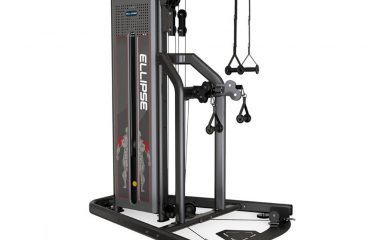
Full body training makes the best use of a complete machine park: guided machines for safe, fast transitions between muscle groups, benches for dumbbell compounds, racks for barbell squats and presses, cardio machines for warm-ups and finishers, and rubber flooring for the free-weights zone. For operators, full body is also the format most compatible with smooth gym flow: members circulate across the whole equipment park instead of queueing at the bench press on “international chest day”.
Mistakes to avoid
- Too much volume per muscle: full body is not leg day plus chest day plus back day in one 2.5-hour marathon. Cap it at 2–4 sets per muscle group per session.
- Always the same order: if you always start with legs, your upper body always trains fatigued. Rotate the exercise order.
- Neglecting compounds: squats, presses, rows and overhead presses are the foundation; isolation work is the garnish.
- No progression: like any programme, full body requires progressive overload week after week.
- Sessions too long: aim for 45–75 minutes; beyond that, quality drops.
Tracking progression: the habit that makes the programme work
Full body training rewards disciplined tracking more than any exotic technique. Log every session: exercise, load, sets, repetitions. Apply one simple rule — when you complete all prescribed repetitions with good technique, raise the load 2.5–5% next session. Review the log monthly: if a lift has stalled for three consecutive weeks, rotate the exercise variant (barbell to dumbbell, machine to cable) rather than adding junk volume. Bodyweight, waist measurement and a monthly progress photo complete the picture. This ten-minute habit is the difference between a programme on paper and results in the mirror.
FAQ — Full body training
Is full body suitable for beginners?
It is the recommended beginner format: motor learning is accelerated by repeating movements three times a week rather than once, and guided machines make it accessible from the first session.
Can you build muscle with full body?
Absolutely. Studies show full body 3x/week produces as much or more hypertrophy than a split at equal total volume, thanks to the higher stimulation frequency.
How long is a session?
45–75 minutes including the warm-up — one of the most time-efficient formats there is.
Are three sessions a week enough?
Yes, for the vast majority of trainees: three full body sessions deliver 9–18 sets per muscle per week, within the optimal hypertrophy range.
Can full body be combined with HIIT?
Yes — add two 20-minute HIIT sessions on a rower or cross-trainer on rest days to support fat loss without compromising recovery.