Floor-Standing Rack Structures for Gyms: The Essential Guide
Storage rarely appears on the first draft of a gym equipment list, and it is almost always the thing operators wish they had planned properly. Plates on the floor, barbells leaning against a wall and accessories scattered across the training area are not just untidy: they are a trip hazard, they shorten the life of the equipment and they make the room look neglected. Floor-standing racks solve all three problems at once, and they cost a fraction of the machines they serve.
This guide covers the main types of rack structure, what they bring to a training floor, how to choose one and how to get the most out of it once it is installed.
The main types of rack
- Plate racks. The workhorse of any free-weight area. Vertical or horizontal pegs hold Olympic plates by diameter, keep the set together and stop discs migrating around the room. A plate rack next to each platform or rack is the single most effective tidiness measure a gym can take.
- Barbell racks. Vertical or horizontal holders that store bars off the floor. Vertical models take very little floor area and suit a corner; horizontal models sit against a wall and make bar selection quicker during busy hours.
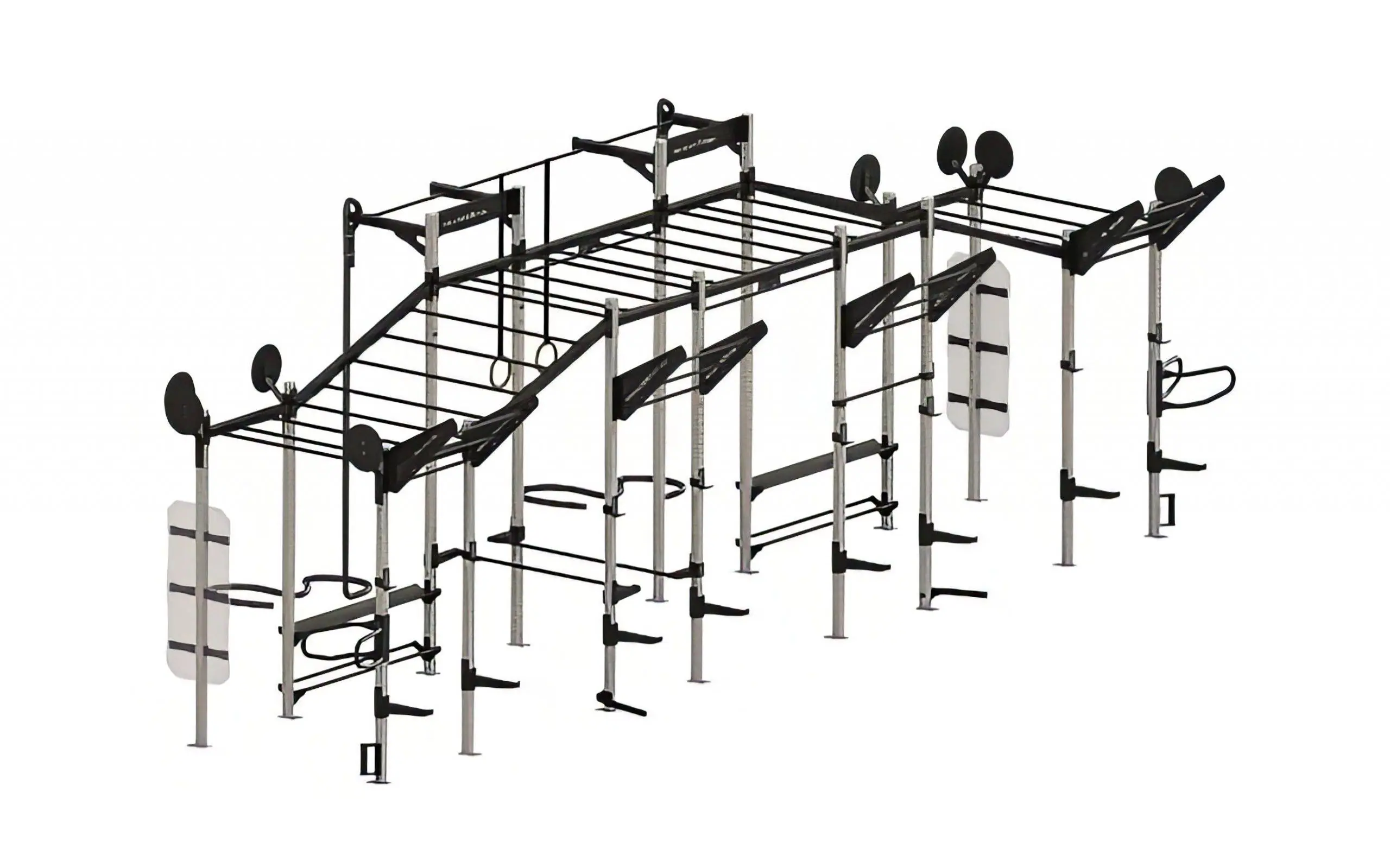
- Functional and multi-purpose racks. Combined units that hold several accessory families at once, from dumbbells and kettlebells to balls, bands and mats. They suit functional training areas where the equipment list is broad and the space is limited.
- Modular racks. Systems built from repeatable sections, so the storage grows with the equipment inventory. If you expect the offer to change, modularity avoids replacing the whole installation each time.
What floor-standing racks bring to a training floor
Space. Storage that occupies a defined footprint frees the rest of the room. A plate rack takes less area than the plates it holds when they are spread out, and it makes the circulation space around a platform genuinely usable.
Accessibility. Equipment stored at working height, sorted by weight and type, is faster to find and faster to put back. That matters most at peak hours, when the time members spend looking for a bar is time a station stands idle.
Safety. Loose plates and bars on the floor are the most common cause of minor injuries in a free-weight area, and they obstruct the routes staff need to reach a member quickly. Defined storage removes both risks.
Durability. Bars stored properly do not roll into each other, and plates on a rack are not dropped on top of one another. Storage extends the life of everything it holds.
Perceived quality. A tidy free-weight area reads as a well-run facility. It is one of the cheapest levers an operator has on how the room is judged.
How to choose your rack structure
Start from what you actually store. Count the bars, the plate sets, the dumbbell pairs and the accessories you own, and add the ones you expect to buy within a year. A rack sized for today fills up immediately.
Check the construction. Steel section, weld quality and the finish are what decide whether a rack survives daily loading and unloading. Look for protective inserts or rubber contact points where the metal touches bars and plates: they prevent chipping on both sides.
Match it to the zone. A crossfit box, a strength area with Olympic platforms and a functional training zone have different needs. Storage should sit within reach of the station it serves, which usually means several small racks rather than one large one.
Consider stability and fixing. Tall storage carrying heavy loads at height should be anchored or ballasted appropriately. Check what the manufacturer specifies and follow it.
Our gym storage furniture covers plate, bar and accessory storage for professional facilities, and it is designed to sit alongside our racks and cages and squat racks and power racks so the free-weight area works as one system.
Getting the most out of your storage
Plan it on the drawing. Storage positions belong on the floor plan alongside the machines, not decided on delivery day. A rack placed where nobody passes will not be used; one placed in a circulation route becomes an obstacle.
Show members how it works. Clear labelling by weight and a short induction do more for tidiness than any sign asking people to put things back. If the correct place for a plate is obvious, most people use it.
Maintain it. Storage is inspected less often than machines, precisely because it looks passive. Add it to the maintenance round: check fixings, look for deformation on the pegs, replace worn protective inserts.
Frequently asked questions
How many plate racks does a free-weight area need?
Enough that no member has to cross the room to return a disc. In practice that means one within reach of every platform or rack rather than a single central point, which is where equipment ends up abandoned.
Vertical or horizontal barbell storage?
Vertical holders use less floor area and suit corners and tight rooms. Horizontal wall-mounted or floor-standing models make bars quicker to select and are easier for members who cannot lift a bar vertically into a slot.
Is storage covered by the same standards as training equipment?
Storage is not a training station, so it does not fall under the same equipment class. It still has to be stable, correctly rated for the load it carries and installed to the manufacturer instructions, and it belongs in your regular safety inspection.
Can storage be added to an existing rig?
Often, yes. Many rig systems accept plate holders, bar holders and accessory attachments on the uprights, which saves floor area. Check the compatibility of the attachment with your specific rig before ordering.
Planning storage with Light In Fitness
Light In Fitness has equipped gyms, clubs, hotels, local authorities and sports facilities since 2013, including the storage that keeps a free-weight area usable. Send us your equipment inventory and your floor plan and we will propose the storage to match. Request a quote and our team will come back to you.