European Manufacturer of Parkour, Ninja and Street Workout Equipment

Parkour, ninja courses and street workout now attract wider interest. Public authorities across Europe face demand for outdoor training spaces with free access. Light In Fitness designs and manufactures equipment for these projects. Municipalities can use it to expand outdoor fitness provision. It also meets a broader aim: making urban space active, free to use and open to everyone.
Why specify a European manufacturer for parkour and street workout equipment?
Working with a European specialist brings practical benefits. This applies to parkour equipment, ninja warrior rigs and street workout structures. First, you have direct access to the technical team. One contact follows the project from design to installation. That continuity helps keep a public tender on schedule.
Second, a specialist knows the safety framework. European manufacturers work with outdoor sports standards and the files inspection bodies request. EN 16630 covers permanently installed outdoor fitness equipment. Equipment designed as a children’s play area uses a different framework: EN 1176-1 for the equipment and EN 1177 for impact-absorbing surfaces. Check the intended users and equipment type before choosing a standard. These frameworks are not interchangeable.
Third, the design can fit your site. A manufacturer that engineers its own structures can account for dimensions, access and existing surfaces. You do not have to force a catalogue layout into the space. This engineering also helps equipment withstand year-round weather. Outdoor durability depends on these conditions.
European manufacturing: a guarantee of quality and safety
Choosing European manufacturing for street workout or outdoor fitness equipment adds a layer of assurance on both durability and compliance. European industrial processes are subject to strict controls on the robustness and reliability of the materials used in modular structures – and on outdoor equipment carrying dynamic loads, material traceability is not a detail.
It also means a shorter and more predictable supply chain, which reduces the delay between order and delivery. That matters when a project has to be delivered within a budget year. Beyond safety, manufacturing within Europe supports a lower-carbon approach, simply because the equipment travels a shorter distance to the site where it will be installed.
Where outdoor training courses belong
These installations work in urban parks, where they give residents free access to physical activity and turn a green space into a meeting point. Local authorities increasingly build them into development plans in order to promote sport for all, in line with national public health guidance and with the European safety standard EN 16630.
Campsites, hotels and holiday villages use them as a differentiator for guests looking for active, playful facilities on site. Schools, colleges and universities install them to develop young peoples physical competence within a supervised and standards-compliant setting. Corporate campuses and leisure parks adopt them for wellbeing, team cohesion and site attractiveness.
What municipalities actually specify
More and more towns want infrastructure their residents can use without booking, membership or supervision. Modular structures fit that ambition precisely, because they can be personalised and extended according to the real needs of the area and its users.
The priority for public buyers today is equipment that integrates into public space rather than sitting on top of it: accessible, visually coherent with the surroundings, and attractive to more than one age group.
Street workout equipment: a growing constituency
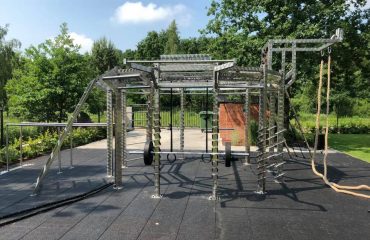
Street workout is popular for its physical and mental health benefits, its accessibility and its community dimension. Dedicated equipment combines varied modules such as fixed bars, wall bars and multi-purpose obstacles. Well laid out, these structures suit beginners and advanced athletes alike and create a dynamic zone where each user progresses at their own pace.
To serve every profile, diversity and ergonomics matter more than module count. An experienced European manufacturer will offer configurations suited to users with reduced mobility as well as options for advanced practitioners, which is what makes an installation genuinely inclusive rather than nominally so.
Ninja courses and parkour equipment: challenge and creativity
Ninja courses in public squares attract a wide audience looking for agility and a physical challenge. Inspired by televised competitions, they combine jumps, traverses and hanging elements that demand coordination, strength and flexibility while feeding the appetite for self-improvement.
Parkour equipment takes a different approach: it is built around movement flow and the freedom to invent new sequences. Purpose-designed modules such as inclined walls, blocks and rails make the practice safer while encouraging creativity and exploration at every level.
Why modular structures win for outdoor sports development
When equipping a play area or a municipal park for the long term, the flexibility of modular structures makes the difference. The principle is simple: standard elements are assembled into a course that fits the site. Authorities can then adapt the installation over time, adding or changing modules as usage patterns evolve.
Beyond appearance, modular equipment simplifies maintenance and extends functional life. That makes infrastructure management easier for municipalities, schools and clubs, while keeping users safe through the robustness of each individual element.
- Ease of maintenance and of extending the course later
- Safety maintained when modules are added or removed
- Adaptation to the abilities and expectations of actual users
- Customisation so the installation reflects local identity
A strategic choice for public space
Installing outdoor fitness equipment or a training course in a neighbourhood encourages every generation to be physically active, with no timetable and no membership fee. It is one of the few public investments that works against sedentary lifestyles while creating a genuinely social, inclusive meeting place.
Public buyers choose a specialist European manufacturer to fit equipment into the existing space. They also seek responsible material choices, strong structures and easy maintenance. These criteria help an outdoor installation remain useful ten years after it opens.
Discuss your site with the design team
Every project starts with the site: dimensions, ground conditions, access, user profile and budget. Send us your site plan and your intended audience and we will come back with a layout, a specification and a costed proposal: request a quote.
Réalisations documentées
- Cage street workout ultime, Carcassonne – armée française
- Cage street workout ultime, Tahiti – armée française, Polynésie
- Cage SP Max, centre EPIDE de Combrée – établissement public d’insertion
- Cage SP Max, lycée Saint-Bénigne de Dijon – établissement scolaire
À lire aussi sur le même thème
- Découvrez la station d’entraînement urbain: votre module de calisthénics en plein air
- Comment éviter la douleur à l épaule pendant les tractions à la barre fixe ?
- Outdoor plate-loaded stainless machines: selection, layout and upkeep
- Professional Rubber Safety Matting: The Complete Buying Guide
- Top Équipements Sport et Jeux pour Aire d’Autoroute Enfant