Why a Custom Rubber Flooring Quote Improves Your Project
When you are fitting out a space for sport or for a club or community organisation, the floor is the decision that quietly governs everything else: safety, acoustics, maintenance cost and how long the room stays usable. A standard price list cannot answer that. A quote built around your actual project can, because it forces the specification questions to be asked before the material is ordered rather than after it is laid. Here is what a properly built rubber flooring quote should take into account.
1. Matching the specification to the actual use
Every project has its own requirements, whether it is a sports hall, a basketball court or a play area. Those three cases do not call for the same product, and treating them as interchangeable is the most common and most expensive mistake in a flooring brief.
A custom quote works through the type of surface required, whether the priority is slip resistance, acoustic performance or impact attenuation; the material family, from rubber to vinyl, linoleum or polyurethane resin; and a detailed analysis of your use case so the covering genuinely fits the room.
One distinction deserves particular attention. Where the surface serves children playing equipment, impact-attenuating surfacing is covered by EN 1177 and the equipment itself by EN 1176-1. These are separate requirements from anything applying to an adult training area, and a quote that does not separate them is not a serious quote. If your project mixes both, say so at the briefing stage. Our rubber gym flooring tiles and playground surfacing are specified against different criteria for exactly this reason.
2. Durability and resistance
Durability is the criterion that decides whether a floor is an investment or a recurring cost. Rubber coverings are chosen for their resistance to wear, to impact and to abrasion, but the performance depends entirely on how the product is specified.
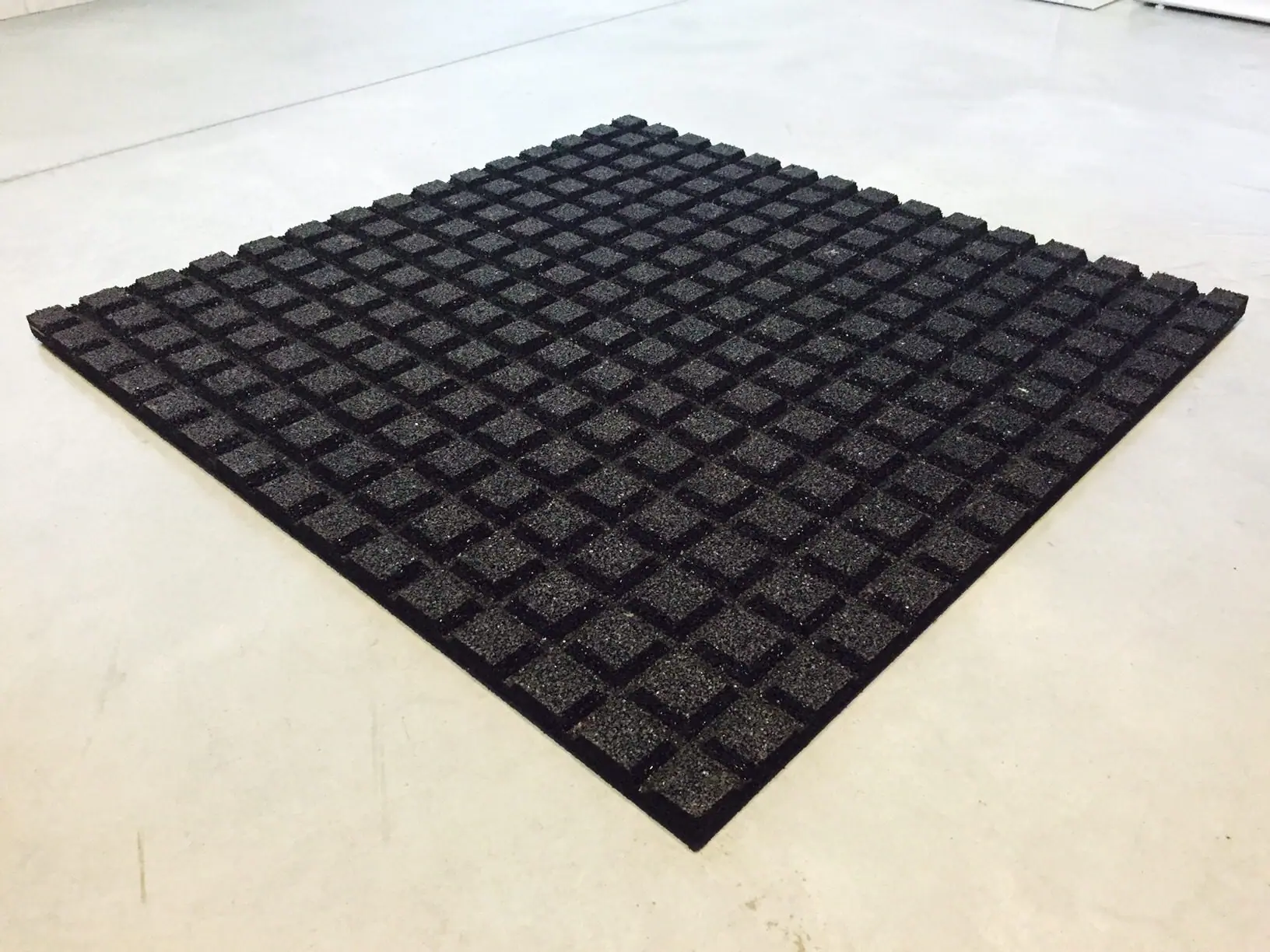
A tailored quote lets you evaluate the thickness of the wear layer and match it to the activity. A multi-sport area or a gym hall needs a thicker, more resilient surface than a circulation zone or a studio used for mat work. Our CrossFit rubber tile 40 mm, supplied in 100 x 100 cm format and listed at 38.50 EUR excluding VAT, is a typical answer where dropped loads are part of the daily use.
3. Ease of maintenance
Maintenance is where the real cost of a floor accumulates, and it is routinely left out of the brief. Rubber, PVC and resin coverings stand out for their longevity and for how simply they clean, but the detail matters.
A quote can include specific finishes that make cleaning faster, and options adapted to damp areas or to zones exposed to cleaning products and other substances. Ask for these to be priced explicitly rather than assumed, because the difference between a surface that is easy to maintain and one that is not shows up within the first year of operation.
4. Acoustic and impact sound insulation
In a gym or a multi-purpose room, acoustic comfort is not a luxury. Dropped weights, group classes and simple footfall all transmit through the structure, and in a shared or multi-storey building this is frequently what generates complaints.
A quote can integrate cork underlays or a thicker covering to reduce noise transmission. The result is a better user experience, particularly in enclosed spaces such as sports halls. If your room sits above or beside a sensitive occupancy, look at acoustic underlays for gym floors as a specified layer rather than as an afterthought.
5. Ranges, finishes and colours
A custom quote also opens up the finish. Artificial turf, interlocking tiles and a wide choice of shades and colours let you combine function with appearance. For club and community projects this matters more than it might seem: the visual atmosphere of the room is part of what members and volunteers respond to, and it costs nothing extra to get it right at the specification stage rather than to regret it afterwards.
6. Markings and customisation
Sports areas need appropriate markings. Playing lines for basketball, volleyball or athletics have to be designed into the floor rather than added later, and a custom quote can include both the design of those markings and the customisation of the space so that the area is immediately ready for use on handover.
What a complete quote should contain
| Item | What to ask for |
|---|---|
| Use case | The activities, the traffic and whether children are among the users |
| Thickness | Wear layer matched to the activity, stated per zone rather than as one figure |
| Format | Tiles, rolls or interlocking, with the tile or roll dimensions stated |
| Acoustics | Underlay type and total build-up, if impact sound is a constraint |
| Fire performance | The reaction-to-fire classification declared for the reference supplied, in full |
| Standards | EN 1177 for impact-attenuating play surfacing and EN 1176-1 for play equipment, where children are users |
| Markings | Sports lines designed and priced, not assumed |
| Maintenance | Cleaning regime and any finish required for damp or chemically exposed areas |
Frequently asked questions
Why not simply order from a price list?
Because a price list prices a product, not a project. Thickness, format, acoustic build-up and markings all depend on the room and the activity, and getting any of them wrong means relaying the floor.
What information should I have ready?
The area in square metres, the room layout, the activities planned, whether weights are dropped, whether children will use the space, and any acoustic constraint from neighbouring occupancies.
Can one floor cover a whole facility?
Rarely. A free-weight zone, a studio, a circulation corridor and a play area have different requirements. A good quote zones the building and specifies each zone separately, which is usually cheaper overall than one heavy specification everywhere.
Does the fire classification matter for a flooring choice?
Yes, and it is determined by the building and its use under the applicable national building regulations. Ask for the classification declared for the exact reference you are buying, and check it against the requirement for your building before ordering.
How does thickness relate to safety?
For adult training areas, thickness is chosen for impact absorption and floor protection. For children play areas it is governed by the required fall height under EN 1177, which is a test-based requirement rather than a matter of preference.
Getting your project quoted
A custom rubber flooring quote makes sure every specific feature of your project is taken into account: durability, ease of maintenance, acoustic insulation, appearance and customisation. Investing in that tailored approach maximises both the quality of the covering and the experience of everyone who uses it, whether the space is a strength training room, a fitness area or a play area.
Light In Fitness has supplied sports flooring to clubs, associations, schools and local authorities since 2013. Send us your plan, your activities and your constraints, and we will come back with a zoned specification and a costed proposal. Request a quote and we will work through it with you.
Réalisations documentées
- Dalles et sols sportifs : livraisons documentées – plusieurs chantiers
- Sol sportif extérieur, square Georges-Vallerey – Taverny (95)