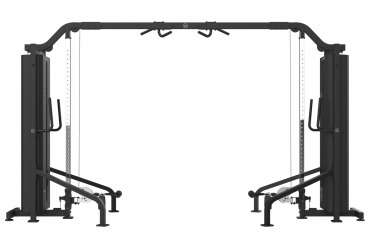
What Is a Converging Strength Machine?
In short: a converging strength machine is a selectorised or plate-loaded unit whose two load arms travel towards each other as the movement finishes. That converging path follows the natural line of pull of the pectorals, lats or deltoids, so the machine combines the guided safety of a fixed frame with joint comfort closer to free weights.
How convergence actually works
On a conventional parallel machine, both handles travel along the same plane from start to finish. On a converging machine, the two arms are mounted on independent pivots and move inwards as they move forward. The result is an arc rather than a straight line, which is how the chest and back muscles genuinely contract: fibres shorten towards a central insertion point, not along parallel rails.
For a commercial operator, the practical consequence is simple. Members reach a stronger peak contraction without having to stabilise a barbell, and shoulder and elbow joints are loaded along a path they tolerate well. That combination is why converging units have become standard in club circuits, hotel gyms and rehabilitation rooms alike.
Guided load and mixed-ability memberships
Guided load is the second half of the story. Because the trajectory is fixed by the frame, a first-time member can train unsupervised on day one, while an experienced lifter can load heavy without a spotter. For a club with a broad membership, that removes a real supervision cost from the floor.
Independent arms also mean each side works alone. Strength imbalances that a barbell hides become visible immediately, which matters for return-to-sport and post-injury programming as much as for hypertrophy.
Which muscle groups converging machines cover
Converging designs exist across the upper body: converging chest press, incline and decline press, converging row, lat pulldown and shoulder press. Each unit targets one group precisely rather than pretending to cover the whole body. Lower-body work on a commercial floor is handled by dedicated leg equipment, not by an upper-body converging frame.
A realistic club layout pairs converging pressing and pulling stations with a free-weight zone. Advanced members alternate the two: the machine for controlled volume and safe failure sets, the barbell for stabiliser recruitment.
Selectorised or plate-loaded?
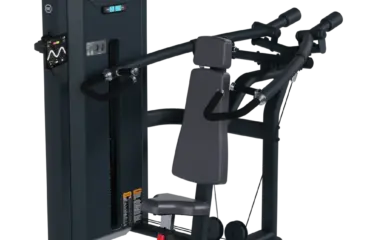
Selectorised converging machines use a weight stack and a pin. They suit high-traffic clubs, hotels and corporate gyms where fast set changes and no loose plates on the floor are the priority. Our Titan converging range sits in this category.
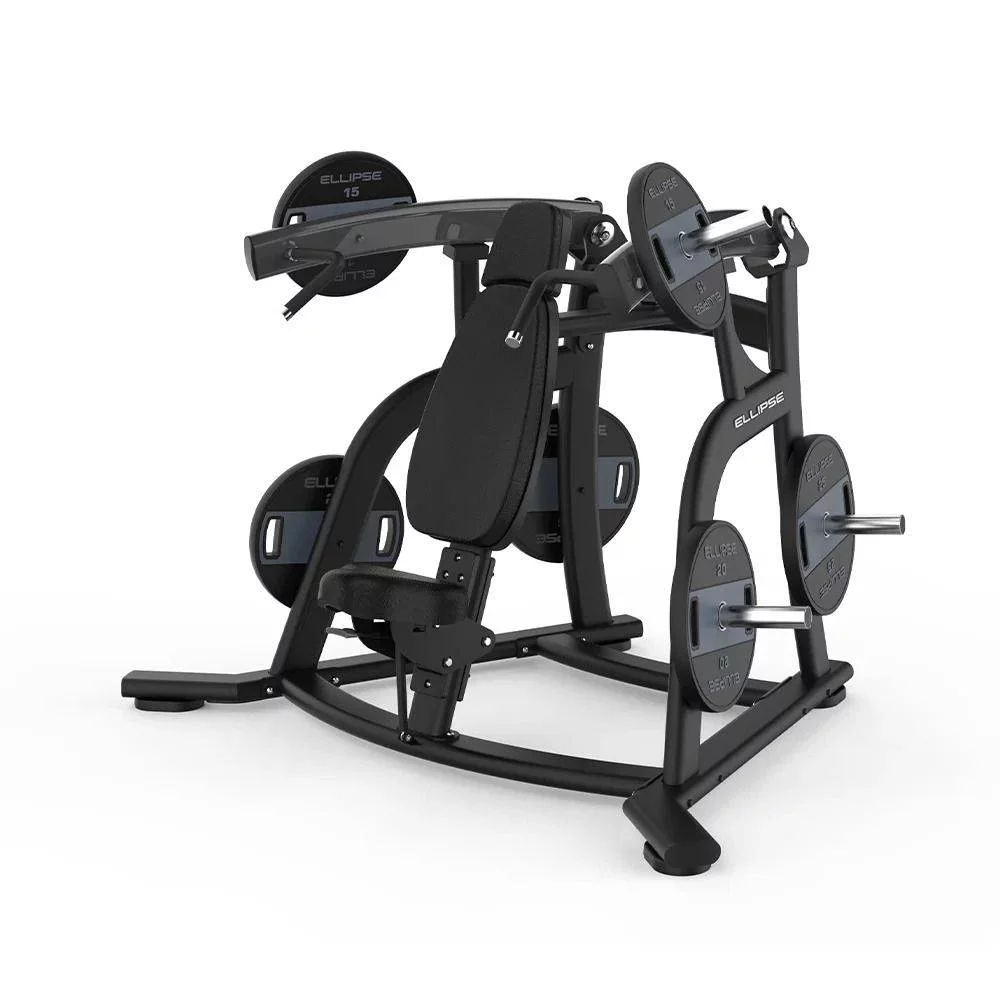
Plate-loaded converging machines take Olympic discs on horns. They give a different loading feel, tolerate very heavy work and cost less per station to expand. The Gold Line converging plate-loaded range is built for strength-focused clubs and performance centres. If the priority is pressing specifically, the dedicated chest press machines category narrows the choice further.
Specifying for professional use
Any machine installed in a facility open to members must be built for institutional use. For indoor stationary training equipment, the applicable reference is EN ISO 20957-1 class S, the class intended for supervised commercial and institutional environments. Frame gauge, bearing quality, cable and pulley rating and upholstery durability are what separate a machine that survives a decade of club traffic from one that does not.
Warranty terms are the honest proxy. Ask what is covered on the steel structure, on moving parts and on upholstery, and for how long, before comparing headline prices.
Frequently asked questions
What is a converging strength machine?
It is a machine whose load arms move towards each other as the repetition finishes. That convergence reproduces the natural biomechanical path of the pectorals and lats, unlike a parallel-trajectory machine where both handles stay on the same plane.
Which muscles do converging machines train?
Mainly the chest on a converging chest press, the back on a converging row or pulldown, and the shoulders on a converging shoulder press. Each machine isolates one group; a converging frame is not a full-body station.
Converging machine or free weights: which is better?
They answer different needs. The machine offers a guided path, precise isolation and safe training to failure without a spotter. Free weights recruit stabilisers more heavily. A complete club programme alternates both.
Are converging machines suitable for beginners?
Yes. The fixed trajectory means correct form is largely built into the frame, which is why converging stations are usually placed early in a guided club circuit.
Specifying a converging range for your facility
Whether you are fitting out a new club, replacing an ageing circuit or adding a strength zone to a hotel or corporate site, the right mix of converging stations depends on your floor area, your membership profile and your traffic. Send us your plan and we will come back with a configuration and a costed proposal: request a quote.